


Elite, the agency that has represented such top models as Cindy Crawford and Naomi Campbell, apologized last week to models and their families after a BBC documentary showed a top Elite executive soliciting sex.
The agency's Milan office said that its worldwide chairman, John Casablancas, had issued a statement offering the agency's "unconditional apologies" for the "shocking, unacceptable and totally incorrect" behavior of some agency executives.
The BBC documentary, which aired late last month, used a hidden camera to follow a female reporter as she went undercover in Milan for six months pretending to be an aspiring model.
Hundreds of young girls come to Milan each year looking for work and end up victimized by unscrupulous agents and public relations agencies that ply them with free drugs, send them to nightclubs and encourage them to have sex with "clients," sometimes for payment, according to the documentary.
Four executives at Elite appeared in the film and have since been suspended by the agency pending an investigation.
"They will see the documentary and will have the chance to justify themselves before being disciplined," the agency said in a statement.
Elite Europe chairman Gerald Marie appears in the documentary saying to an undercover journalist filming him with a hidden camera: "I'll give you one million lire (US$525) if you go to bed with me."
Elite also said it would re-examine the chaperone system that has been used to protect under-aged models "so that cases like those revealed by the documentary won't be repeated."
The program has caused an outcry in London, where the documentary has reportedly been passed on by its director Donal MacIntyre to British Prime Minister Tony Blair's government for consideration.
A spokesman for Blair's office said the documentary "will be examined carefully," the Italian daily La Repubblica said.
In Milan, fashion houses and modelling agencies either brushed off the documentary as sensationalist or blasted it as biased and unfair.
Modelling agency Riccardo Gay, like Elite, says it keeps close tabs on the models who work for it and forbids the under-age models from going out at night.
Both agencies noted, however, that smaller modelling agencies might not have the same strict standards.
While there was outrage at what was seen as the BBC team's deception in making the documentary, there was also widespread recognition among public relations firms and agencies that younger aspirants ran the risk of being victimized.
Italian knitwear maker Angelo Missoni, for example, said his family-owned company refused to use models aged below 16.
"Actually the subject (of using under-age models) is part of a broader question that should also involve the world of sports," Missoni told the Italian news agency ANSA. "There's no law that says that the entertainment business can't use minors -- it should be the business itself that won't permit it."
By Thursday, a local politician was demanding rules that would bar under-age models from the catwalks, and Milan's chief public prosecutor, Francesco Saverio Borrelli, had promised an investigation if necessary.
"It's not up to me to decide whether or not the documentary was accurate," Italian papers quoted Borrelli as saying. "I only want to underline the fact that an attack on the world of fashion -- and the Milan fashion world in particular -- is unjustified ...
"Regarding the eventual legal consequences of the contents of the programme ... it is up to the prosecutors' office to decide whether to take the initiative," Borrelli added.

‘NO SECURITY RISK’: The Railway Bureau reassured the public that the technicians’ activities were limited to technical guidance and did not involve sensitive systems The Railway Bureau yesterday said it had invited eight Chinese technicians to assist with an airport MRT construction project. The bureau issued the confirmation after an Internet user said Chinese nationals had entered the construction zone of Taiwan Taoyuan International Airport’s Terminal 3 project. They asked why “individuals from an enemy state” were allowed access to such a major national infrastructure project, which raised serious concerns over Taiwan’s industrial safety, sensitive systems and information security. The bureau’s Northern Region Engineering Branch Office said subcontractor Taiwan Handle Industrial Co (台灣手把工業) of the Taoyuan airport MRT’s “Contract No. CU05 Project A14 Station Civil, MEP &

A US uncrewed surface vessel (USV) encountered multiple Chinese warships during an autonomous transit of the Taiwan Strait, US defense company Seasats said in a statement on Wednesday. Seasats announced that a Lightfish USV had completed the first autonomous transit of the Taiwan Strait. Over five days, the USV traversed the entire length of the Strait while constantly monitoring surface vessel traffic, the company said. The Lightfish encountered multiple Chinese warships, one of which was a Chinese People’s Liberation Army Navy (PLAN) Type 056 corvette, it said. The Chinese vessels were operating “well within Taiwan’s exclusive economic zone without transmitting their identity via the

Taiwan is still in the process of assessing the possibility of recruiting workers from Eswatini, the Ministry of Foreign Affairs said yesterday, adding that its goal is to help Eswatini upgrade its vocational training centers. If there are plans to recruit workers from Eswatini, safeguarding national security, protecting public health and ensuring the employment rights of Taiwanese would be prerequisites, Department of West Asian and African Affairs Director-General Yen Chia-liang (顏嘉良) told a news conference. Key considerations would also include filling labor shortages in specific industries, and fostering bilateral professional and technical exchanges, he said. Yen was asked about the progress of labor
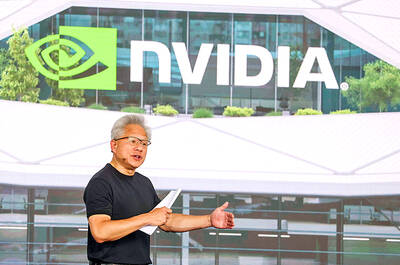
‘BOOMING’: ’ The number of partners we have here is incredible. You can see from their stock prices. They’re doing so well, they’re so happy,’ Jensen Huang said Nvidia Corp’s spending in Taiwan has ballooned to about US$150 billion a year, 10 times the US$10 billion to US$15 billion the company spent five years ago, Nvidia chief executive officer Jensen Huang (黃仁勳) said yesterday, suggesting Taiwan’s strategic importance in the global artificial intelligence (AI) supply chain. “Taiwan is the epicenter of the AI revolution. This is where the chips come, packaging comes. This is where the systems are made. This is where AI supercomputers were created,” Huang said at a meeting for the company’s employees in Beitou-Shilin Technology Park (北投士林科技園區) in Taipei, the planned site of Nvidia’s Taipei headquarters. “Taiwan


 RSS
RSS