

South Korean President Lee Jae-myung ruled out sending troops to the Strait of Hormuz to join the US war against Iran, despite pressure from US President Donald Trump, as Lee fights to reverse hemorrhaging public support and get his policy agenda back on track.
Lee has seen his approval ratings plunge in the past two months, hitting a fresh record low of 37 percent in a poll released yesterday — down from a high of 67 percent earlier this year. He faces strong domestic opposition to sending troops to the Middle East.
“There will be no involvement or intervention in the war,” Lee said during a snap news conference aimed at shoring up public support. “We will not deploy troops or military assets for that purpose. We have adhered to that principle so far, and that principle will remain unchanged.”
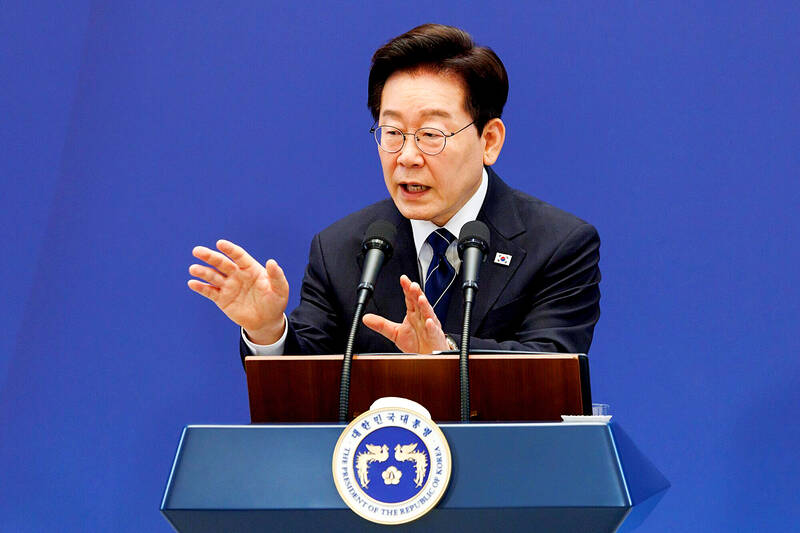
Photo: Bloomberg
The remarks were Seoul’s clearest message yet on deploying troops or military assets to the Middle East after Trump ramped up pressure on the US ally over its lack of support for the war with Iran.
South Korea is reviewing ways to help ensure safe passage through the strait by expanding the operations of its naval unit already deployed near the area, Lee said.
While the comments might please Lee’s base domestically, they might further fuel tension with key security partner Washington, Zeitgeist Institute director Eom Kyeong-young said.
“Just imagine how the US would feel hearing that,” Eom said, adding that more diplomatic language could have been helpful.
“He seemed to make those remarks with his core supporters in mind, but they looked problematic coming from a president,” Eom added.
At home, many South Koreans have soured on Lee over the economy. Even as the global artificial intelligence build-out reaps record profits for chip giants SK Hynix Inc and Samsung Electronics Co, voters are seeing little impact on their lives, with surveys highlighting growing discontent on issues such as Seoul’s high property prices.
Lee apologized “to the people who continue to struggle through their daily lives in difficult circumstances.”
He said he was “taken aback by what seemed to be a sudden wave of disappointment and concern from the public,” but added that “the people are always right.”
Lee ordered a sweeping reshuffle of his cabinet weeks ago, changing out his finance, defense and justice ministers among others, with his top policy adviser Kim Yong-beom stepping down.
The reset and shift in messaging have failed to boost Lee’s approval ratings.
“This is a crisis of trust. Voters are at a point where they don’t believe what he says, no matter what he says,” Eom said.
Lee has also been struggling to balance Seoul’s all-important relationship with security ally Washington, which stations about 28,500 soldiers in the South in part to help protect it from the nuclear-armed North.
Trump canceled long-planned joint military drills with Seoul last month, citing his friendship with North Korean leader Kim Jong-un and Seoul’s purported refusal to help with Iran.
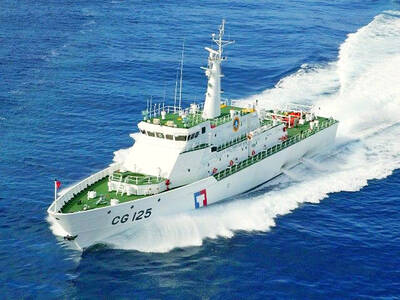
GEOPOLITICAL SIGNIFICANCE: The CGA’s nonmilitary role makes it a tool to avert diplomatic issues, an official said, while confirming the donation of a ship to Manila Coast Guard Administration (CGA) ships are scheduled to sail to the Philippines bearing the words “Taiwan Coast Guard” in a high-profile visit in October next year, the first such visit by a Taiwanese maritime law enforcement vessel to the Southeast Asian nation, the agency said yesterday. The CGA also confirmed that it had donated one of its decommissioned patrol vessels to the Philippines in a rare transfer of a retired ship to a nondiplomatic ally. The Republic of China (ROC) Navy last made such a visit in 1974, shortly before the Philippines switched diplomatic recognition to the People’s Republic of China in

‘GLOBAL WARNING’: The infiltration is not just a local problem, as Beijing has been deploying the same tactics worldwide against Western democracies, a report said Between 50,000 and 100,000 Chinese spies are operating in Taiwan, far more than the National Security Bureau’s previous estimate of 5,000, German journalist and author Jurgen Kremb said on Monday. Kremb presented his research, titled “The War of Spies: How China’s Intelligence Services Are Infiltrating Taiwan — and What Europe Must Learn from It,” at a joint event held by the Taiwan offices of the Friedrich Naumann Foundation and the European Values Center for Security Policy. The report was published in June in the Ministry of Justice Investigation Bureau’s Prospect & Exploration Monthly (展望與探索月刊). By spies, he said he was referring to informants,

PRICE STABILIZATION: The Ministry of Economic Affairs has urged the legislature to support the Cabinet’s supplementary budget for state-owned energy companies State-owned oil supplier CPC Corp, Taiwan (CPC, 台灣中油) on Saturday announced that it would raise domestic gasoline prices by NT$0.7 (US$0.02) per liter and diesel prices by NT$0.6 per liter this week after international crude oil prices rose above US$100 per barrel last week. Formosa Petrochemical Corp (台塑石化) yesterday said that it matched CPC’s price adjustments for this week. The decisions end a six-week period during which CPC and Formosa kept fuel prices in Taiwan unchanged. Retail gasoline prices this week would rise to NT$31.2, NT$32.7 and NT$34.7 per liter for 92, 95 and 98-octane unleaded gasoline respectively at CPC
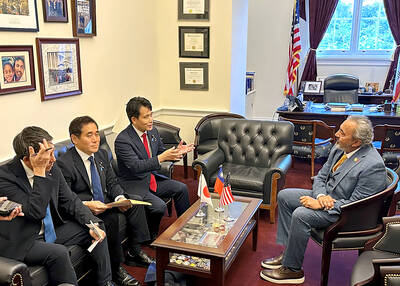
WASHINGTON MEETING: Japan’s Hirofumi Takinami said participants rejected the idea that the US should limit its defensive perimeter to the Second Island Chain US and Japanese lawmakers agree that the US must defend the First Island Chain, including Taiwan, and should not fall back to the Second Island Chain, while “a Taiwan contingency is a Japan contingency and therefore a US-Japan alliance contingency,” media reported after a meeting between officials of the two nations in Washington on Tuesday. A delegation of Japanese lawmakers from the Liberal Democratic Party met with US Senator Thom Tillis, co-chair of the Senate Taiwan Caucus, and US Representative Ami Bera, co-chair of the US Congressional Taiwan caucus, to discuss issues concerning East Asia and the Taiwan Strait. The Japanese and


 RSS
RSS