

Russians yesterday began voting in a tightly controlled three-day election that is set to tighten Russian President Vladimir Putin’s 26-year grip on power, in the country’s fifth year of war with Ukraine.
It is Russia’s first parliamentary election since Moscow sent troops to Ukraine in February 2022. Only parties that support Putin and the Kremlin’s military campaign have been registered to run. Moscow has also organized voting in occupied Ukraine.
The EU slammed the elections, saying “repression” had been used to eradicate opponents, while a Council of Europe body denounced the vote as “fake.”
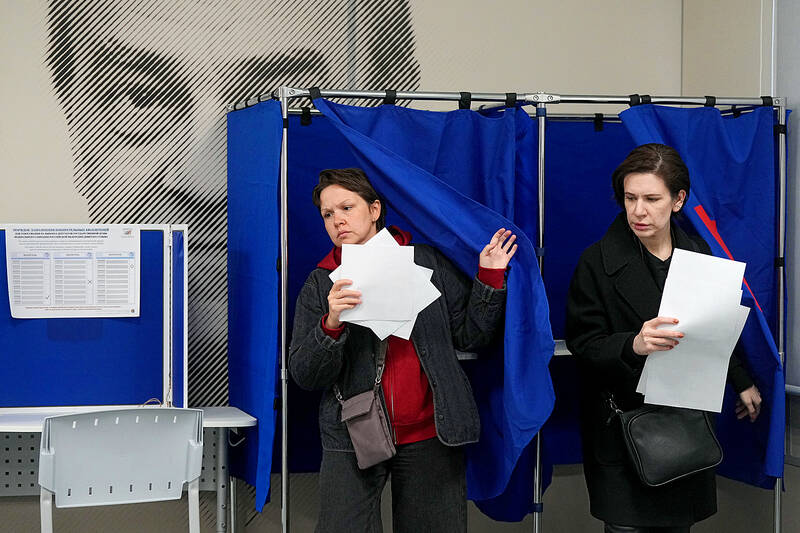
Photo: AP
While few Russians doubt Putin’s United Russia party would cruise to victory again, the vote offers a gauge of public support for the war. Putin has ruled Russia since 1999 and his party has dominated politics since the early 2000s. Moscow has banned criticism of the Ukraine campaign, and elections under Putin rarely produce surprises. Putin had called on Russians to vote to show they back Moscow’s troops and to deliver an “answer to those who want to weaken Russia.”
The Kremlin published footage of the 73-year-old president voting online — rare footage of the longtime leader. On Moscow’s streets, several voters said they wanted the war in Ukraine to end — but on Russia’s terms, backing Putin’s goals.
Rail worker Sergei Korenets said he would back United Russia, voting for “stability” — echoing Putin’s main slogan.
Asked whether four-and-a-half years of war amounts to “stability,” Korenets said: “Of course, I want all this [the war] to end as quickly as possible.”
Despite sweeping Western sanctions, Russia’s economy has not collapsed and life in the capital remains relatively normal even as Moscow bombards Ukrainian cities daily.
United Russia faces only parties that broadly back Putin’s policies and the war: the Communist Party, the nationalist LDPR, A Just Russia and New People.
Yabloko, which called for an end to the fighting, was barred from running shortly before the vote. One of its main figures, Lev Shlosberg, was imprisoned for criticizing the war.
Russia has since 2022 introduced Soviet-style censorship and jailed war critics.
“I am fully for the special military operation,” Lyubov said.
“NATO cannot be at our borders,” she added, repeating one of Putin’s arguments for launching the war.
However, she criticized some social policies, upset by Putin raising the pension age several years ago, saying she wanted a “return to the Soviet economic system.”
Older voters are among Putin’s strongest supporters, although many complain about living standards.
Putin’s political opponents have mostly been driven into exile ,and his main opponent, Alexei Navalny, died in an arctic prison in 2024.
Russia’s exiled opposition has urged anti-Kremlin Russians not to boycott the elections, but instead vote “against Putin’s party.”
Navalny’s widow, Yulia Navalnaya, called on anti-war Russians to cast their ballots at noon tomorrow.
Yabloko disagrees, saying that it was better not to vote.
“You are suggesting that we once again go, like sheep, dancing to their tune, and vote for those who have caused the deaths of people in Russia and Ukraine?” party chairman Nikolay Rybakov said.
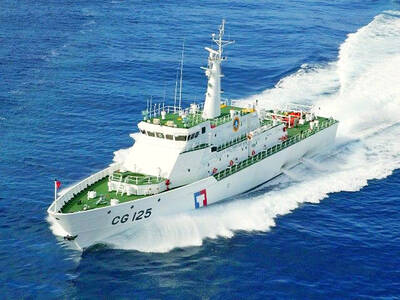
GEOPOLITICAL SIGNIFICANCE: The CGA’s nonmilitary role makes it a tool to avert diplomatic issues, an official said, while confirming the donation of a ship to Manila Coast Guard Administration (CGA) ships are scheduled to sail to the Philippines bearing the words “Taiwan Coast Guard” in a high-profile visit in October next year, the first such visit by a Taiwanese maritime law enforcement vessel to the Southeast Asian nation, the agency said yesterday. The CGA also confirmed that it had donated one of its decommissioned patrol vessels to the Philippines in a rare transfer of a retired ship to a nondiplomatic ally. The Republic of China (ROC) Navy last made such a visit in 1974, shortly before the Philippines switched diplomatic recognition to the People’s Republic of China in

‘GLOBAL WARNING’: The infiltration is not just a local problem, as Beijing has been deploying the same tactics worldwide against Western democracies, a report said Between 50,000 and 100,000 Chinese spies are operating in Taiwan, far more than the National Security Bureau’s previous estimate of 5,000, German journalist and author Jurgen Kremb said on Monday. Kremb presented his research, titled “The War of Spies: How China’s Intelligence Services Are Infiltrating Taiwan — and What Europe Must Learn from It,” at a joint event held by the Taiwan offices of the Friedrich Naumann Foundation and the European Values Center for Security Policy. The report was published in June in the Ministry of Justice Investigation Bureau’s Prospect & Exploration Monthly (展望與探索月刊). By spies, he said he was referring to informants,

PRICE STABILIZATION: The Ministry of Economic Affairs has urged the legislature to support the Cabinet’s supplementary budget for state-owned energy companies State-owned oil supplier CPC Corp, Taiwan (CPC, 台灣中油) on Saturday announced that it would raise domestic gasoline prices by NT$0.7 (US$0.02) per liter and diesel prices by NT$0.6 per liter this week after international crude oil prices rose above US$100 per barrel last week. Formosa Petrochemical Corp (台塑石化) yesterday said that it matched CPC’s price adjustments for this week. The decisions end a six-week period during which CPC and Formosa kept fuel prices in Taiwan unchanged. Retail gasoline prices this week would rise to NT$31.2, NT$32.7 and NT$34.7 per liter for 92, 95 and 98-octane unleaded gasoline respectively at CPC
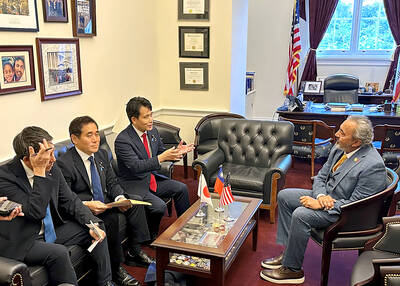
WASHINGTON MEETING: Japan’s Hirofumi Takinami said participants rejected the idea that the US should limit its defensive perimeter to the Second Island Chain US and Japanese lawmakers agree that the US must defend the First Island Chain, including Taiwan, and should not fall back to the Second Island Chain, while “a Taiwan contingency is a Japan contingency and therefore a US-Japan alliance contingency,” media reported after a meeting between officials of the two nations in Washington on Tuesday. A delegation of Japanese lawmakers from the Liberal Democratic Party met with US Senator Thom Tillis, co-chair of the Senate Taiwan Caucus, and US Representative Ami Bera, co-chair of the US Congressional Taiwan caucus, to discuss issues concerning East Asia and the Taiwan Strait. The Japanese and


 RSS
RSS