

President William Lai (賴清德) yesterday inspected joint precision missile live-fire drills at the Jioupeng Base (九鵬基地) in Pingtung County, where multiple types of attack drones took part in joint combat exercises for the first time.
The three-day drills, which concluded yesterday, featured indigenous Hsiung Feng III anti-ship missile systems, Tien Kung III surface-to-air missile systems and US M142 High Mobility Artillery Rocket Systems, footage released by the Presidential Office showed.
The drills were the first time multiple types of attack drones had been incorporated into joint combat exercises, Lai told military personnel.
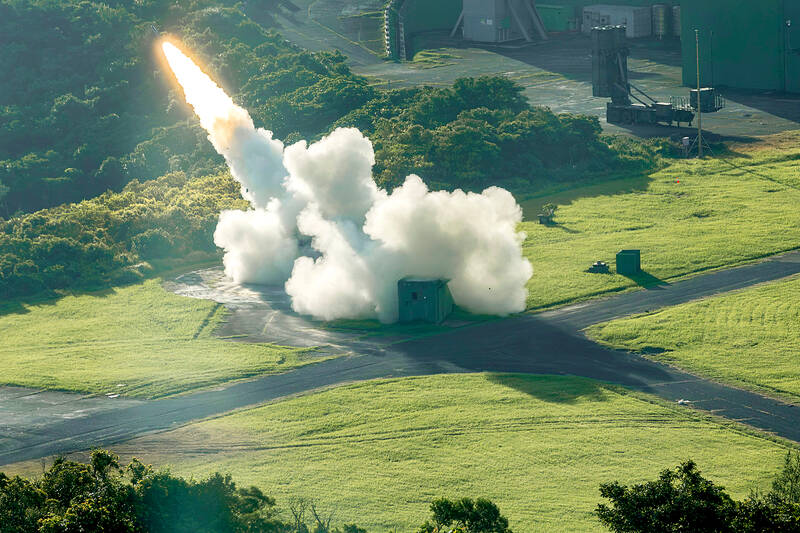
Photo: AP via the Presidential Office
“The coordinated use of uncrewed vehicles and conventional weapons showed that the military is accelerating efforts to strengthen its overall combat capabilities,” Lai said. “It also demonstrated to the people and the international community that the armed forces have confidence in their ability to defend national sovereignty and fulfill their responsibility to maintain regional peace and stability.”
Units carried out joint air defense, counterstrike, sea-air coordination, coastal strikes and nearshore defense operations during the drills, he said, praising the personnel for their performance.
Meanwhile, the Ministry of National Defense said a Chinese military drone flew from Taiwan’s southwestern airspace to waters off Taitung between 12:05am and 6am yesterday morning to monitor the exercise.
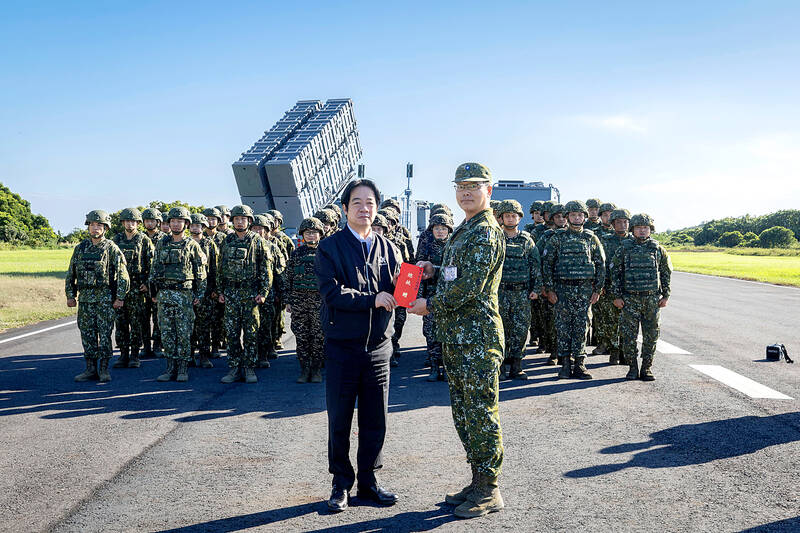
Photo: AP via the Presidential Office
As the timing coincided with Lai’s inspection of the exercise, the military closely monitored the drone and deployed aircraft, naval vessels and land-based missile systems, it said.
Lai has made defense modernization a key part of his agenda, given the rising threat from China, including by developing drones and spending more on defense, something US President Donald Trump has repeatedly pressed allies to do.
Lai yesterday was accompanied on his visit by Minister of National Defense Wellington Koo (顧立雄), other senior security officials and Ocean Affairs Council Minister Kuan Bi-ling (管碧玲), whose agency runs the Coast Guard Administration (CGA).
The government has been working to better integrate the CGA into overall defense planning, as it would have an auxiliary role to the navy in case of a war.
During the main annual war games last month, a coast guard ship was fitted with anti-ship missiles.
Separately yesterday, Premier Cho Jung-tai (卓榮泰), while inspecting plans for the construction of new facilities for the Matsu Coast Guard Patrol Team, announced that in addition to improving compensation for six categories of CGA personnel, the government would also improve the agency’s equipment.
Next year, one 1,000-tonne patrol frigate, three 100-tonne patrol boats and six 35-tonne patrol boats would be deployed for maritime patrol and security operations, he said.
The government has also allocated NT$1.93 billion (US$60.68 million) to build a 2,000-tonne ocean-going patrol vessel, as well as NT$140 million to enhance special operations equipment, to improve the effectiveness of efforts to combat smuggling and human trafficking operations, he said.
Additional reporting by Reuters, Chung Li-hua and Lo Tien-pin
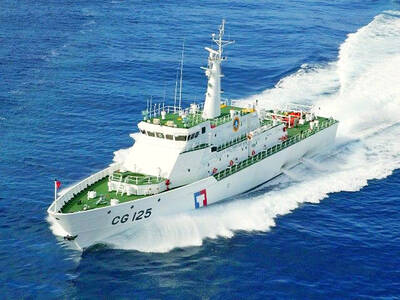
GEOPOLITICAL SIGNIFICANCE: The CGA’s nonmilitary role makes it a tool to avert diplomatic issues, an official said, while confirming the donation of a ship to Manila Coast Guard Administration (CGA) ships are scheduled to sail to the Philippines bearing the words “Taiwan Coast Guard” in a high-profile visit in October next year, the first such visit by a Taiwanese maritime law enforcement vessel to the Southeast Asian nation, the agency said yesterday. The CGA also confirmed that it had donated one of its decommissioned patrol vessels to the Philippines in a rare transfer of a retired ship to a nondiplomatic ally. The Republic of China (ROC) Navy last made such a visit in 1974, shortly before the Philippines switched diplomatic recognition to the People’s Republic of China in

‘GLOBAL WARNING’: The infiltration is not just a local problem, as Beijing has been deploying the same tactics worldwide against Western democracies, a report said Between 50,000 and 100,000 Chinese spies are operating in Taiwan, far more than the National Security Bureau’s previous estimate of 5,000, German journalist and author Jurgen Kremb said on Monday. Kremb presented his research, titled “The War of Spies: How China’s Intelligence Services Are Infiltrating Taiwan — and What Europe Must Learn from It,” at a joint event held by the Taiwan offices of the Friedrich Naumann Foundation and the European Values Center for Security Policy. The report was published in June in the Ministry of Justice Investigation Bureau’s Prospect & Exploration Monthly (展望與探索月刊). By spies, he said he was referring to informants,

PRICE STABILIZATION: The Ministry of Economic Affairs has urged the legislature to support the Cabinet’s supplementary budget for state-owned energy companies State-owned oil supplier CPC Corp, Taiwan (CPC, 台灣中油) on Saturday announced that it would raise domestic gasoline prices by NT$0.7 (US$0.02) per liter and diesel prices by NT$0.6 per liter this week after international crude oil prices rose above US$100 per barrel last week. Formosa Petrochemical Corp (台塑石化) yesterday said that it matched CPC’s price adjustments for this week. The decisions end a six-week period during which CPC and Formosa kept fuel prices in Taiwan unchanged. Retail gasoline prices this week would rise to NT$31.2, NT$32.7 and NT$34.7 per liter for 92, 95 and 98-octane unleaded gasoline respectively at CPC
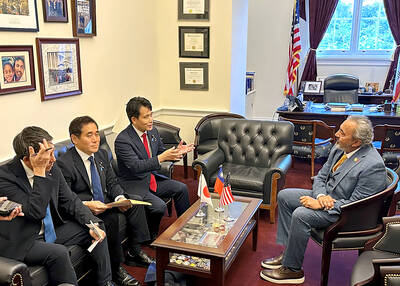
WASHINGTON MEETING: Japan’s Hirofumi Takinami said participants rejected the idea that the US should limit its defensive perimeter to the Second Island Chain US and Japanese lawmakers agree that the US must defend the First Island Chain, including Taiwan, and should not fall back to the Second Island Chain, while “a Taiwan contingency is a Japan contingency and therefore a US-Japan alliance contingency,” media reported after a meeting between officials of the two nations in Washington on Tuesday. A delegation of Japanese lawmakers from the Liberal Democratic Party met with US Senator Thom Tillis, co-chair of the Senate Taiwan Caucus, and US Representative Ami Bera, co-chair of the US Congressional Taiwan caucus, to discuss issues concerning East Asia and the Taiwan Strait. The Japanese and


 RSS
RSS