

Japan is considering a new midterm defense spending target of 3.5 percent of GDP in line with NATO and other US allies, a move that could send a shock wave through financial markets concerned about Japanese Prime Minister Sanae Takaichi’s spending plans.
Japanese defense officials have already signaled a willingness to sharply increase defense spending in meetings with their US counterparts, people familiar with the matter said.
One scenario under consideration is to match a commitment made by South Korea to increase defense spending to 3.5 percent of GDP over 10 years, they said.
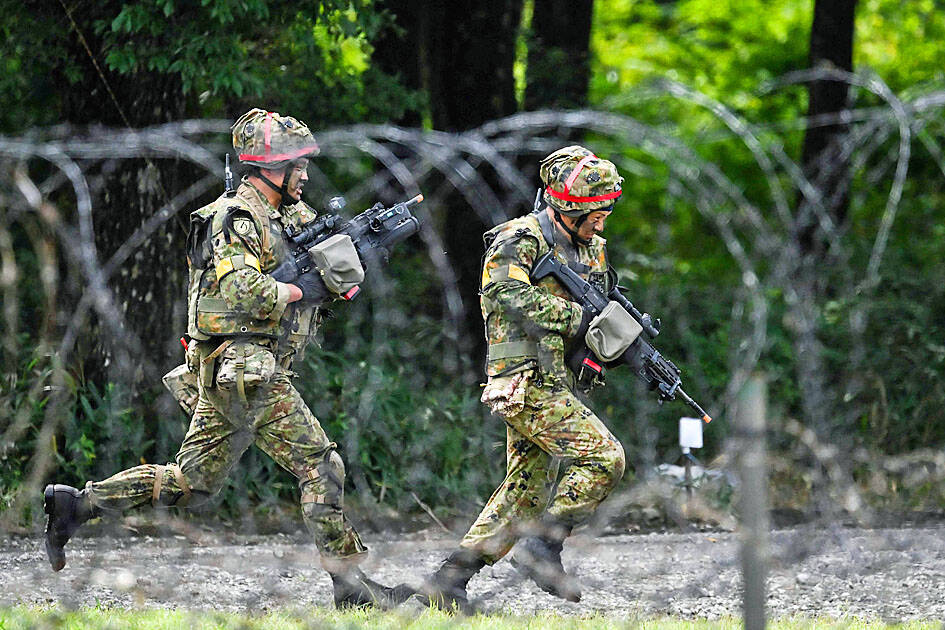
Photo: AFP
A lower target, such as 3 percent, is also possible, one of the people said.
Like other US allies, Tokyo has been under pressure from US President Donald Trump’s administration to boost its defensive strength and reduce its reliance on the US military. Takaichi has already accelerated defense spending to almost 2 percent of GDP in the financial year ended in March, two years ahead of schedule.
Until 2022, Japan had an informal cap on defense spending at about 1 percent of GDP, an indication of how quickly thinking on defense has changed in the past few years. A new five-year defense spending plan is expected at the end of this year.
Committing to 3.5 percent could unsettle market players wary of large debt issuance, even though Takaichi has pledged to follow a “responsible, proactive fiscal policy.”
US defense officials have largely avoided public pressure on Japan to commit to a 3.5 percent defense spending goal, but they have made clear that they expect significantly more investment.
“We are anxiously looking for Japan to step up,” US Undersecretary of Defense for Policy Elbridge Colby said last month of Tokyo’s defense spending.
In meetings between defense officials from both nations, Japan has indicated it would most likely align with other US allies, but it has avoided discussing details, according to the people, who requested anonymity because of the sensitivity of the matter.
Some Japanese officials have said they are not ready to make a formal pledge and would deny the existence of such a goal if it was made public, the people said.
In public, Japanese Minister of Defense Shinjiro Koizumi has said spending would be determined by military needs rather than monetary targets.
The ministry did not immediately provide a response to a request for comment. The Pentagon declined to comment.
Koizumi in April said that defense spending and related expenditures for this fiscal year of ¥10.6 trillion (US$68.48 billion) were equivalent to 1.9 percent of nominal GDP in 2022.
Measured against the Cabinet Office’s nominal GDP forecast for this fiscal year, spending would come to 1.5 percent, he said.
A budget of 3.5 percent using that forecast would amount to ¥24 trillion, more than double the current amount.
International Institute for Strategic Studies Japan chair Robert Ward said the groundwork had been laid among policymakers and bureaucrats in Japan for a big jump in defense spending.
It is now mostly a matter of timing of when Japan goes to 3.5 percent, he said.
“Whether it’s over five years or 10 years, I don’t see any alternative given how important the US alliance is,” Ward said.
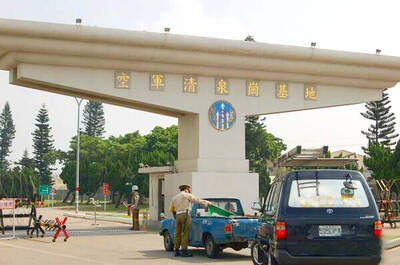
An unauthorized drone intrusion over Ching Chuan Kang Air Base (清泉崗基地) at Taichung International Airport on Tuesday night forced the temporary closure of the base, diverting eight fighter jets and delaying a commercial flight, authorities said. Air Force Command Headquarters said that clear weather had allowed for scheduled night training exercises, but after a drone was spotted entering the airspace, the control tower declared an emergency closure of the airport, forcing eight Indigenous Defense Fighter jets in the air to divert and land at Hsinchu Air Base (新竹基地). Taichung airport director Chang Jui-shu (張瑞澍) said the airspace intrusion lasted from 7:37pm to
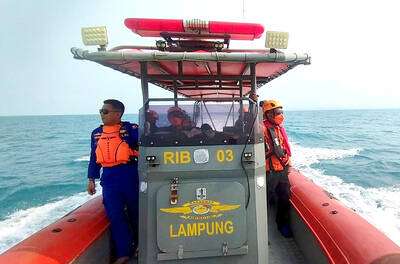
Indonesian rescuers searched for eight people who went missing at sea while heading to a volcanic island to report on an eruption there, officials said yesterday. Anak Krakatau initially erupted for about 25 hours over the weekend, and it has since continued to erupt intermittently with explosions ejecting lava, ash and incandescent volcanic material from the crater, the Indonesian Geology Agency said in a statement. A speedboat carrying five photojournalists, two crew members and a route guide lost contact after leaving Carita, a coastal town in Banten Province, for the volcanic island, Banten Province Search and Rescue Office Chief Al Amrad said. He

PRICE STABILIZATION: The Ministry of Economic Affairs has urged the legislature to support the Cabinet’s supplementary budget for state-owned energy companies State-owned oil supplier CPC Corp, Taiwan (CPC, 台灣中油) on Saturday announced that it would raise domestic gasoline prices by NT$0.7 (US$0.02) per liter and diesel prices by NT$0.6 per liter this week after international crude oil prices rose above US$100 per barrel last week. Formosa Petrochemical Corp (台塑石化) yesterday said that it matched CPC’s price adjustments for this week. The decisions end a six-week period during which CPC and Formosa kept fuel prices in Taiwan unchanged. Retail gasoline prices this week would rise to NT$31.2, NT$32.7 and NT$34.7 per liter for 92, 95 and 98-octane unleaded gasoline respectively at CPC
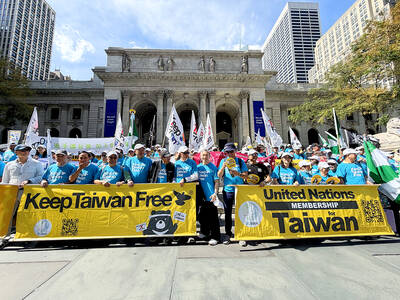
More than 100 Taiwanese-Americans, Taiwanese lawmakers and members of civic groups on Saturday marched through New York City to call for Taiwan’s participation in the UN, with Marshall Island Permanent Representative to the UN John Silk joining the event to show support. Participants chanted: “UN for Taiwan” and “Keep Taiwan Free” as they marched through central Manhattan, passing Times Square and Bryant Park before ending near the New York Public Library. The annual march brought together Taiwanese community groups from across the US East Coast. Silk expressed hope that Taiwan would one day be able to participate in UN meetings


 RSS
RSS