

Foreign diplomatic and business visits to Taiwan are reaching new highs, with landmark firsts and large-scale delegations, the Ministry of Foreign Affairs (MOFA) said, pledging to deepen mutual trust and substantive cooperation.
Italian Senate Vice President Gian Marco Centinaio led the largest-ever delegation of Italian lawmakers to Taiwan from Aug. 31 to Sept. 5, where he met with President William Lai (賴清德), Deputy Legislative Speaker Johnny Chiang (江啟臣) and other dignitaries, and attended Semicon Taiwan.
Yves-Francois Blanchet, leader of Canada’s Bloc Quebecois, led a delegation to Taiwan earlier this month, marking the first trip by a party member to Taiwan since the party’s founding in 1991, and the first time a sitting leader of a major Canadian political party led a delegation to the nation, the ministry said.
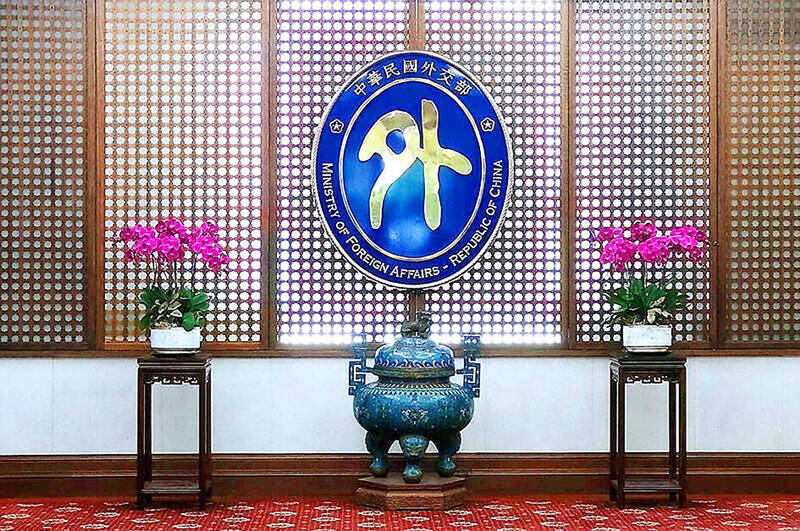
Photo: Yang Cheng-yu, Taipei Times
On the industry front, Arizona Commerce Authority president and CEO Sandra Watson led a delegation of more than 100 representatives from industry, government and academia — including five mayors and several key political figures — to Taiwan during Semicon Taiwan earlier this month.
Former commander of the US Army Pacific Charles A. Flynn led a 41-member delegation to Taiwan to attend the Taiwan-US Defense Industry Forum in May, focusing on the transformation of the Taiwan-US defense supply chain and technological research and development (R&D), the largest delegation for such an event.
In addition, several Japanese lawmakers visited Taiwan recently, including former Japanese minister of agriculture, forestry and fisheries Yasuhiro Ozato, who visited earlier this month, the ministry said.
Nobuyuki Baba, chair of the Japan Innovation Party’s Taiwan friendship discussion group, led a parliamentary delegation to Taiwan from Monday to Wednesday last week, marking the party’s first major visit since joining the ruling coalition with Japan’s Liberal Democratic Party, it added.
Japanese Senator Haruo Kitamura also led a seven-member cross-party parliamentary delegation from the Diet Members’ Association for Peace and Stability in the Taiwan Strait to Taiwan on Tuesday last week, it said.
Ministry spokesman Hsiao Kuang-wei (蕭光偉) said the exchanges highlight Taiwan’s deepening interactions with its international partners, built on shared values of democracy, freedom, human rights and the rule of law, while reflecting growing global concern and support for the nation.
International support for Taiwan is not only about the number or size of visiting delegations, and greater importance lies in further transforming these exchanges into sustained, mutually beneficial and concrete cooperation, he said.
The ministry will continue to leverage “integrated diplomacy” — combining forces across government, legislature, local authorities, business, academia and civil society — to deepen Taiwan’s partnerships with like-minded nations, Hsiao said.
The ministry will continue deepening bilateral mutual trust and exchanges at all levels, and leverage Taiwan’s strengths in technology, industry, healthcare, disaster prevention and democratic resilience to align mutual interests with partners and push forward practical cooperation, he said.
Taiwan aims to make meaningful contributions to key global issues through bilateral and multilateral engagements, and it would continue to work with like-minded partners to serve as a reliable ally, upholding a rules-based international order and promoting peace, stability and prosperity in the region, he said.
Kuo Kuo-wen (郭國文), a Democratic Progressive Party legislator and chair of the Taiwan-East Asia Parliamentary Friendship Association and the Taiwan Semiconductor Strategy Parliamentary Coalition, yesterday said that the international community not only focuses only on Taiwan’s security, but increasingly values its semiconductor industry and its role in global supply chains.
Amid exchanges with the foreign delegations, the next step for Taiwan should be turning these short visits into lasting relationships and institutionalized cooperation, he said.
Kuo said the ruling parties in Taiwan and Japan have evolved from holding virtual meetings during the COVID-19 pandemic to in-person exchanges, expanding from “2+2” talks to “4+4” talks, and will further scale up to “5+5” talks during the seventh policy dialogue in Tokyo today.
The transition marks a shift from the “a Taiwan contingency is a Japan contingency” strategic concept to concrete tactical execution aimed at solving practical issues, he said.
Kuo said after he led a delegation to Japan for official talks with Japan’s Parliamentary League for Semiconductor Strategy Promotion in April, he hopes future exchanges can be institutionalized.
Taiwan should expand its international space by establishing long-term cooperation across semiconductors, talent, R&D and supply chain resilience, and turning the visits into a stable mechanism and concrete outcomes, he said.
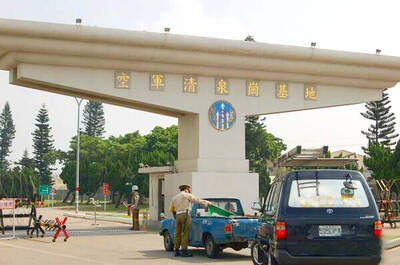
An unauthorized drone intrusion over Ching Chuan Kang Air Base (清泉崗基地) at Taichung International Airport on Tuesday night forced the temporary closure of the base, diverting eight fighter jets and delaying a commercial flight, authorities said. Air Force Command Headquarters said that clear weather had allowed for scheduled night training exercises, but after a drone was spotted entering the airspace, the control tower declared an emergency closure of the airport, forcing eight Indigenous Defense Fighter jets in the air to divert and land at Hsinchu Air Base (新竹基地). Taichung airport director Chang Jui-shu (張瑞澍) said the airspace intrusion lasted from 7:37pm to
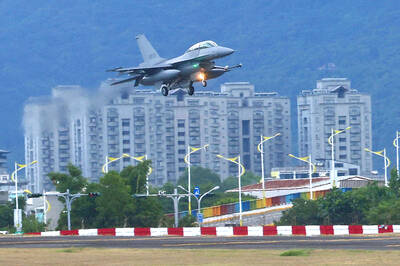
The air force plans to build 26 more hardened aircraft shelters as the number of F-16Vs stationed along Taiwan’s east coast is expected to reach 120 when the final shipment of 66 jets procured from the US arrives. The incoming jets would be stationed at Chihhang Air Base in Taitung County, augmenting the F-16V Block 20s operated by the 5th Tactical Fighter Wing in Hualien County, officials said yesterday. The air force plans to allocate more than NT$6.88 billion (US$218.1 million) from next year to 2031 to build the shelters in Hualien and Taitung as part of the implementation of a “one
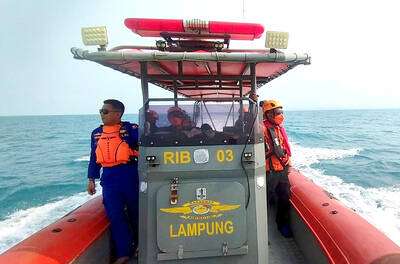
Indonesian rescuers searched for eight people who went missing at sea while heading to a volcanic island to report on an eruption there, officials said yesterday. Anak Krakatau initially erupted for about 25 hours over the weekend, and it has since continued to erupt intermittently with explosions ejecting lava, ash and incandescent volcanic material from the crater, the Indonesian Geology Agency said in a statement. A speedboat carrying five photojournalists, two crew members and a route guide lost contact after leaving Carita, a coastal town in Banten Province, for the volcanic island, Banten Province Search and Rescue Office Chief Al Amrad said. He
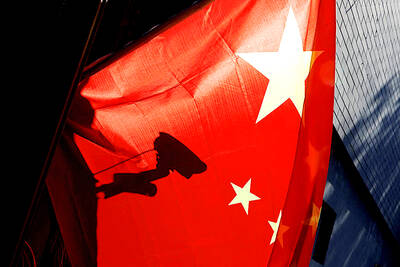
NO LIMITS: More legislation expanding Beijing’s control over the movement of people, money and information raises risks for Taiwanese travelers and businesses, officials said China is set to implement several laws in the coming months that expand the definition of national security, creating greater risks for Taiwanese traveling to or doing business in China, Taiwanese officials said yesterday. Beijing’s Ethnic Unity and Progress Promotion Law took effect on July 1, while a draft “Internet Information Service Management Measures” finished its public consultation on Aug. 2, but has yet to be adopted. China’s Regulations of the State Council on Exit and Entry Administration are to take effect on Tuesday next week, while amendments to its National Defense Mobilization Law and the Ministry of Public Security’s Measures


 RSS
RSS