

Smartphone and Internet access in Taiwan exceeds 90 percent even among the lowest-income households, a survey released by the Directorate-General of Budget, Accounting and Statistics (DGBAS) showed.
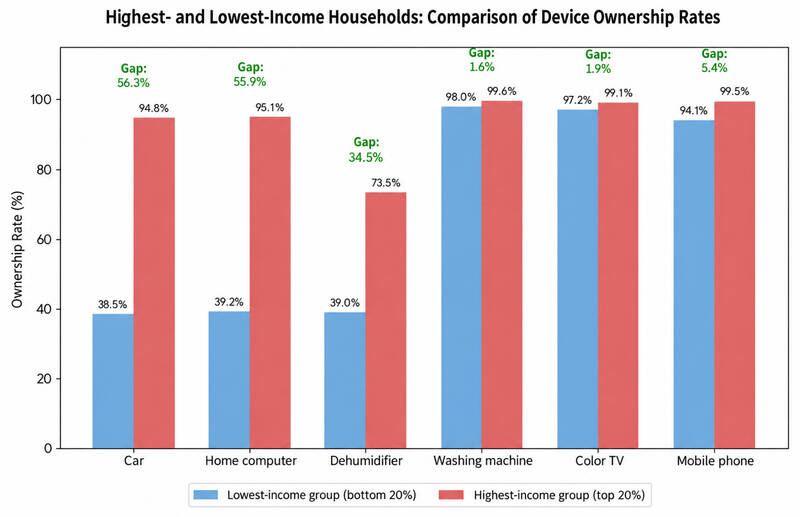
The latest Survey of Family Income and Expenditure, which compared the top 20 percent of income earners with the bottom 20 percent, found Taiwan’s highest and lowest-income households show the largest disparity in ownership rates for cars, computers and dehumidifiers, while basic home appliances, mobile phones and Internet access have become nearly universal across income levels.
The survey found that Taiwan has largely achieved digital inclusion, with more than 90 percent of low-income households having access to mobile phones and Internet connectivity.
Prepared by reporter Kao Chia-ho
While car ownership has remained stable since 2017, with a national penetration rate of about 60 to 61 percent after first surpassing 50 percent in 1996, ownership rates differ sharply by income level, the survey showed.
More than 95 percent of households in the highest income bracket own a car, compared with 39 to 42 percent of households in the lowest income bracket — a gap of more than 50 percentage points, indicating that the high price of vehicles and maintenance costs remain significant barriers for low-income households.
More than 96 percent of high-income households own a home computer, compared with 34 to 43 percent of low-income households.
Dehumidifier ownership ranges from 65 to 70 percent among high-income households, compared with 40 to 44 percent among low-income households, suggesting that low-income families prioritize essential needs over quality-of-life appliances.
In contrast, basic appliances such as color televisions and washing machines maintain near-universal adoption at 98 to 99 percent across all income groups.
Mobile phone ownership exceeds 90 percent in the lowest income group and approaches 100 percent in the highest group, while Internet access equipment showed a similar pattern, with more than 91 percent of low-income households connected online, almost matching the rate among wealthier families.
Mobile phones and mobile Internet services have replaced many of the household technologies that once dominated daily life, the survey showed.
Mobile phone ownership rose to 98.04 percent last year from 86.15 percent in 2005, surpassing televisions, which stood at 97.65 percent, to become the most common household device in Taiwan, the survey showed.
Cable television subscriptions, once the dominant source of living-room entertainment, peaked at an 86.36 percent adoption rate in 2017, up from 54.15 percent in 1995, but declined to 80.44 percent last year as streaming services gained ground.
Devices such as video cassette recorders have disappeared from Taiwanese homes, while digital camera ownership fell to 5.7 percent from 51.7 percent over 15 years.
Similarly, the landline telephone penetration rate, which peaked at 97.55 percent in 2005, dropped by more than 24 percentage points to 73.76 percent last year.
CONTINUED ON PAGE 3
DGBAS data on household consumption patterns also showed that Taiwanese spending habits have undergone significant changes over the past three decades.
While basic expenses such as food, clothing, housing and transport have declined or stagnated as a proportion of overall budgets, spending on healthcare, dining out and lodging has grown rapidly, the data showed.
The share of spending on food, beverages and tobacco fell to 15.36 percent last year from 19.53 percent in 1995, while expenses on clothing and footwear dropped to 2.57 percent from 4.6 percent.
Spending on housing services, utilities and fuel edged down to 24.09 percent from 25.13 percent, while transportation and communications slipped slightly to 11.39 percent from 11.47 percent, indicating stable spending patterns for housing and commuting needs.
In contrast, the share of spending on restaurants and accommodation surged to 14.19 percent last year from 8.16 percent 30 years ago, while healthcare spending also rose sharply to 14.08 percent from 9.96 percent over the same period.
DGBAS officials attributed the rise in dining and travel spending to the growing number of dual-income households and single-person households, saying that dining out has become normal, as cooking at home takes longer.
People are also increasingly willing to spend on specialty restaurants, as well as domestic and overseas travel, and hotel stays, reflecting a growing preference for lifestyle and leisure experiences, they said.
The increase in healthcare expenditure is largely driven by Taiwan’s rapidly aging population, they said.
As more households care for elderly family members, spending on nutritional supplements, out-of-pocket treatment for chronic illnesses, long-term care and caregiving services has become a growing financial burden, they added.

Taiwan, which accounts for more than half of the global outsourced semiconductor assembly and testing market, is well-positioned to develop copackaged optics (CPO) and manufacture precision silicon photonics chips, the Ministry of Economic Affairs said yesterday. Silicon photonics are emerging as a mainstream optical communications technology and is seen as key to overcoming bottlenecks in AI computing power. The technology is a key project under the government’s New 10 Major AI Infrastructure Projects, with industry, government, academia and research institutions working to overcome critical technological hurdles and build a self-reliant silicon photonics supply chain, the ministry said. Nvidia Corp in March invested US$4
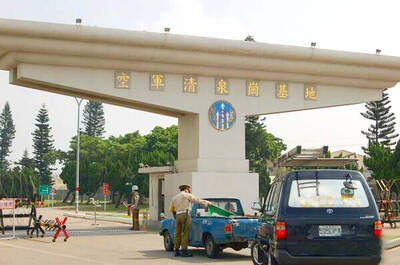
An unauthorized drone intrusion over Ching Chuan Kang Air Base (清泉崗基地) at Taichung International Airport on Tuesday night forced the temporary closure of the base, diverting eight fighter jets and delaying a commercial flight, authorities said. Air Force Command Headquarters said that clear weather had allowed for scheduled night training exercises, but after a drone was spotted entering the airspace, the control tower declared an emergency closure of the airport, forcing eight Indigenous Defense Fighter jets in the air to divert and land at Hsinchu Air Base (新竹基地). Taichung airport director Chang Jui-shu (張瑞澍) said the airspace intrusion lasted from 7:37pm to
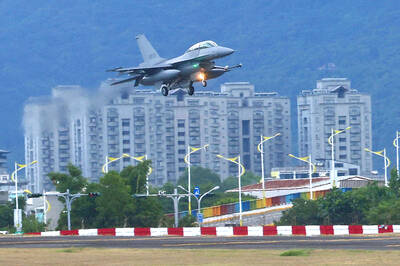
The air force plans to build 26 more hardened aircraft shelters as the number of F-16Vs stationed along Taiwan’s east coast is expected to reach 120 when the final shipment of 66 jets procured from the US arrives. The incoming jets would be stationed at Chihhang Air Base in Taitung County, augmenting the F-16V Block 20s operated by the 5th Tactical Fighter Wing in Hualien County, officials said yesterday. The air force plans to allocate more than NT$6.88 billion (US$218.1 million) from next year to 2031 to build the shelters in Hualien and Taitung as part of the implementation of a “one
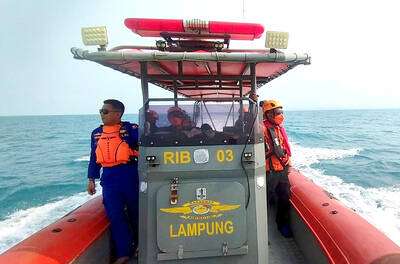
Indonesian rescuers searched for eight people who went missing at sea while heading to a volcanic island to report on an eruption there, officials said yesterday. Anak Krakatau initially erupted for about 25 hours over the weekend, and it has since continued to erupt intermittently with explosions ejecting lava, ash and incandescent volcanic material from the crater, the Indonesian Geology Agency said in a statement. A speedboat carrying five photojournalists, two crew members and a route guide lost contact after leaving Carita, a coastal town in Banten Province, for the volcanic island, Banten Province Search and Rescue Office Chief Al Amrad said. He


 RSS
RSS