

An attempted attack in Leipzig, Germany, had all the hallmarks of state-sponsored terrorism, European Commission Vice President Kaja Kallas said yesterday, adding that Europe needs to coordinate on what more can be done given the escalation of Russia’s attacks on Ukraine.
The German government on Tuesday said it had concluded that Russia was responsible for the attempted drone attack last month.
Speaking ahead of an informal gathering of European foreign ministers in Ireland, Kallas also said that work is ongoing on 1,600 sanctions listings related to Russia’s military complex and “maybe there are more to be added.”

Photo: AFP
Ministers arriving at the meeting said the bloc needs to look for more ways to put pressure on Moscow.
“I think we need to now really explore all the options on the table in terms of tightening the sanctions,” Finnish Minister of Foreign Affairs Elina Valtonen told reporters.
Lithuanian Minister of Foreign Affairs Kestutis Budrys said Europeans need to consider their options and respond.
“It is obvious Russia does not see the political cost of its hybrid activities against us. So for them, this is the cheap way to make tensions in our society,” Budrys said, adding that “our goal is to show that these activities will neither intimidate us nor prevent us from supporting Ukraine and maintaining our pressure on Russia.”
German Minister of Foreign Affairs Johann Wadephul said that the EU would work on imposing further sanctions on Russian individuals in the coming weeks.
“Pressure on Russia is being stepped up and support for Ukraine also remains at a high level. That is the unity we are demonstrating at this time,” Wadephul said.
Some European ministers pointed to risks stemming from Russia’s activities following the Leipzig incident.
“We are lucky that nothing happened, but we see what happened in Romania, what happened in so many countries,” Luxembourg Minister of Foreign Affairs Xavier Bettel said. “We see that there is no will from the Russian side to de-escalate. It’s my neighboring country, so the danger is coming closer.”
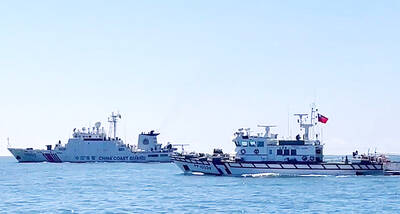
China deployed a record number of coast guard, scientific research and other ships near Taiwan’s waters last month, the Coast Guard Administration (CGA) said, as Beijing dials up pressure on Taipei. The coast guard warned of an increasingly severe situation, as analysts say the increased activity is part of China’s bid to map the region for submarine warfare. The number of Chinese ships detected around Taiwan proper soared to a record 244 last month — an average of nearly eight every day, official data showed. That compares with 55 ships detected in June and 30 in May, and 58 in July last year. In

The Hualien District Prosecutors’ Office yesterday launched an investigation following allegations by a former foreign correspondent in Taiwan of widespread vote-buying in Hualien County. In an interview with Formosa TV (FTV, 民視) aired on Saturday, former Financial Times Taiwan correspondent Kathrin Hille spoke about Taiwan’s democracy and said that she now lives in rural Hualien, where “all the votes are bought.” Neighbors would talk about who had come by and leave cash on the table showing “how much each vote was worth that year,” Hille said. The practice needs to be addressed, considering Taiwan has been a democracy for many
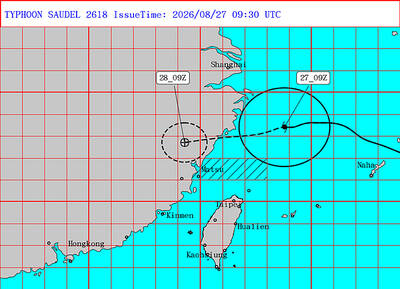
Taiwan is bracing for heavy rain in the south and rough seas around outlying Lienchiang County (Matsu), as Typhoon Saudel passes north toward eastern China, with forecasters yesterday warning of localized flooding over the next two days. Saudel is expected to pass closest to Taiwan today, when its outer rain bands are forecast to brush past Matsu, before making landfall at about noon in China’s Zhejiang Province and weakening significantly, the Central Weather Administration said. The storm’s outer bands, combined with strengthening southwesterly winds, are expected to bring heavy rain to southern and southeastern Taiwan today, it said. As the storm approaches Matsu,

LIMITED: The bill’s NT$40bn annual spending cap would prevent Taiwan from effectively building up its drone combat capabilities, National Defense Minister Wellington Koo said The legislature yesterday rejected the Executive Yuan’s NT$210 billion (US$6.62 billion) special budget proposal to buy military drones and instead passed its own plan, which earmarks NT$40 billion per year over six consecutive years. The Executive Yuan said its plan to buy about 210,000 drones by 2031 could not wait, as the wars in Ukraine and Iran showed the importance of uncrewed systems in modern warfare amid a rising threat from China. However, the Chinese Nationalist Party (KMT) and Taiwan People’s Party (TPP) used their opposition majority to pass a bill providing NT$240 billion through annual budgets over six years, with annual


 RSS
RSS