

Iran yesterday launched a wave of attacks on US sites across the Middle East as violence surged after an extensive US bombardment and the deaths of four people at an Iranian wedding party.
Iran’s Islamic Revolutionary Guard Corps (IRGC) announced attacks on US bases in Jordan, the United Arab Emirates, Kuwait, Bahrain and Iraq’s autonomous Kurdistan region.
US President Donald Trump had warned earlier of “much harder and higher” attacks if Iran retaliated to the US strikes, which Iran’s military and state media said killed 18 people.
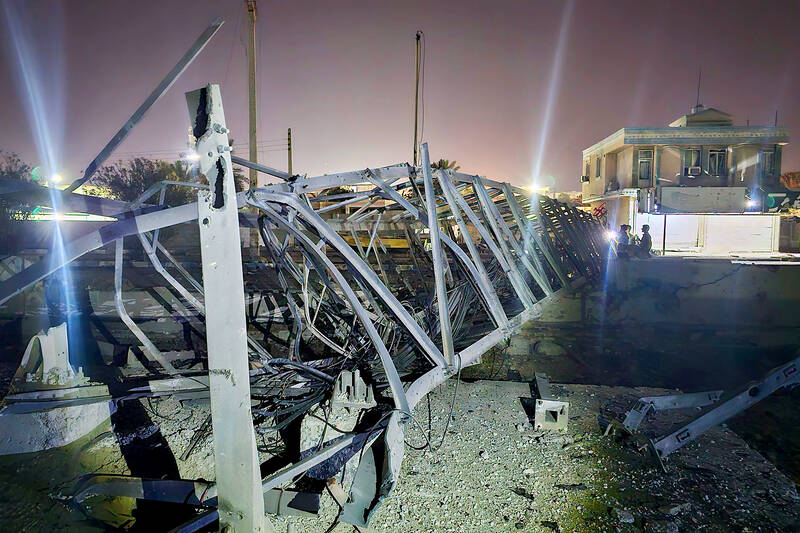
Photo: AP
The Iranian Red Crescent on Tuesday said that four people including a child were killed and more than 50 people were wounded by a US attack at a wedding in Iran’s south.
A video shared by an Iranian government account showed debris and damage at what it said was the wedding site in Sirik following a US strike, with people heard screaming in the background.
“Unfortunately, this is a residential building. And unfortunately, this happened during my daughter’s wedding ceremony,” Ali Mallahi, father of the bride and owner of the building, said in a video carried by state TV. “It is a very saddening incident... Thank God the casualties were not higher.”
Iran’s top negotiator Mohammad Bagher Ghalibaf lashed out over the wedding attack.
“If a power acts like Satan, picks targets like Satan and kills like Satan, it’s Satan,” he wrote on X.
The US military did not address the incident directly.
US Central Command spokesman Tim Hawkins said that “the US military never targets civilians, unlike the IRGC.”
Iran’s retaliatory strikes included “a coordinated missile and drone attack on US bases in Erbil” in Kurdistan, the state-run Islamic Republic News Agency reported.
The IRGC also announced a missile attack on a US Marine training camp in Jordan on the Gulf of Aqaba, Iran’s Tasnim news agency reported.
In the Gulf, air raid sirens sounded in Bahrain and also Kuwait, where authorities said an Iranian drone set off a blaze at a residential complex.
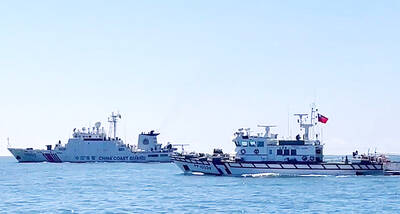
China deployed a record number of coast guard, scientific research and other ships near Taiwan’s waters last month, the Coast Guard Administration (CGA) said, as Beijing dials up pressure on Taipei. The coast guard warned of an increasingly severe situation, as analysts say the increased activity is part of China’s bid to map the region for submarine warfare. The number of Chinese ships detected around Taiwan proper soared to a record 244 last month — an average of nearly eight every day, official data showed. That compares with 55 ships detected in June and 30 in May, and 58 in July last year. In

The Hualien District Prosecutors’ Office yesterday launched an investigation following allegations by a former foreign correspondent in Taiwan of widespread vote-buying in Hualien County. In an interview with Formosa TV (FTV, 民視) aired on Saturday, former Financial Times Taiwan correspondent Kathrin Hille spoke about Taiwan’s democracy and said that she now lives in rural Hualien, where “all the votes are bought.” Neighbors would talk about who had come by and leave cash on the table showing “how much each vote was worth that year,” Hille said. The practice needs to be addressed, considering Taiwan has been a democracy for many
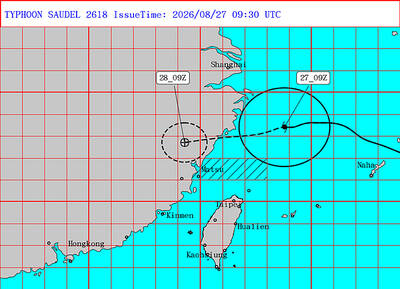
Taiwan is bracing for heavy rain in the south and rough seas around outlying Lienchiang County (Matsu), as Typhoon Saudel passes north toward eastern China, with forecasters yesterday warning of localized flooding over the next two days. Saudel is expected to pass closest to Taiwan today, when its outer rain bands are forecast to brush past Matsu, before making landfall at about noon in China’s Zhejiang Province and weakening significantly, the Central Weather Administration said. The storm’s outer bands, combined with strengthening southwesterly winds, are expected to bring heavy rain to southern and southeastern Taiwan today, it said. As the storm approaches Matsu,

LIMITED: The bill’s NT$40bn annual spending cap would prevent Taiwan from effectively building up its drone combat capabilities, National Defense Minister Wellington Koo said The legislature yesterday rejected the Executive Yuan’s NT$210 billion (US$6.62 billion) special budget proposal to buy military drones and instead passed its own plan, which earmarks NT$40 billion per year over six consecutive years. The Executive Yuan said its plan to buy about 210,000 drones by 2031 could not wait, as the wars in Ukraine and Iran showed the importance of uncrewed systems in modern warfare amid a rising threat from China. However, the Chinese Nationalist Party (KMT) and Taiwan People’s Party (TPP) used their opposition majority to pass a bill providing NT$240 billion through annual budgets over six years, with annual


 RSS
RSS