

US President Donald Trump’s 50 percent tariffs on certain Canadian goods, which took effect yesterday, delivered another blow to bilateral trade, renewing focus on Ottawa’s efforts to reduce dependence on its southern neighbor.
Canadian Prime Minister Mark Carney’s strategy involves a search for new markets, a focus on domestic trade and the launch of major projects.
The two economies are heavily inter-connected, with about 70 percent of all Canadian exports heading to the US.
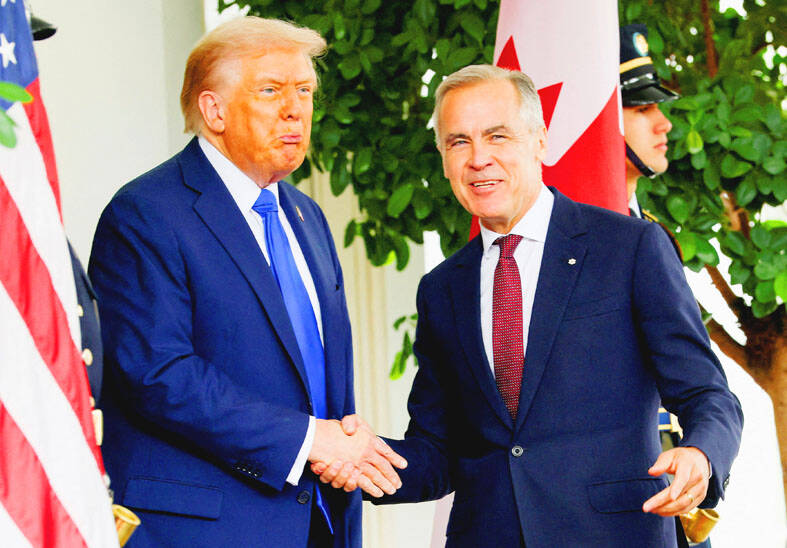
Photo: Reuters
Previous Trump levies on autos, steel, aluminum and lumber have hit Canada hard, forcing job losses and stunting growth.
Canada has even entered a technical recession this year after two consecutive quarters of economic contraction.
The latest tariffs came into force after days of negotiations failed to produce an agreement.
They impact about US$20 billion worth of goods, or 5.5 percent of Canadian exports to the US, targeting products ranging from hockey sticks to cement.
Carney said Canada would match the US tariffs “dollar for dollar to protect our workers and businesses.”
The exports affected by the US tariffs include products that were previously protected under the North American trade pact, the US-Mexico-Canada Agreement (USMCA).
At first glance, “that’s frightening,” Laval University international economic law professor Richard Ouellet said.
“Until now, the USMCA acted as kind of a shield. The Americans are opening a breach,” he said.
Trump declined to renew the USMCA on July 1, making it subject to annual reviews.
While Trump ditching USMCA exemptions could forecast more extreme measures to come, Canada’s largest bank, RBC, predicted that the first package of 50 percent tariffs would not “significantly change broader Canadian growth.”
“That’s because the new tariffs, while significant, will still impact a small segment of total trade,” RBC said, adding that about 80 percent of Canadian goods would still enter the US tariff-free.
Since taking office in March last year, Carney has focused on diversifying economic partnerships to reduce Canada’s reliance on the US market.
“Canada has what the world wants,” Carney said in a statement following the breakdown of negotiations with Washington. “We will not allow any nation to determine our future.”
Carney has headed to China, India and Saudi Arabia, and made several stops in Europe seeking deals to expand Ottawa’s economic relationships overseas.
In January, he signed a preliminary agreement with China, providing for the import of electric vehicles to Canada.
Relations with Europe have also been bolstered. Canada last month selected the German firm TKMS to build its new fleet of submarines.
Canada’s central bank last month said the economy was “showing signs of improving,” adding that some businesses were adjusting to US protectionism, including by finding new customers abroad.
A report from the Canadian minister of international trade said that last year, the value of exports to non-US markets jumped by 11 percent, hitting 33 percent at one point — the highest level in more than four decades.
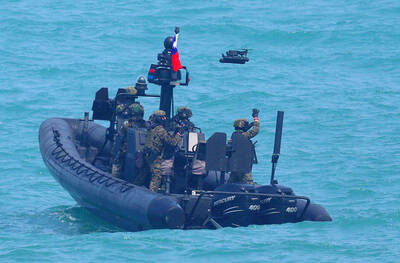
‘UNITED FRONT’ TACTICS: Beijing is pressuring Taiwanese politicians to block the Executive Yuan’s proposed special act to fund military uncrewed vehicles, a source said The Legislative Yuan is slated to hold cross-caucus negotiations on 14 versions of a draft uncrewed vehicle act on Thursday, amid rumors that Beijing is pressuring some Taiwanese politicians to block passage of a special bill proposed by the Ministry of National Defense to procure military drones and uncrewed vessels. A source in Beijing said the Chinese Communist Party has been using its United Front Work Department and Taiwan Affairs Office to pressure Taiwanese politicians who are friendly toward Beijing, pushing them to block the Executive Yuan’s proposed special act to fund military uncrewed vehicles. The proposed legislation would allocate
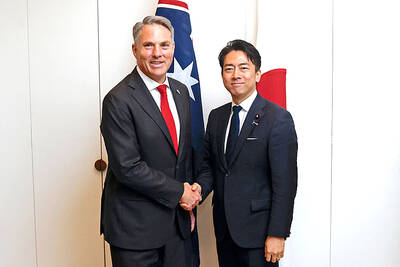
Japan will conduct tests of hypersonic missiles and other projectiles on Australian soil, the two countries’ defense ministers said yesterday as they deepened military cooperation, including with a codeveloped laser system. Australian Minister for Defence Richard Marles said alongside his Japanese counterpart, Shinjiro Koizumi, in Canberra that the deal would see a “better and enhanced arrangement between Australia and Japan for Japan’s use of our missile ranges over the course of the next decade.” “We have spoken previously about Australia being able to provide strategic depth to Japan across a range of areas, but one of them is the use
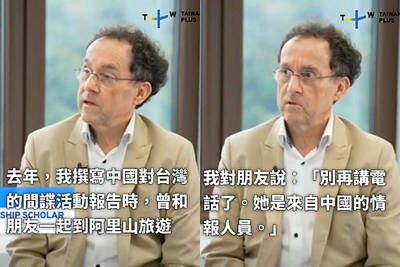
A German veteran journalist and author said the Ministry of Justice Investigation Bureau (MJIB) has confirmed his suspicion that he was followed by a Chinese spy on Alishan (阿里山) last year. Jurgen Kremb, who has long researched Chinese intelligence agencies, Asian geopolitics and cross-strait relations, made the comment during an interview with Taiwan Plus on Sunday. A video of the interview was subsequently shared by the Canadian Trade Office in Taipei on its Facebook page. Kremb said that last year, while writing a report on Chinese espionage activities targeting Taiwan, he traveled to Alishan with friends. A young Asian woman approached them and
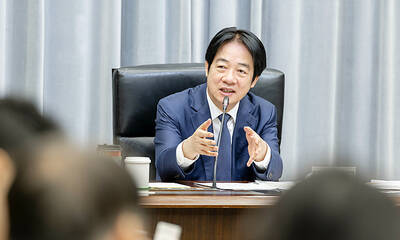
2027 BUDGET: Given the nation’s strong economic growth, the government has proposed the universal cash handout to allow everyone to share in the ‘AI dividend’ The government would allocate NT$235.7 billion (US$7.4 billion) in next year’s budget to fund a NT$10,000 cash payment for every citizen next year as the economy continues to grow, President William Lai (賴清德) announced yesterday. Lai made the announcement after being briefed on the Executive Yuan’s proposed central government budget for next year for the second time. The government would still maintain a balanced budget with no net increase in debt after incorporating the universal cash handout into the general budget, he said. The latest statistics from the Directorate-General of Budget, Accounting and Statistics show Taiwan’s economy performing more strongly than previously


 RSS
RSS