

The UN’s most powerful body, the Security Council, met yesterday to hold another straw poll to gauge the popularity of a growing field of contenders to lead the embattled organization.
UN Conference on Trade and Development Secretary-General and former Costa Rican vice president Rebeca Grynspan was the front-runner after last month’s first informal vote, in which the council’s 15 members, including the five with veto power, pass judgement in secret on the candidates.
Argentine diplomat and International Atomic Energy Agency Director-General Rafael Grossi is also a candidate along with former Chilean president Michelle Bachelet, former Ecuadorian minister of foreign affairs Maria Fernanda Espinosa, former Guyanese minister of foreign affairs Carolyn Rodrigues-Birkett, former Ugandan minister of foreign affairs Olara Otunnu and former Senegalese president Macky Sall.
Photo: EPA
After the first round concluded, former Ecuadorian minister of industries and productivity Ivonne A-Baki threw her hat into the race to succeed Antonio Guterres, who would complete his second five-year term on Dec. 31.
“While the first straw poll set the scene for the Secretary-General race, the second may give us some direction about where it is headed,” UN International Crisis Group head Daniel Forti said. “Diplomats expect fluctuations in the vote distribution compared to the July poll. Most will be watching to see whether the early front-runners consolidate their support or slip in the standings.”
“It is unlikely that any candidate will emerge from [yesterday’s] poll with a decisive lead,” he said.
The veto-wielding nations — the UK, China, France, Russia and the US — might wait until later to express their preferences, while new contenders could emerge, he added.
Even if a candidate earns the required nine votes from the 15 available in the Security Council, they must also avoid a veto by the five major powers, which are deeply divided. Once a candidate clears those bars, their name would go to the General Assembly of all UN members for confirmation.
The Security Council straw poll was devised in the early 1980s in an attempt to break a deadlock between two candidates shut down by vetoes.
The informal mechanism has persisted, in various forms, despite criticism from countries opposed to the opaque process.
Each member state must anonymously assign each candidate one of three labels: “encourage,” “discourage” or “no opinion.” That would give those with no support the opportunity to withdraw — although they are not obliged.
In the first rounds of the process expected to take several weeks, all ballots are the same color.
However, after an unspecified number of votes, the ballots of the five permanent members would become a different color from those of the elected members, making it possible to identify potential vetoes, without knowing which country blackballed any given candidate.
It is tradition that the UN’s top job should rotate between different regions.
Under that premise, the role should go to a candidate from Latin America this time. There are many candidates from the region, although Sall and Otunnu hail from Africa.
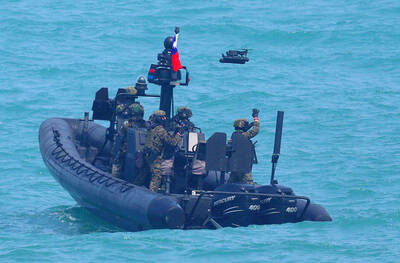
‘UNITED FRONT’ TACTICS: Beijing is pressuring Taiwanese politicians to block the Executive Yuan’s proposed special act to fund military uncrewed vehicles, a source said The Legislative Yuan is slated to hold cross-caucus negotiations on 14 versions of a draft uncrewed vehicle act on Thursday, amid rumors that Beijing is pressuring some Taiwanese politicians to block passage of a special bill proposed by the Ministry of National Defense to procure military drones and uncrewed vessels. A source in Beijing said the Chinese Communist Party has been using its United Front Work Department and Taiwan Affairs Office to pressure Taiwanese politicians who are friendly toward Beijing, pushing them to block the Executive Yuan’s proposed special act to fund military uncrewed vehicles. The proposed legislation would allocate
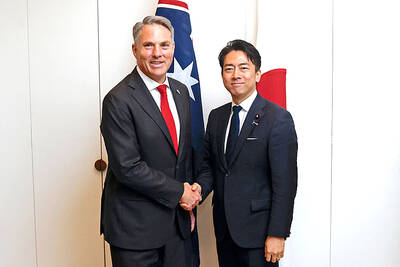
Japan will conduct tests of hypersonic missiles and other projectiles on Australian soil, the two countries’ defense ministers said yesterday as they deepened military cooperation, including with a codeveloped laser system. Australian Minister for Defence Richard Marles said alongside his Japanese counterpart, Shinjiro Koizumi, in Canberra that the deal would see a “better and enhanced arrangement between Australia and Japan for Japan’s use of our missile ranges over the course of the next decade.” “We have spoken previously about Australia being able to provide strategic depth to Japan across a range of areas, but one of them is the use
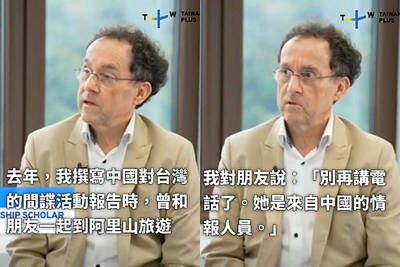
A German veteran journalist and author said the Ministry of Justice Investigation Bureau (MJIB) has confirmed his suspicion that he was followed by a Chinese spy on Alishan (阿里山) last year. Jurgen Kremb, who has long researched Chinese intelligence agencies, Asian geopolitics and cross-strait relations, made the comment during an interview with Taiwan Plus on Sunday. A video of the interview was subsequently shared by the Canadian Trade Office in Taipei on its Facebook page. Kremb said that last year, while writing a report on Chinese espionage activities targeting Taiwan, he traveled to Alishan with friends. A young Asian woman approached them and
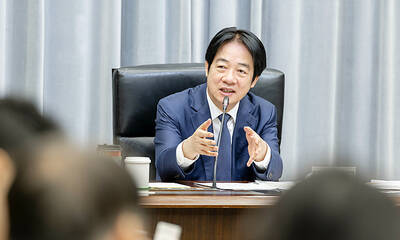
2027 BUDGET: Given the nation’s strong economic growth, the government has proposed the universal cash handout to allow everyone to share in the ‘AI dividend’ The government would allocate NT$235.7 billion (US$7.4 billion) in next year’s budget to fund a NT$10,000 cash payment for every citizen next year as the economy continues to grow, President William Lai (賴清德) announced yesterday. Lai made the announcement after being briefed on the Executive Yuan’s proposed central government budget for next year for the second time. The government would still maintain a balanced budget with no net increase in debt after incorporating the universal cash handout into the general budget, he said. The latest statistics from the Directorate-General of Budget, Accounting and Statistics show Taiwan’s economy performing more strongly than previously


 RSS
RSS