

Help could not come soon enough on yesterday for thousands of evacuees on Indonesia’s Flores island after a powerful earthquake killed at least 53 people, injured dozens and damaged hundreds of houses and buildings.
About 5,000 people fled their homes as the magnitude 7.7 quake hit the island early on Saturday, followed by about 1,000 aftershocks of varying intensities in the hours that followed, officials said.
People in some areas were left without electricity and telecommunications, and at least one emergency access road remained inaccessible.
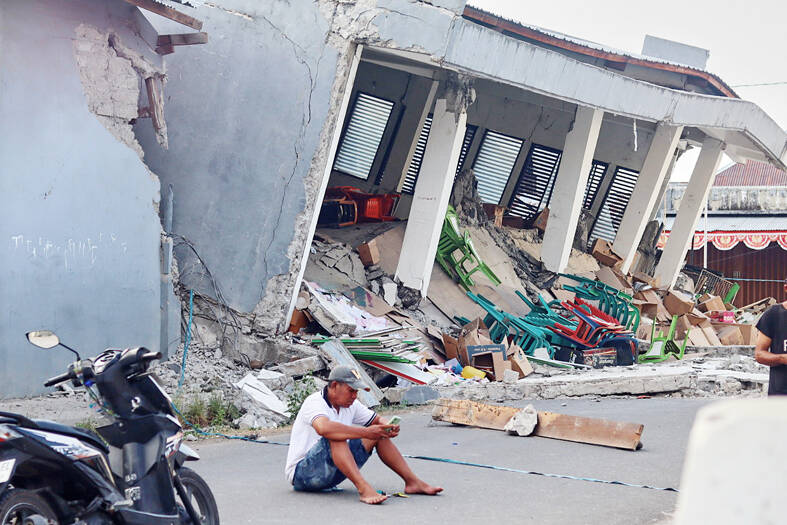
Photo: AP
“We need food, drink, medicines and diapers for the children,” Umri, a resident of Nangahale village on the north coast of Flores, said yesterday morning.
The 55-year-old, who like many Indonesians uses one name, has been hiding out on a hilltop for 24 hours with others afraid to return home.
At Kisol village a few hours away, Bertolomeus Tiga, 42, said that his house was one of several collapsed by the quake that also brought down part of the local church.
“The police came yesterday and collected all the data, but there’s no aid yet. The most important thing is probably staple foods. Food and drink ... medicine,” he said.
Bertolomeus said villagers were afraid to return to compromised homes and buildings.
“For the time being, we’re still taking refuge outside. We’re still living outside,” he added.
The head of the Indonesian National Disaster Management Agency (BNPB), Suharyanto, said at least five helicopters, several planes, a naval vessel and search and rescue ships were on their way to help.
The agency upped the death toll yesterday to 53 from 47 the day before, with 135 people injured.
There were no reports of missing people.
Survivors were in urgent need of assistance in the form of emergency tents, food, medicines, blankets, camp beds, mats, clean water and electricity generators, rescue officials said.
The epicenter of the shallow quake was located just off the north coast of the island, authorities said.
The affected areas have few, if any, high-rise buildings.
BNPB spokesman Berton Suar Pelita Panjaitan said at least 914 houses on the island were severely damaged and hundreds of others to a lesser degree.
Dozens of public buildings were also affected, including 93 educational and 36 health facilities, and 38 government offices.
The International Federation of Red Cross and Red Crescent Societies said on Saturday that preparations were under way to bring aid to thousands in temporary shelters.
The Indonesian government sent 50,000 aid packages weighing a total of 275 tonnes to the area, and European Commission President Ursula von der Leyen offered help from the bloc’s Copernicus Earth observation satellites.
In Ruteng, a town about 200km from the worst-hit part of the island, heavy machinery were clearing rubble from the street yesterday.
The local hospital had been badly damaged, and patients were evacuated to tents erected outside.

CHINESE THREAT: The military also simulated repelling an attack on Penghu and transporting military vehicles from Hualien to Yilan to reinforce defenses in the north The government yesterday slowed mobile Internet coverage for a large swathe of the central part of Taiwan proper for the first time during annual war games, simulating communication disruption in the event of a Chinese attack or natural disaster. Taiwan, which has long lived with the threat of a Chinese invasion, holds air raid drills along with its war games every year, clearing people from the streets for 30 minutes. During the Internet “throttling” drill, centered on Taichung, only basic mobile phone services worked, although other functions, including ATMs, traffic signals, landlines and fixed-line Internet services, were not affected. Air raid sirens rang
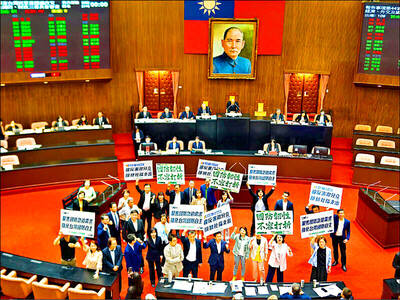
The Chinese Nationalist Party (KMT) and other opposition politicians are “taking Taiwan’s democracy hostage” for selfish gain, The Economist said in a column published online on Tuesday. “Taiwan’s freedoms should be a strength, raising the costs to China of a takeover. Shamefully, they are being betrayed from within,” the British news magazine said. While a lot of countries have toxic politicians, Taiwan’s stand out as particularly irresponsible, and “the blame is not evenly distributed,” it said. Although President William Lai (賴清德) is stubborn and, unlike his predecessor, does not consult KMT moderates, the opposition has triggered a “rolling constitutional crisis,”

CHINESE INFLUENCE? The TPP denied any knowledge that the Chinese immigrant had been reporting to Beijing or that she had participated in the party’s decisionmaking The New Taipei District Court yesterday sentenced Chinese immigrant Xu Chunying (徐春鶯) to seven years in prison for fraud, helping Chinese nationals illegally enter Taiwan and acting at Beijing’s direction to influence Taiwanese politics. The New Taipei District Prosecutors’ Office said it found that Xu and Cross-Strait Marriage Harmony Promotion Association chairman Chung Chin-ming (鍾錦明) had maintained long-term contact with Yang Wentao (楊文濤), director of the Cross-Strait Marriage and Family Service Center, and Sun Xian (孫憲), vice director of the Shanghai China Council for the Promotion of Peaceful National Reunification. Prosecutors accused Xu and Chung of accepting instructions to campaign for certain

The Chinese Communist Party (CCP) has reportedly set four priorities for its Taiwan policy at its Beidaihe (北戴河) summer meeting, including opposing “Taiwanese independence” and supporting “patriotic forces” in Taiwan’s November nine-in-one local elections, an official said yesterday. The two-week Beidaihe meeting started on Monday last week, with this year’s theme being “Striving Forward in the 15th Five-Year Plan.” Aside from discussing the agenda of the CCP Central Committee’s fifth plenary session in late October and the 21st CCP National Congress, former and current Chinese officials would focus on strategies toward the US and Taiwan, as well as domestic personnel affairs. A


 RSS
RSS