

A Taiwan-based scam ring allegedly funneled more than NT$5 billion (US$156 million) a year to China while targeting Taiwanese and Chinese in the US, Japan and Canada, police said yesterday.
Police revealed the case after more than a dozen people were arrested for allegedly transporting cash in a scheme targeting a Taiwanese woman surnamed Hsu (徐) living in California.
Amid a surge in the stock market last year, the group targeted Hsu, who is in her 80s and has been living in California for nearly 30 years, although most of her family lives in Taiwan, police said in a statement.
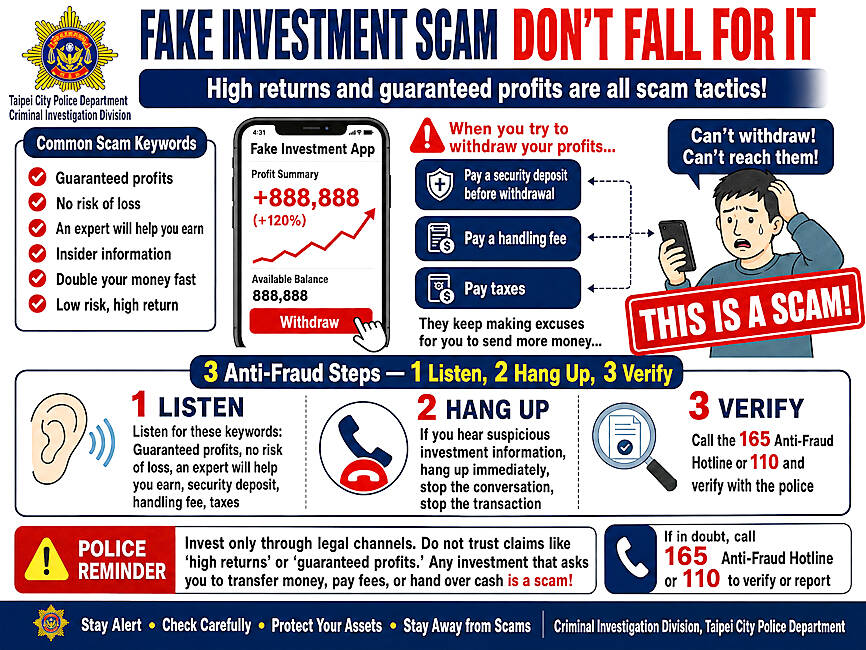
Photo courtesy of the Taipei City Police Department
The group sent members to California, who operated in teams of three on a rotating basis, police said.
They rented accommodation near Hsu’s home, from where they monitored her, police said.
Whenever the group deceived Hsu into handing over cash or gold, the members in California would collect it, police said, adding that between September last year and Jan. 8, three or four teams made trips to the US.
Each team stayed in the US for about a month, with about 17 in-person pickups conducted in total, collecting NT$89.26 million (US$2.79 million) in cash and gold, the statement said.
Hsu in May returned to Taiwan and reported the case, as the men she had interacted with had Taiwanese accents and issued receipts written in traditional Chinese, it said.
The Taipei City Police Department and the National Police Agency’s Criminal Investigation Bureau said they formed a joint task force, which found more than 10 fingerprints on 17 falsified receipts provided by Hsu.
The fingerprints showed that several of the suspects had backgrounds with the Bamboo Union, or they had been convicted of fraud, the statement said.
Three suspects were arrested in June in an initial round of raids, it said.
In a large operation conducted last month, police arrested more than 20 other suspects in Taipei and central Taiwan, it said.
The suspects who collected the money would convert it into cryptocurrency in California and transfer it in batches to Taiwan, China or Cambodia, it said.
They would not carry much cash when flying, making it difficult to track the flow of the cash, it said.
Once a target was identified, the group would dispatch members posing as investment advisers to collect money, police said.
Hsu was not the only target, with communication records showing that Taiwanese living in the US, Japan and Canada were defrauded of more than NT$10 million combined, the task force said.
Based on nearly a year of financial records gathered during the investigation, most of the funds — totaling more than NT$5 billion — were transferred to China, it said.

CHINESE THREAT: The military also simulated repelling an attack on Penghu and transporting military vehicles from Hualien to Yilan to reinforce defenses in the north The government yesterday slowed mobile Internet coverage for a large swathe of the central part of Taiwan proper for the first time during annual war games, simulating communication disruption in the event of a Chinese attack or natural disaster. Taiwan, which has long lived with the threat of a Chinese invasion, holds air raid drills along with its war games every year, clearing people from the streets for 30 minutes. During the Internet “throttling” drill, centered on Taichung, only basic mobile phone services worked, although other functions, including ATMs, traffic signals, landlines and fixed-line Internet services, were not affected. Air raid sirens rang
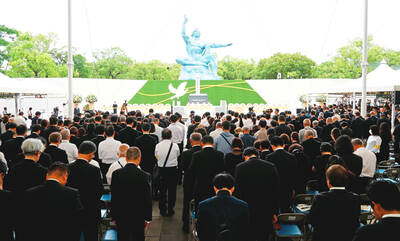
‘IRONIC’: The Nagasaki memorial calls for the abolition of nuclear weapons and peace, but it sided with China, which has been threatening peace in the Strait, an official said Taipei yesterday protested the seating arrangement at the Nagasaki atomic bombing memorial ceremony, saying that the Nagasaki City Government’s decision to place its representative outside the diplomatic delegation area slighted Taiwan’s national status and played into Beijing’s efforts to suppress the nation. Representative to Japan Lee Yi-yang (李逸洋) said he declined to attend the event, because the seat placement deliberately diminished Taiwan’s status and dignity, with Chen Ming-chun (陳銘俊), head of the Fukuoka Branch of the Taipei Economic and Cultural Office in Osaka, attending in his place. Taiwan is known worldwide for its commitment to peace and democracy, Lee said, adding that

CHINESE INFLUENCE? The TPP denied any knowledge that the Chinese immigrant had been reporting to Beijing or that she had participated in the party’s decisionmaking The New Taipei District Court yesterday sentenced Chinese immigrant Xu Chunying (徐春鶯) to seven years in prison for fraud, helping Chinese nationals illegally enter Taiwan and acting at Beijing’s direction to influence Taiwanese politics. The New Taipei District Prosecutors’ Office said it found that Xu and Cross-Strait Marriage Harmony Promotion Association chairman Chung Chin-ming (鍾錦明) had maintained long-term contact with Yang Wentao (楊文濤), director of the Cross-Strait Marriage and Family Service Center, and Sun Xian (孫憲), vice director of the Shanghai China Council for the Promotion of Peaceful National Reunification. Prosecutors accused Xu and Chung of accepting instructions to campaign for certain
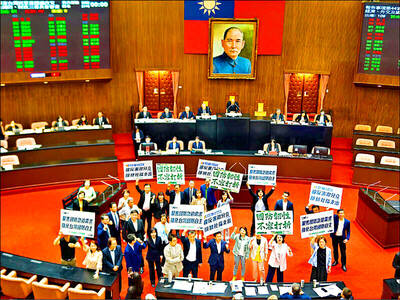
The Chinese Nationalist Party (KMT) and other opposition politicians are “taking Taiwan’s democracy hostage” for selfish gain, The Economist said in a column published online on Tuesday. “Taiwan’s freedoms should be a strength, raising the costs to China of a takeover. Shamefully, they are being betrayed from within,” the British news magazine said. While a lot of countries have toxic politicians, Taiwan’s stand out as particularly irresponsible, and “the blame is not evenly distributed,” it said. Although President William Lai (賴清德) is stubborn and, unlike his predecessor, does not consult KMT moderates, the opposition has triggered a “rolling constitutional crisis,”


 RSS
RSS