

Taiwan has produced 2,577 missiles over the past five years, passing a key test of the nation’s capability to surge military production, a high-ranking defense official said yesterday.
The National Chungshan Institute of Science and Technology (NCSIST) achieved the figure by manufacturing missiles at capacity in the race to fill the orders authorized under the Sea-Air Combat Power Improvement Plan, the official said on condition of anonymity.
The orders included the land-and ship-based versions of the Hsiung Feng (雄風, “Brave Wind”) II and III anti-ship cruise missiles, Wan Chien (萬劍, “Ten Thousand Swords”) air-to-ground cruise missiles, Tien Kung (天劍, “Sky Sword”) II and III air defense missiles and Chien Hsiang (劍翔, “Rising Sword”) loitering munitions, the official said.
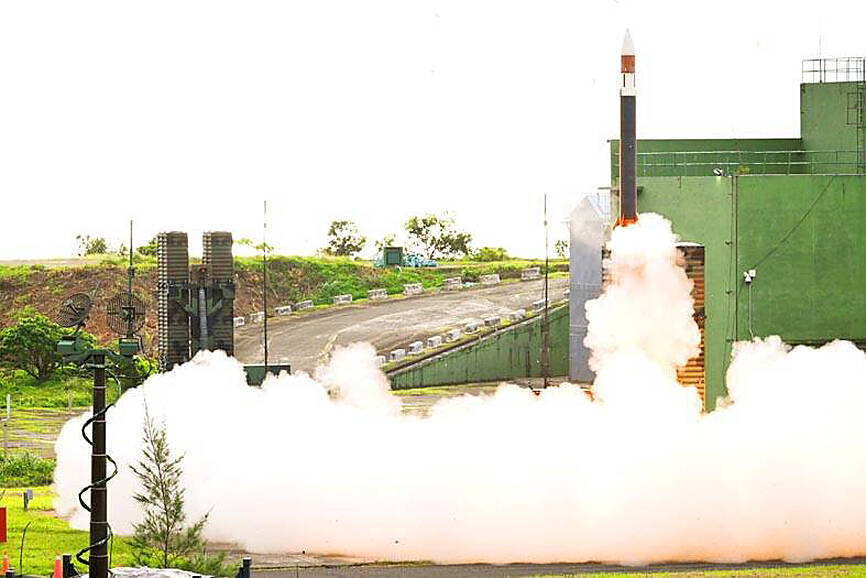
Photo: Chen Yi-kuan, Taipei Times
The Wan Chien missiles had a three-year production run, while Hsiung Feng IIE extended-range missiles and the Chien Hsiang attack drones had four-year production runs, they said.
The NCSIST overcame three critical production bottlenecks to pass the stress tests the orders posed, the official said.
The institute optimized assembly lines in anticipation of the high volume of orders, and obtained a domestically sourced 300-gallon (1,136 liter) industrial mixer at its missile propellant factory and high-powered X-ray equipment, they said.
The NCSIST’s acquisition of a mixer manufactured entirely in Taiwan was significant, as stringent foreign export controls prevent Taiwan from procuring the equipment overseas, the official said.
The mixer, capable of more than 80 production cycles a year, has boosted production capacity since going online in July last year, they said.
The upgraded X-ray equipment, which is capable of penetrating heavy-displacement rocket motors, accelerated the quality control process by 36 percent, the official said.
The Ministry of National Defense said in a report to the legislature that the NCSIST could produce up to 150 Wan Chien missiles, 96 Tien Kung III missiles, 70 Hsiung Feng III supersonic anti-ship missiles and 131 Hsiung Feng II missiles per year, with no delay if upgraded variants are produced instead.
The institute can produce up to 50 Wan Chien missiles and 48 Chien Hsiang drones a year, the report said.
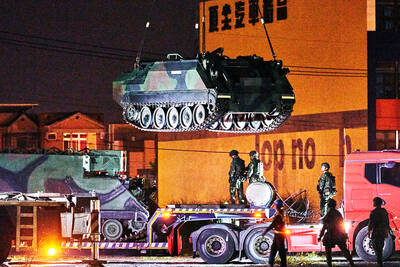
CHINESE THREAT: The military also simulated repelling an attack on Penghu and transporting military vehicles from Hualien to Yilan to reinforce defenses in the north The government yesterday slowed mobile Internet coverage for a large swathe of the central part of Taiwan proper for the first time during annual war games, simulating communication disruption in the event of a Chinese attack or natural disaster. Taiwan, which has long lived with the threat of a Chinese invasion, holds air raid drills along with its war games every year, clearing people from the streets for 30 minutes. During the Internet “throttling” drill, centered on Taichung, only basic mobile phone services worked, although other functions, including ATMs, traffic signals, landlines and fixed-line Internet services, were not affected. Air raid sirens rang
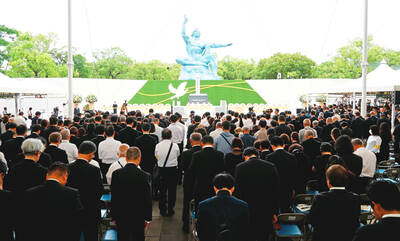
‘IRONIC’: The Nagasaki memorial calls for the abolition of nuclear weapons and peace, but it sided with China, which has been threatening peace in the Strait, an official said Taipei yesterday protested the seating arrangement at the Nagasaki atomic bombing memorial ceremony, saying that the Nagasaki City Government’s decision to place its representative outside the diplomatic delegation area slighted Taiwan’s national status and played into Beijing’s efforts to suppress the nation. Representative to Japan Lee Yi-yang (李逸洋) said he declined to attend the event, because the seat placement deliberately diminished Taiwan’s status and dignity, with Chen Ming-chun (陳銘俊), head of the Fukuoka Branch of the Taipei Economic and Cultural Office in Osaka, attending in his place. Taiwan is known worldwide for its commitment to peace and democracy, Lee said, adding that

CHINESE INFLUENCE? The TPP denied any knowledge that the Chinese immigrant had been reporting to Beijing or that she had participated in the party’s decisionmaking The New Taipei District Court yesterday sentenced Chinese immigrant Xu Chunying (徐春鶯) to seven years in prison for fraud, helping Chinese nationals illegally enter Taiwan and acting at Beijing’s direction to influence Taiwanese politics. The New Taipei District Prosecutors’ Office said it found that Xu and Cross-Strait Marriage Harmony Promotion Association chairman Chung Chin-ming (鍾錦明) had maintained long-term contact with Yang Wentao (楊文濤), director of the Cross-Strait Marriage and Family Service Center, and Sun Xian (孫憲), vice director of the Shanghai China Council for the Promotion of Peaceful National Reunification. Prosecutors accused Xu and Chung of accepting instructions to campaign for certain
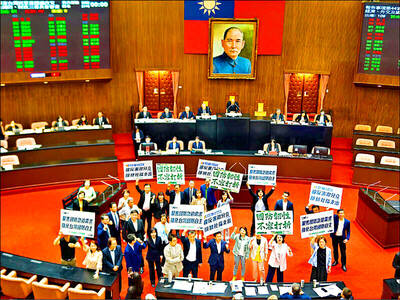
The Chinese Nationalist Party (KMT) and other opposition politicians are “taking Taiwan’s democracy hostage” for selfish gain, The Economist said in a column published online on Tuesday. “Taiwan’s freedoms should be a strength, raising the costs to China of a takeover. Shamefully, they are being betrayed from within,” the British news magazine said. While a lot of countries have toxic politicians, Taiwan’s stand out as particularly irresponsible, and “the blame is not evenly distributed,” it said. Although President William Lai (賴清德) is stubborn and, unlike his predecessor, does not consult KMT moderates, the opposition has triggered a “rolling constitutional crisis,”


 RSS
RSS