

President William Lai (賴清德) made a late-night dash in the back of an armored personnel carrier to a command center as part of the Han Kuang Exercises, which entered their second day yesterday.
Taiwan began the 10 days of drills on Wednesday, which are made up of exercises designed to bolster preparations should China ever attempt to take Taiwan by force.
Yesterday’s drills featured exercises across Taiwan, with the north focusing on coastal defenses, central Taiwan trialing logistics procedures, military units in the south conducting a road barrier deployment drill and armed troops in Taitung County heading to outlying islands for tactical training.
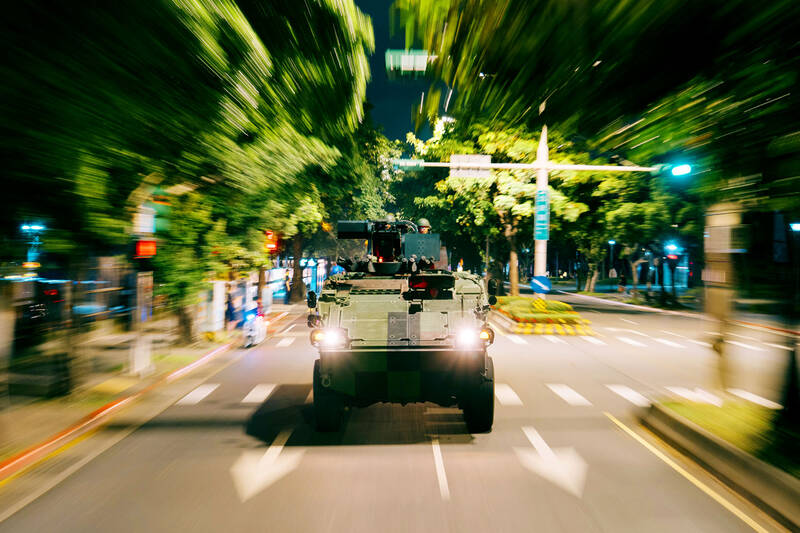
Photo courtesy of the Presidential Office
The Presidential Office said that Lai and other senior officials had been taken the previous night to a command center, and showed images of him wearing body armor and a helmet getting into the back of an armored vehicle.
The officials “conducted drills on commanding defensive operations and maintaining the continued functioning of government during emergency situations,” office spokeswoman Karen Kuo (郭雅慧) said in a statement.
The drills were intended to review the command structure, interagency coordination and emergency-response mechanisms, ensuring that the government can continue operating effectively in the face of “unforeseen circumstances,” Kuo said.
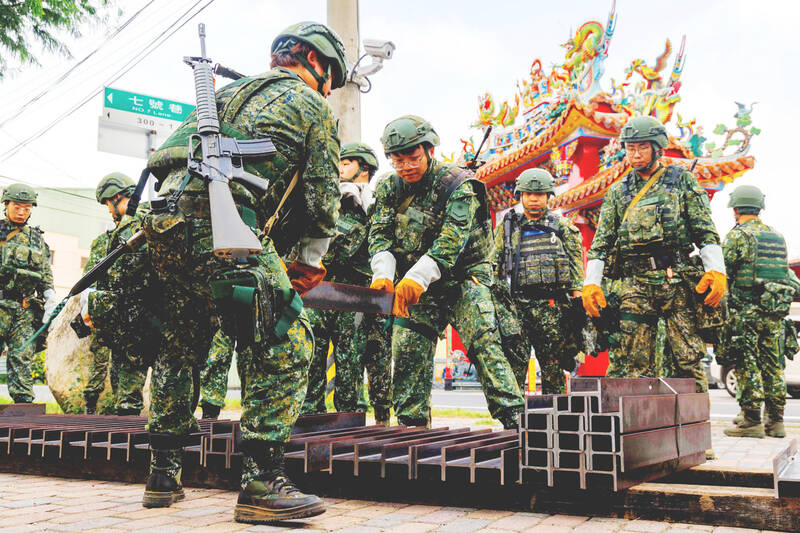
Photo: Cheng Yu-chen, AFP
It was the first time that Lai, who took office in 2024, has taken part as president in the Wan Chun plan to evacuate Taiwan’s leader to a safe place during war or other crisis.
Troops and equipment have fanned out across Taiwan in the Han Kuang drills, which are also testing new systems and tactics.
Lai yesterday boarded a Coast Guard Administration (CGA) vessel docked at Taipei Port in New Taipei City’s Bali District (八里) to observe coastal defense operations.
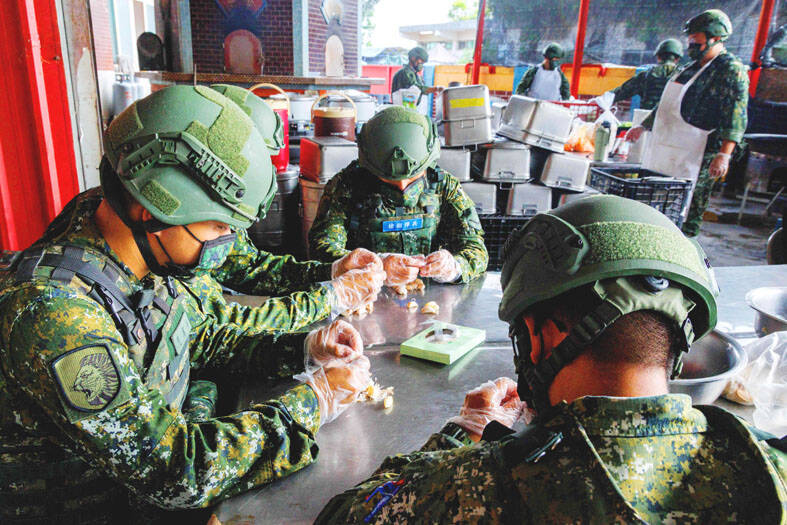
Photo: Cheng Yu-chen, AFP
He watched missile launchers being fitted on one of the CGA’s Anping-class catamarans that has space for the weapons, which are normally carried by the navy’s Tuo Chiang-class fast-attack warships.
He later visited a loading area at the port to learn about mine deployment operations and defensive measures carried out by the army’s 53rd Engineer Group.
Other drills in northern Taiwan included the deployment of Patriot and Tien Kung (天弓, Sky Bow) missile launcher units to tactical positions at riverside parks in Taipei and New Taipei City.
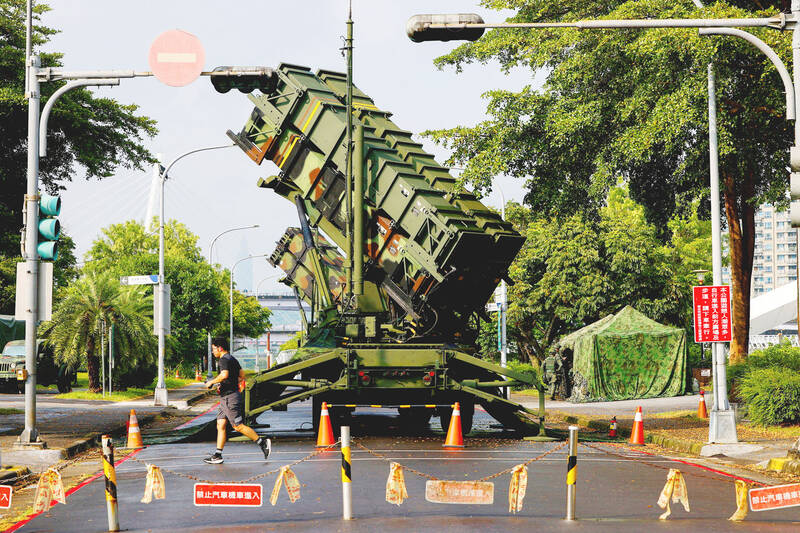
Photo: Ann Wang, Reuters
To prevent sensitive operating systems from being photographed, troops covered the launcher vehicles’ control panels with camouflage netting, while armed personnel guarded the areas.
Su Tzu-yun (蘇紫雲), a researcher at the government-funded Institute for National Defense and Security Research, said the primary purpose of deploying mobile air defense missile systems is to preserve combat effectiveness.
Open spaces such as parks in Taipei are preferred, as they minimize disruption to civilian facilities, Su said.
The missile systems are designed to operate with their launch and command units separated by several dozen kilometers, which improves their ability to survive an attack, he said, adding that they form part of Taiwan’s layered air defense network.
In Changhua County, troops conducted wartime readiness training, including drone reconnaissance drills, while testing military-civilian coordination and logistics procedures by having road barrier materials delivered by civilian vehicles.
Reservists practiced drone operations, close-quarters combat and setting up simulated machine-gun and artillery positions.
Military units in southern Taiwan conducted a road barrier deployment drill at Kaohsiung International Airport, with engineers setting up obstacles to simulate the defense of key transportation hubs. More than 30 reservists also took part.
More than 100 armed troops at Taitung’s Fugang Fishing Port (富岡漁港) boarded passenger vessels under cover, and loaded weapons and supplies before heading to Green Island (綠島) and Lanyu (Orchid Island, 蘭嶼) for tactical training.
The drills in eastern Taiwan included establishing defensive positions and conducting drone reconnaissance exercises.
The drills were intended to test the ability to reinforce outlying islands, the military said, adding that personnel carried out the loading, transport and control of weapons and supplies swiftly.
The exercise was based on a scenario in which Chinese People’s Liberation Army forces attempt to seize the two islands as forward bases for an attack on Taiwan proper, using them as locations for helicopter and drone operations, a source familiar with the matter said.
The military practiced rapidly reinforcing the islands to prevent their capture.
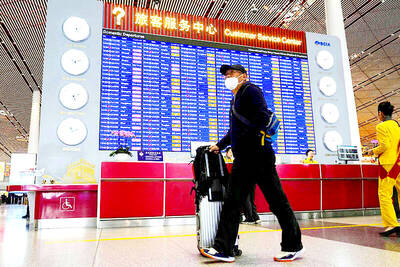
Taiwanese travelers could face exit restrictions as China expands government control under new regulations, an analyst said yesterday. China’s State Council has released new exit and entry regulations that expand the authorities’ power to restrict travel. Hung Pu-chao (洪浦釗), deputy head of Tunghai University’s Center for Mainland China and Regional Development Research, said the new regulations focus on managing cross-border activities as a whole, bringing the movement of talent, technology, information and social networks under the scope of national security oversight. The 19-part rules, which take effect on Sept. 15, were issued by Beijing for “regulating exit and entry management, protecting legitimate
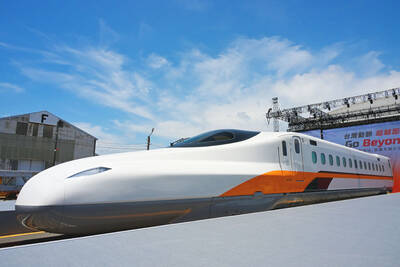
MORE WORK AHEAD: Trains must be assembled when they arrive, and undergo static and dynamic testing, while operation-critical systems must be established, an official said Taiwan High Speed Rail Corp (THSRC) yesterday said it would implement its largest timetable overhaul in 20 years, including the introduction of “super express” trains linking northern and southern Taiwan without intermediate stops. The new timetable is scheduled to be announced in the fourth quarter of this year and could be implemented as early as the beginning of next year, it said. The last major timetable revision was in 2015, when stops in Miaoli, Changhua and Yunlin counties were added to select services. All 12 new N700ST trainsets are scheduled to enter service by September 2028, expanding the fleet to 46 from

Japan’s Defense White Paper released yesterday highlighted Taiwan Strait security as a major concern, saying China has expanded military activities around Taiwan, used repeated drills to normalize the presence of the Chinese People’s Liberation Army (PLA), and strengthened blockade, precision strike, and joint operation capabilities. Chinese military aircraft entering Taiwan’s surrounding airspace surpassed 3,700 sorties last year, a sharp increase from about 970 in 2021, the paper said, adding that Chinese naval activity around Taiwan also rose to about 2,600 sorties. Since 2022, Beijing has repeatedly conducted large-scale military drills around Taiwan, said the paper, which is titled Security for the Future. The
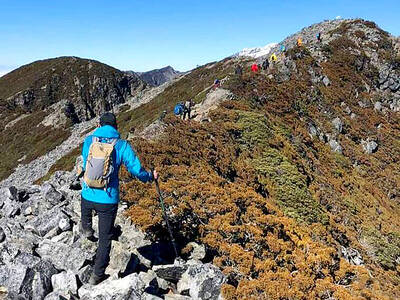
The National Park Service (NPS) is planning to charge visitors to many of the 100 Peaks of Taiwan as early as next year in order to fund environmental conservation and park operations. It has drafted amendments to the National Park Act (國家公園法) to establish a national park fund and charge visitors applying for an entry permit to ecologically protected areas of any of the nine national parks or the Shoushan National Nature Park (壽山國家自然公園). The draft would be sent to the Executive Yuan for review early next year, and could be implemented by the end of next year, sources said. The NPS sought


 RSS
RSS