

The National Park Service (NPS) is planning to charge visitors to many of the 100 Peaks of Taiwan as early as next year in order to fund environmental conservation and park operations.
It has drafted amendments to the National Park Act (國家公園法) to establish a national park fund and charge visitors applying for an entry permit to ecologically protected areas of any of the nine national parks or the Shoushan National Nature Park (壽山國家自然公園).
The draft would be sent to the Executive Yuan for review early next year, and could be implemented by the end of next year, sources said.
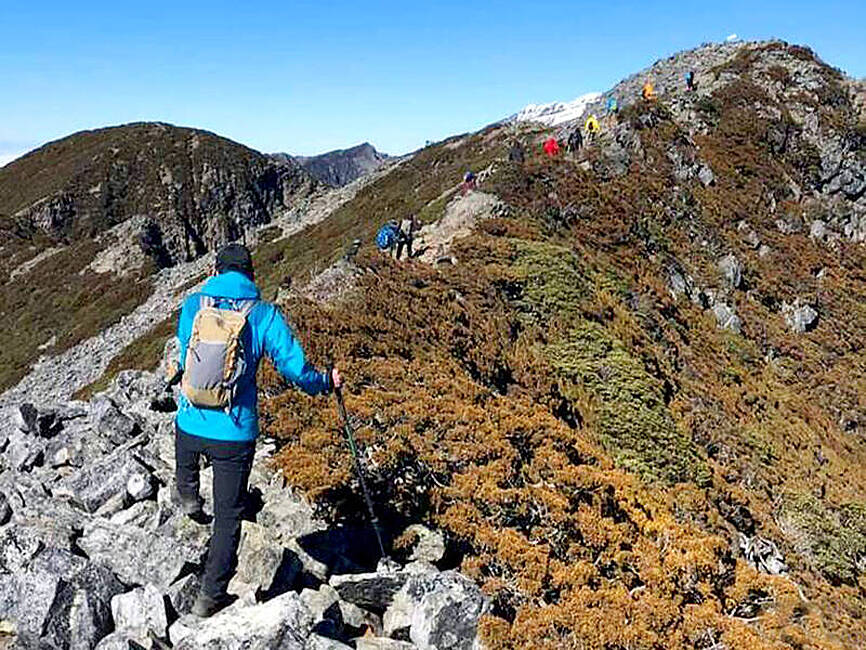
Photo: Wu Liang-yi, Taipei Times
The NPS sought the regulatory change after the Control Yuan last year said the Ministry of the Interior should consider charging entry fees, collecting donations and covering facility maintenance costs, based on the “user pays” principle, they added.
About 200,000 applications have been received to hike in one of the three alpine national parks — Yushan (玉山), Shei-Pa (雪霸) and Taroko (太魯閣).
The draft amendments outline the legal basis and sources of revenue of the national park fund and how it would be spent.
Sources of revenue would include government budgets, interest, conservation fees, operating income, fines or forfeits, donations and climate adaptation grants, according to the bill.
According to the draft amendments, funds would be on environmental conservation and education, recreation services, international exchanges, volunteer incentives, and other allowances or compensation.
Most areas within the three alpine national parks are ecologically protected areas that would charge visitors for entry permits under the pending regulatory change, including 76 of the 100 Peaks of Taiwan, as well as dozens of hiking trails.
Entry permits to such protected areas are currently free and receive hundreds of thousands of applications every year, but there is a limit on the daily number of visitors allowed into these areas given the limited environmental carrying capacity.
Kenting National Park’s (墾丁國家公園) Longkeng (龍坑) and Nanrenshan (南仁山) and the Yangmingshan National Park’s (陽明山國家公園) Lujiaokeng (鹿角坑) and Huangzuishan (磺嘴山) are ecologically protected areas with many visitors.
At present, only a few facilities of national parks, such as parking lots, the Yangming Shuwu (陽明書屋) building, the Oluanpi Park (鵝鑾鼻公園) and the Guangao Lodge (觀高山屋), have fees that flow to the national treasury.
Mountain cabins built down the line would also charge fees, such as the one on the Qilai (奇萊) ridgeline within the Taroko National Park, expected to enter service this year.
The fees would go to the national park fund if the bill is passed, sources said, adding that the draft stiffens fines and penalties for certain crimes at national parks.
For example, burning trees or vegetation would be punishable by imprisonment for up to a year, short-term detention, or a fine of up to NT$1 million.
The penalty could be increased by 50 percent if the fire results in a disaster, it added.
NPS Deputy Director Chang Wei-chuan (張維銓) said the service has completed the draft but has yet to officially discuss the fee amounts, how to charge them and whether the rates should vary by region.
The draft bill was formulated on advice from administrative agencies, civic groups, academics and experts, he said.
It would be sent to the ministry for review in October and then sent to the Executive Yuan and the Legislative Yuan for review, he added.
National Pingtung University of Science and Technology forestry assistant professor Wu Hsing-ju (吳幸如) said it is not unusual for national parks to charge an entry fee, which Taiwan could have done earlier, in line with international practices.
Visitors to Taiwan’s national parks are not charged entry fees, but are known to damage the environment or leave trash behind, she said.
Some guests set out on hikes insufficiently prepared, increasing risk and rescue difficulty, Wu said, adding that she agrees with the “user pays” principle.
However, national park authorities should clarify how the collected fees would be used, she said.
It could be used to enhance the safety of guests or wildlife conservation, which would be more acceptable to the public, Wu said.
For example, inappropriate wildlife feeding or kitchen waste disposal has caused conflicts between tourists and wildlife, she said, adding that collected fees could be used to fund research regarding such issues.
The fees could be used to purchase bear or macaque resistant trash cans or train personnel for environmental education, she added.
Providence University tourism associate professor Huang Cheng-tsung (黃正聰) said he supports the “user pays” principle.
He said the rates could be varied for different regions based on the annual number of visitors.
For example, authorities could charge a tourist conservation fee for tourist locations, designated scenic areas and natural and cultural ecology scenic areas, in accordance with the Act for the Development of Tourism (發展觀光條例), Huang said.
Ranging from NT$30 to NT$200, tourist conservation fees were determined based on annual tourist arrivals, he said, adding that the measure could apply to national parks’ entry fees.
Environmental wear and tear would worsen with increased visitors and would require enhanced conservation efforts, Huang said.
Collected fees would flow to “the big reserve” if they are not earmarked for specific purposes, he said, expressing support for the bill.

Taiwan has suspended visa processing for Moroccans in response to Morocco halting visa applications for Taiwanese travelers worldwide, the Ministry of Foreign Affairs said yesterday. The Moroccan embassy in Japan on Thursday last week informed Taiwanese travel agencies that it would suspend its visa confirmation letter application service for Taiwanese seeking to travel to Morocco, the ministry said in a statement. Taiwanese are required to obtain the letter before traveling to Morocco, the Bureau of Consular Affairs Web site says. Applications are submitted through the Moroccan embassy in Japan, which forwards them to Morocco for review. Once approved, the authorization

MORE WORK AHEAD: Trains must be assembled when they arrive, and undergo static and dynamic testing, while operation-critical systems must be established, an official said Taiwan High Speed Rail Corp (THSRC) yesterday said it would implement its largest timetable overhaul in 20 years, including the introduction of “super express” trains linking northern and southern Taiwan without intermediate stops. The new timetable is scheduled to be announced in the fourth quarter of this year and could be implemented as early as the beginning of next year, it said. The last major timetable revision was in 2015, when stops in Miaoli, Changhua and Yunlin counties were added to select services. All 12 new N700ST trainsets are scheduled to enter service by September 2028, expanding the fleet to 46 from

SIDE-BY-SIDE: The US appreciates Taiwan’s partnership in maritime security and safety, and supports its strong contributions to global maritime law enforcement, the AIT said The American Institute in Taiwan (AIT) yesterday for the first time shared a photograph of Taiwanese and US coast guard vessels operating side-by-side, saying that the two sides conducted joint operations ranging from search-and-rescue to maritime law enforcement. The Coast Guard Administration (CGA) and the US Coast Guard are “coordinating shared objectives such as search and rescue, preparing for tropical storms, disaster relief, preserving maritime resources, countering illegal fishing, and interdicting illegal drug shipments at sea,” the AIT said on Facebook. “The US appreciates Taiwan’s partnership in maritime security and safety, and supports Taiwan’s meaningful contributions on global issues including maritime law

The Ministry of Foreign Affairs (MOFA) yesterday said it has temporarily suspended spot market purchases of liquefied natural gas (LNG) from Papua New Guinea (PNG) after the country’s foreign minister earlier this month unilaterally announced that Taiwan’s representative office there would be closed. PNG Minister of Foreign Affairs Justin Tkatchenko on July 16 said that his government had decided to close Taiwan’s representative office in Port Moresby. The cessation of operations and the formal closure of the physical presence of Taiwan’s representative office was an “administrative action” to “reaffirm Papua New Guinea’s one China policy,” a statement posted on Tkatchenko’s Facebook page


 RSS
RSS