


Members of the US House of Representatives on Wednesday pledged firm support for Taiwan as they welcomed Legislative Speaker Han Kuo-yu (韓國瑜) to Washington, at a time when the administration of US President Donald Trump is reviewing a US$14 billion arms sales package to Taiwan, months after it received preliminary congressional approval.
More than 30 House representatives streamed into the reception at the Longworth House Office Building to show their support, including US representatives Nancy Pelosi, Michael McCaul and Ted Lieu.
“I love Taiwan,” McCaul said as he welcomed Han. “It’s very important to me to say that the United States supports you, Mr Speaker.”
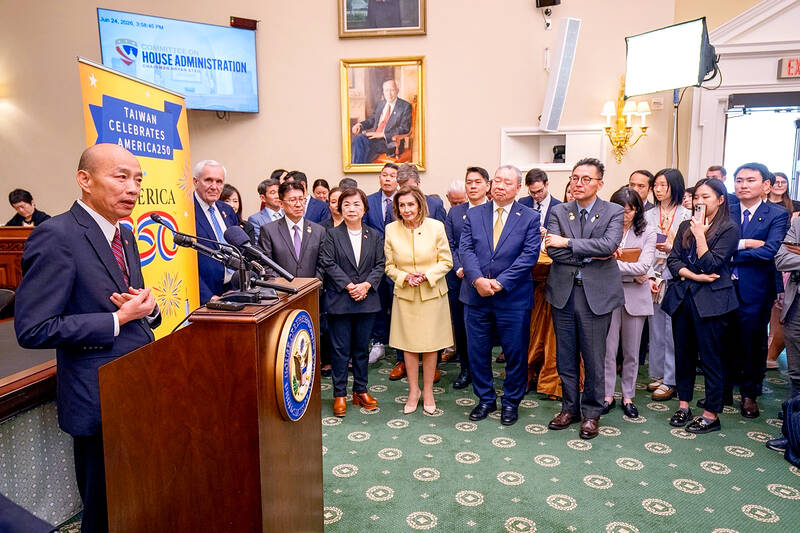
Photo courtesy of Taiwan People’s Party Legislator Hung Yu-shiang
“The support for Taiwan is bipartisan and bicameral — both houses, both parties,” Pelosi said. “It’s about peace. It’s also about commerce in terms of keeping the ships able to travel here.”
Han, who is leading an eight-person delegation, arrived in the nation’s capital on Tuesday night after a stop in Phoenix, Arizona, where chipmaker Taiwan Semiconductor Manufacturing Co (TSMC, 台積電) is building new fabs and producing advanced chips crucial to powering the artificial intelligence boom.
TSMC is the poster child of Taiwan’s importance to the US economy.
The delegation met with seven US senators earlier on Wednesday, including US Senator Jeanne Shaheen, the top Democrat on the Senate Foreign Relations Committee.
The Democratic senators called on the Trump administration to move ahead with the arms sale to Taiwan without further delay.
“We remain committed to maintaining close and friendly relations with Taiwan, providing Taiwan with arms for self-defense and supporting deterrence against growing coercion from the People’s Republic of China,” they said in a statement.
Washington is obligated by a domestic law to provide Taiwan with sufficient hardware to fend off any invasion from China.
Trump, after his May trip to Beijing, has said he would be reviewing the arms package, which Beijing opposes.
Trump has suggested that the package could be a bargaining chip.
US Secretary of State Marco Rubio has said that US policy regarding Taiwan remains unchanged.
On Wednesday, several US lawmakers showed their support for the arms package.
“I’m here today ... to affirm in the strongest terms that Taiwan is not a bargaining chip. It is an island of freedom. And we need to do all we can to preserve it,” US Representative Lloyd Doggett said. “I believe we need to make available every weapon that Taiwan needs in its defense as quickly as it becomes possible.”
Lieu accused the Trump administration of holding up the package.
“I urge the administration to reverse that and to allow their arms sale to proceed,” he said.
Han, a member of the Chinese Nationalist Party (KMT), in a speech complimented the US for its achievements in the past 250 years and said that Taiwan, like the US, cherishes the values of freedom and democracy, and that both sides shoulder the responsibilities of safeguarding the democratic system, and of maintaining regional stability and peace.
Han touted the robust trade between Taiwan and the US.
Taiwan has surpassed Germany as the fourth-largest trading partner of the US, largely driven by the demand for Taiwan’s advanced chips and other tech hardware.
Han also urged Washington to help Taiwan gain more international space.
“On the international stage, Taiwan feels very lonely in its heart,” Han said. “I am here asking Taiwan’s good friends in [the US] Congress ... to help us participate in global activities.”
Han is scheduled to leave the US today for the inaugural nonstop flight by EVA Air (長榮航空) between Washington Dulles International Airport and Taiwan Taoyuan International Airport, which has also been touted as proof of deepening Taiwan-US ties.
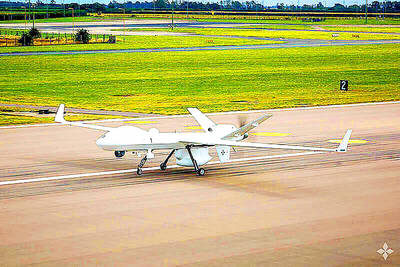
BOOST: By operating the same advanced systems as the US military, Taiwan would be better positioned to share and integrate intelligence with partners, an expert said The first batch of MQ-9B SkyGuardian drones has arrived in Taiwan, and is being assembled and tested by drone manufacturer General Atomics and the military ahead of flight trials as part of the air force’s acquisition to bolster its aerial surveillance capabilities, a source said yesterday. The air force allocated a budget of NT$21.7 billion (US$687 million) from 2022 to 2029 to procure four MQ-9B uncrewed aerial vehicles (UAVs) manufactured by General Atomics along with associated equipment such as ground control stations. The US has agreed to deliver the four MQ-9Bs to Taiwan in two batches this year and next
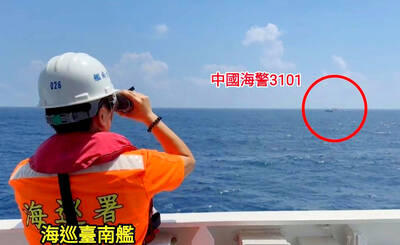
‘BRAZEN’: The holiday did not stop China from activities that infringe on Taiwan’s maritime jurisdiction, but the CGA is ready to defend the nation, Kuan Bi-ling said Beijing is intensifying maritime pressure on Taiwan, but the nation will never yield, Ocean Affairs Council Deputy Minister Sung Chen-en (宋承恩) said. The Coast Guard Administration (CGA) has adopted a “shadowing and monitoring” approach to avoid falling into a Chinese trap to escalate tensions and deepen the conflict, Sung said in an interview published yesterday in the Chinese-language Liberty Times (the Taipei Times’ sister newspaper). China Coast Guard formations patrolling waters east of Taiwan, as well as official Chinese vessels entering areas around Itu Aba Island (Taiping Island, 太平島) and Pratas Islands (Dongsha Islands, 東沙群島) show Beijing’s attempts to significantly step up
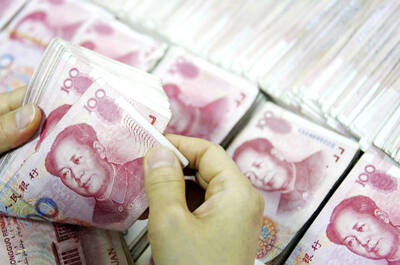
Taiwanese firms’ China investments have dwindled to less than 1 percent of their total foreign investments, putting China-based investments on track for a record low this year, Ministry of Economic Affairs data showed. Taiwan’s investments abroad in the first five months of this year reached US$35.92 billion, Department of Investment Review data showed. Investments outside China totaled US$35.61 billion, up 133.94 percent year-on-year, while investments in China totaled US$310.3 million, down 32.3 percent and about 0.86 percent of the total, data showed. Major overseas projects included Taiwan Semiconductor Manufacturing Co’s (TSMC, 台積電) US$30 billion capital injection into an overseas subsidiary,
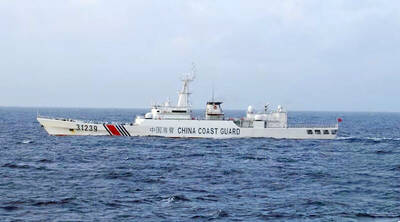
GLOBAL CONCERN: The UK, German and French offices reiterated their opposition to unilateral changes to the Taiwan Strait ‘status quo,’ particularly by threat or force The UK, Germany and France’s de facto embassies in Taiwan, as well as the US’ office, yesterday expressed concern over China’s “special maritime law enforcement operations” in waters east of Taiwan, saying that such behavior threatens regional stability. In a joint statement issued by the British Office Taipei, the German Institute Taipei and the French Office in Taipei, the three offices, which represent their respective countries’ interests in Taiwan in the absence of official diplomatic ties, said that they had “noted with concern novel Chinese activity in the waters east of Taiwan.” “These actions threaten regional stability, and the freedom of navigation


 RSS
RSS