


“We will not let the Communist Party of China [CCP] define who we are,” Vice President Hsiao Bi-khim (蕭美琴) said in an interview posted yesterday on American Thought Leaders for the Epoch Times.
Amid China’s increasingly aggressive cognitive, psychological, political and legal warfare, “everything we’re doing today in strengthening Taiwan is to prevent an invasion,” Hsiao told interviewer Jan Jekielek.
Taiwan remains in a defensive position against China’s cognitive warfare, and maintaining that peace must be sustained through strength, she said.
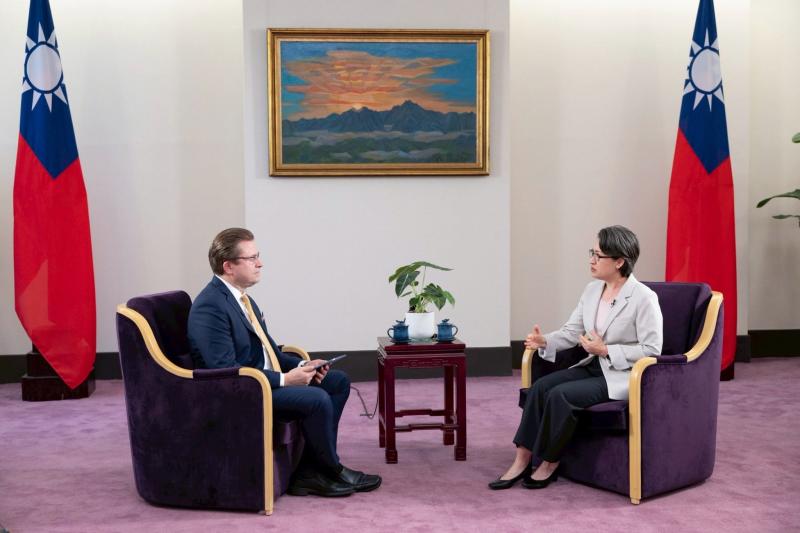
Photo: Screen grab from Vice President Hsiao Bi-khim’s Facebook page
Hsiao also referenced Taiwan’s “cat warrior diplomacy,” which promotes an agile, soft-power approach in contrast to Beijing’s “wolf warrior” tactics.
“Democracy delivers. It’s not just an ideal,” she said.
Beijing has labeled Hsiao a pro-Taiwanese independence figure and sanctioned her.
“They’ve called me a separatist, but they’ve accused me of cooperating with the Americans, that’s another source of their anger tantrum,” she said.
Hsiao said she “takes it in stride” as she has no personal business in China.
“It will not stop us from doing what we need to do to protect our country, to defend Taiwan, to defend our values, but also to work with other partners internationally,” she said.
Taiwan-US relations are “one of the most consequential partnerships in the world,” Hsiao said, adding that by acting as force multipliers for each other in diplomacy, the two sides can continue to make advances in economic and security partnerships.
“Many of us see Taiwan and Silicon Valley or the US tech community as one single big ecosystem,” she said.
Hsiao said she hopes the administration of US President Donald Trump will provide additional policy tools to support Taiwan, such as legislation that would avoid double taxation.
“We appreciate that there’s been a framework that we call economic prosperity partnership dialogue that started in the first Trump administration and has carried on to today,” she added.
Many nations worldwide remain economically entangled with Beijing and should consider that while China saw tremendous economic growth from the end of the Cold War, “we have not seen the kind of political openness or progress that many had expected, and instead we’ve seen, in some areas, the reverse,” she said.
Looking ahead to 2040, Hsiao said that “the people of Taiwan strive to be a great country when it comes to contributing to technology progress, when it comes to contributing to humanity, when it comes to contributing to a more peaceful and stable region.”
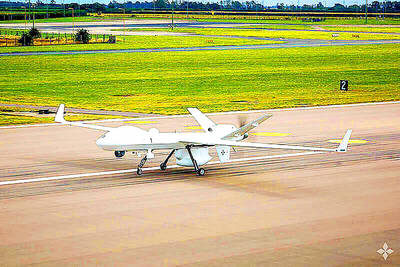
BOOST: By operating the same advanced systems as the US military, Taiwan would be better positioned to share and integrate intelligence with partners, an expert said The first batch of MQ-9B SkyGuardian drones has arrived in Taiwan, and is being assembled and tested by drone manufacturer General Atomics and the military ahead of flight trials as part of the air force’s acquisition to bolster its aerial surveillance capabilities, a source said yesterday. The air force allocated a budget of NT$21.7 billion (US$687 million) from 2022 to 2029 to procure four MQ-9B uncrewed aerial vehicles (UAVs) manufactured by General Atomics along with associated equipment such as ground control stations. The US has agreed to deliver the four MQ-9Bs to Taiwan in two batches this year and next
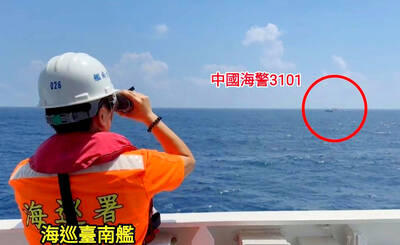
‘BRAZEN’: The holiday did not stop China from activities that infringe on Taiwan’s maritime jurisdiction, but the CGA is ready to defend the nation, Kuan Bi-ling said Beijing is intensifying maritime pressure on Taiwan, but the nation will never yield, Ocean Affairs Council Deputy Minister Sung Chen-en (宋承恩) said. The Coast Guard Administration (CGA) has adopted a “shadowing and monitoring” approach to avoid falling into a Chinese trap to escalate tensions and deepen the conflict, Sung said in an interview published yesterday in the Chinese-language Liberty Times (the Taipei Times’ sister newspaper). China Coast Guard formations patrolling waters east of Taiwan, as well as official Chinese vessels entering areas around Itu Aba Island (Taiping Island, 太平島) and Pratas Islands (Dongsha Islands, 東沙群島) show Beijing’s attempts to significantly step up
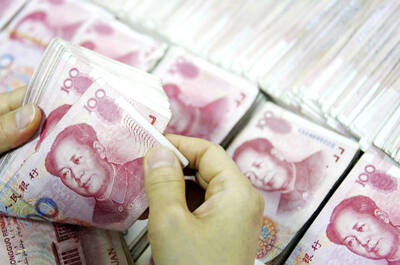
Taiwanese firms’ China investments have dwindled to less than 1 percent of their total foreign investments, putting China-based investments on track for a record low this year, Ministry of Economic Affairs data showed. Taiwan’s investments abroad in the first five months of this year reached US$35.92 billion, Department of Investment Review data showed. Investments outside China totaled US$35.61 billion, up 133.94 percent year-on-year, while investments in China totaled US$310.3 million, down 32.3 percent and about 0.86 percent of the total, data showed. Major overseas projects included Taiwan Semiconductor Manufacturing Co’s (TSMC, 台積電) US$30 billion capital injection into an overseas subsidiary,
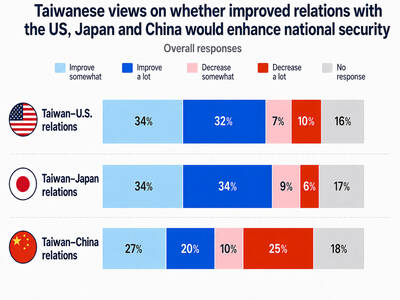
VARYING OPINIONS: People with different political affiliations have different views on how bilateral ties with the US, Japan and China would affect Taiwan’s security Two-thirds of Taiwanese view closer US and Japan ties as beneficial to security, a survey by Taiwan’s top military think tank showed. To gauge the Taiwanese public’s perceptions of how different external relationships affect security, the Institute for National Defense and Security Research commissioned a survey by National Chengchi University’s Election Study Center asking respondents whether closer relations with the US, Japan and China would strengthen or weaken Taiwan’s national security. The results, published on Thursday in a report by institute researcher Lee Kuan-chen (李冠成), found that about 66 percent of respondents believe improved Taiwan-US relations would strengthen national security,


 RSS
RSS