


Taiwan is set to see a surge in arms deliveries in the second half of this year as up to eight major weapons systems are expected to be delivered or commissioned.
Officials call it the most significant recent “harvest year” for the military’s upgrade programs.
US and Taiwanese manufacturers have resolved issues that caused delays in the delivery schedule of many arms sales and the indigenous defense submarine program, the latest Ministry of National Defense force structure plan said.
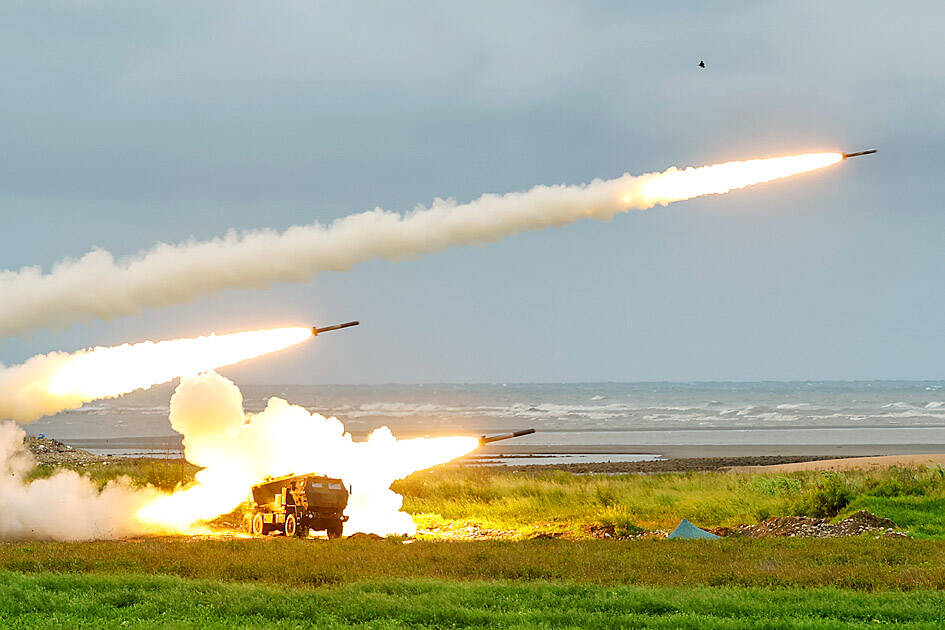
Photo: Ritchie B. Tongo, EPA
The armed forces are expected to receive the largest hardware infusion over the past few years, it said.
The new equipment should be a major boon for the armed forces, with drastic capability enhancement in areas such as deep strikes, counter-amphibious assault and submarine warfare, the document said.
Some of the long-awaited weapon platforms would begin their journey to Taiwan, while others would be delivered between next month and December, the document said.
F-16V jets, complete with trained crews and conformal fuel tanks, would be delivered in batches over the coming months, it said.
Taiwan’s first indigenously developed submarine, the Hai Kun (Narwhal, 海鯤), should conduct its final deep-sea diving tests between next month and September before being delivered to the navy for commissioning, the document said.
The full order of 14 M136 Volcano Vehicle-Launched Scatterable Mine Systems should be shipped from the US to Taiwan soon, not in separate groups as originally planned, it said.
The US reported a major breakthrough in the production of Stinger air defense missiles and plans to deliver 500 of the weapons the end of the year, the document said.
The first MQ-9B high-altitude drones and their ground control equipment would be shipped between next month and September, it said.
The force structure plan said 18 High Mobility Artillery Rocket Systems and a large number of Harpoon Coastal Defense Systems would arrive soon, following the earlier delivery of support equipment.
MS-110 Multispectral Airborne Reconnaissance Systems, a surveillance and targeting pod slated for the air force’s F-16 jets, would be delivered through the end of the year, it said.
The army is integrating the M136 Volcano minelaying system and M1A2T Abrams main battle tanks into its forces and doctrine, the document said.
The ministry plans to organize the M136 Volcano minelaying systems in “mobile interdiction teams” established under combined-arms and infantry brigades of army regional commands, it said.
The M1A2T Abrams, which the US delivered in full earlier this year, are being plugged into combined-arms brigades and conducting live-fire drills, the document said.
In related developments, the armed forces issued a request for proposal for a multi-caliber sniper rifle to augment T112 sniper rifles already in service.
The system should feature a quick-change barrel capable of chambering 7.62x51mm NATO, .300 Norma Magnum, and .338 Norma Magnum rounds, the request said.
When firing the 7.62x51mm, .300 Norma Magnum and .338 Norma Magnum rounds, the weapon system should have an effective range of at least 800m, 1,200m and 1,500m respectively, it said.
The rifle should be a bolt-action weapon with a 10 round magazine capacity when chambered for 7.62mm, the document said.
The military’s recently acquired T-112 is chambered for .50 BMG with anti-materiel capability ranging out to 2,000m, weighing 12.5kg and with a 5-round magazine capacity.
They are primarily issued to the Marine Corps’ Amphibious Reconnaissance Battalion, the army’s Airborne Special Service Company and the Military Police Special Service Company.

National Taiwan University (NTU) yesterday said it disqualified a person from an entrance examination for using AI smart glasses to cheat, along with two others for making untruthful statements in their curriculum vitae. The three applicants were given null scores, Taiwan’s highest-ranked university said, calling on prospective students to be honest in the admissions process. NTU registrar Lee Hung-sen (李宏森) said that the cheating applicant wore a hat and thick-rimmed glasses to the second written exam for medical school, claiming that they felt cold. Suspicions were aroused when the applicant stared oddly at the test for long stretches while steadily bringing the paper
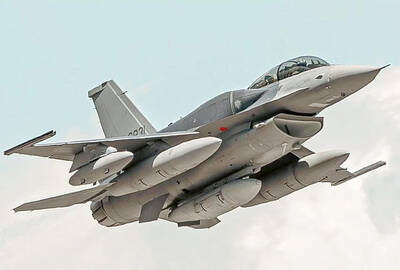
66 FIGHTER JETS: The aircraft is likely undergoing preparations for its transfer to Taiwan — a significant step forward in the nation’s modernization program, a lawmaker said The first of Taiwan’s order of F-16V Block 70 aircraft has been sighted in Texas ahead of delivery, Democratic Progressive Party (DPP) Legislator Wang Ting-yu (王定宇) said. Taiwan’s first F-16V Block 70 two-seat aircraft, tail number 6831, was seen flying from Lockheed Martin’s production facility in Greenville, South Carolina, to Naval Air Station Joint Reserve Base Fort Worth in Texas, Wang wrote on Facebook yesterday. The plane is likely undergoing preparations for its transfer to Taiwan, marking a significant step forward in the Republic of China Air Force’s modernization program, Wang said, citing military analysts. The F-16V Block 70 is a new-build version
NOT JUST NUMBERS: What matters to intelligence work is crucial, reliable information, so even a few credible leads can be highly valuable to national security, a legislator said The National Security Bureau (NSB) yesterday said it has finished the establishment of an information-reporting channel for Chinese nationals, the aim of which is to broaden intelligence gathering on China’s political, military, economic and social developments. Chinese nationals can submit information on the Web page, https://report.nsb.gov.tw, the NSB said in a statement. The move aims to expand the bureau’s diverse intelligence sources and is pursuant to the National Intelligence Services Act (國家情報工作法), it said, adding that it referenced practices adopted by intelligence agencies in the US, the UK and Israel. An increasing number of people are approaching Taiwanese agencies to provide information, as
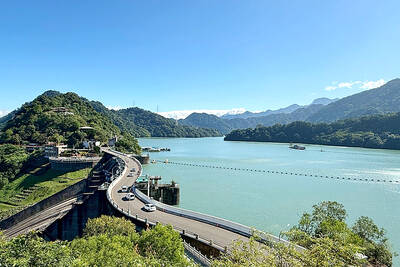
The “pearl chain” water project is nearing completion, President William Lai (賴清德) and Premier Cho Jung-tai (卓榮泰) said yesterday, adding that the initiative linking reservoirs would help secure water supplies for agriculture and semiconductor development. The “pearl chain” project, spearheaded by the Water Resources Agency, aims to create a network across Taiwan, facilitating water transfers between areas, optimizing water use and reinforcing regional resource management. The initiative is nearing completion and would link Taiwan’s reservoirs and dams into an integrated network, Lai said during the groundbreaking ceremony of the nation’s first semiconductor supply chain zone at the Pingtung section of the Southern


 RSS
RSS