


The Presidential Office yesterday expressed its gratitude to the leaders of the G7 for issuing a joint statement reiterating their opposition to attempts to unilaterally and forcibly change the “status quo” in the Taiwan Strait.
“We highlight the importance of a free and open Indo-Pacific based on the rule of law,” said the G7 statement released on the same day.
“We reaffirm our opposition to any unilateral attempts to change the status quo, in particular by force or coercion, in the East and South China seas and across the Taiwan Strait, which should only be resolved peacefully through dialogue,” it said.
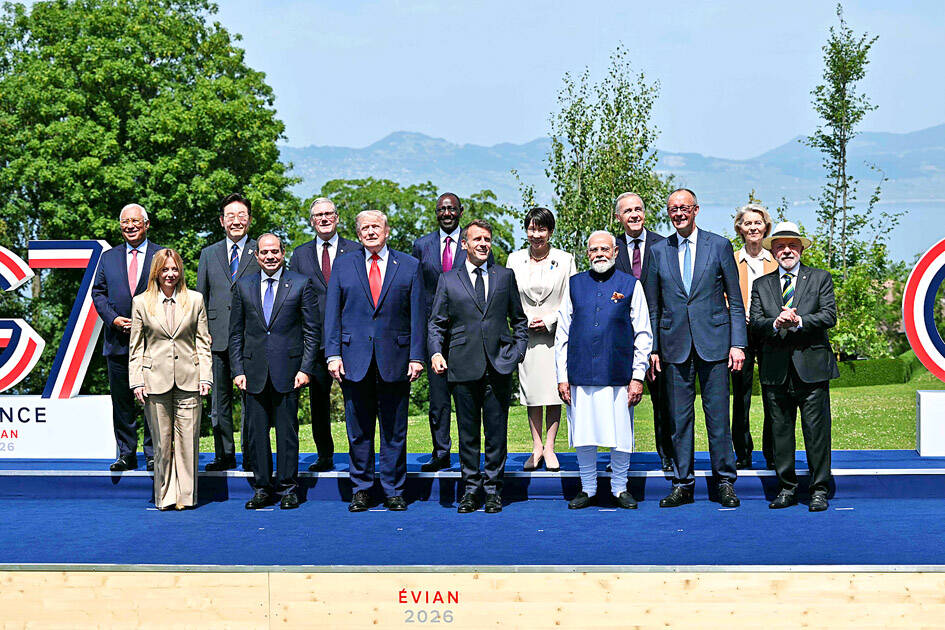
Photo: AFP
That marked the sixth consecutive year since 2021 that the G7 summit has underscored the importance of peace and stability across the Taiwan Strait. A comparison of past language shows that Taiwan Strait security has increasingly been framed as part of the broader Indo-Pacific security architecture.
The Taiwan Strait issue was first included in a G7 leaders’ summit communique at the 2021 meeting in the UK. The statement at the time emphasized the importance of peace and stability in the Taiwan Strait, and encouraged the peaceful resolution of cross-strait issues, but did not mention China or include language opposing unilateral attempts to change the “status quo.”
At the 2022 G7 summit in Germany, leaders reaffirmed the importance of peace and stability in the Taiwan Strait and, for the first time, added language opposing any unilateral attempts to change the “status quo.”
The 2023 summit in Hiroshima, Japan, marked the most significant step-up in the past few years. In addition to reiterating the importance of peace and stability and calling for the peaceful resolution of cross-strait issues, the G7 explicitly opposed “any unilateral attempts to change the status quo by force or coercion.”
Summits in 2024 and last year largely maintained the same position.
Presidential Office spokeswoman Karen Kuo (郭雅慧) said in a statement that peace in the Taiwan Strait has widespread support in the international community, and is in the core interest of the world.
Taiwan plays a crucial role in the democratic alliance and global supply chains, and will continue to bolster its defense capabilities as a responsible regional partner and member of the international community, in the interest of regional peace and global prosperity, Kuo said.
The G7 Summit was held from Monday to yesterday in Evian-les-Bains, France.

National Taiwan University (NTU) yesterday said it disqualified a person from an entrance examination for using AI smart glasses to cheat, along with two others for making untruthful statements in their curriculum vitae. The three applicants were given null scores, Taiwan’s highest-ranked university said, calling on prospective students to be honest in the admissions process. NTU registrar Lee Hung-sen (李宏森) said that the cheating applicant wore a hat and thick-rimmed glasses to the second written exam for medical school, claiming that they felt cold. Suspicions were aroused when the applicant stared oddly at the test for long stretches while steadily bringing the paper

66 FIGHTER JETS: The aircraft is likely undergoing preparations for its transfer to Taiwan — a significant step forward in the nation’s modernization program, a lawmaker said The first of Taiwan’s order of F-16V Block 70 aircraft has been sighted in Texas ahead of delivery, Democratic Progressive Party (DPP) Legislator Wang Ting-yu (王定宇) said. Taiwan’s first F-16V Block 70 two-seat aircraft, tail number 6831, was seen flying from Lockheed Martin’s production facility in Greenville, South Carolina, to Naval Air Station Joint Reserve Base Fort Worth in Texas, Wang wrote on Facebook yesterday. The plane is likely undergoing preparations for its transfer to Taiwan, marking a significant step forward in the Republic of China Air Force’s modernization program, Wang said, citing military analysts. The F-16V Block 70 is a new-build version
NOT JUST NUMBERS: What matters to intelligence work is crucial, reliable information, so even a few credible leads can be highly valuable to national security, a legislator said The National Security Bureau (NSB) yesterday said it has finished the establishment of an information-reporting channel for Chinese nationals, the aim of which is to broaden intelligence gathering on China’s political, military, economic and social developments. Chinese nationals can submit information on the Web page, https://report.nsb.gov.tw, the NSB said in a statement. The move aims to expand the bureau’s diverse intelligence sources and is pursuant to the National Intelligence Services Act (國家情報工作法), it said, adding that it referenced practices adopted by intelligence agencies in the US, the UK and Israel. An increasing number of people are approaching Taiwanese agencies to provide information, as
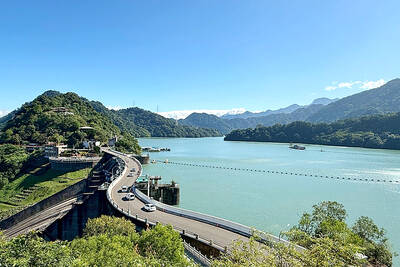
The “pearl chain” water project is nearing completion, President William Lai (賴清德) and Premier Cho Jung-tai (卓榮泰) said yesterday, adding that the initiative linking reservoirs would help secure water supplies for agriculture and semiconductor development. The “pearl chain” project, spearheaded by the Water Resources Agency, aims to create a network across Taiwan, facilitating water transfers between areas, optimizing water use and reinforcing regional resource management. The initiative is nearing completion and would link Taiwan’s reservoirs and dams into an integrated network, Lai said during the groundbreaking ceremony of the nation’s first semiconductor supply chain zone at the Pingtung section of the Southern


 RSS
RSS