


New Solomon Islands Prime Minister Matthew Wale yesterday said he would review a secretive 2022 security pact with Beijing, which rattled Canberra and Washington by opening the door to Chinese forces in the South Pacific.
Asked about that pact alongside Australian Prime Minister Anthony Albanese, the Solomons leader, elected last month, said he had been “praying and fasting” about the Chinese security deal.
“We are going to be reviewing, as we are reviewing other security agreements that we have with many other countries,” he said.
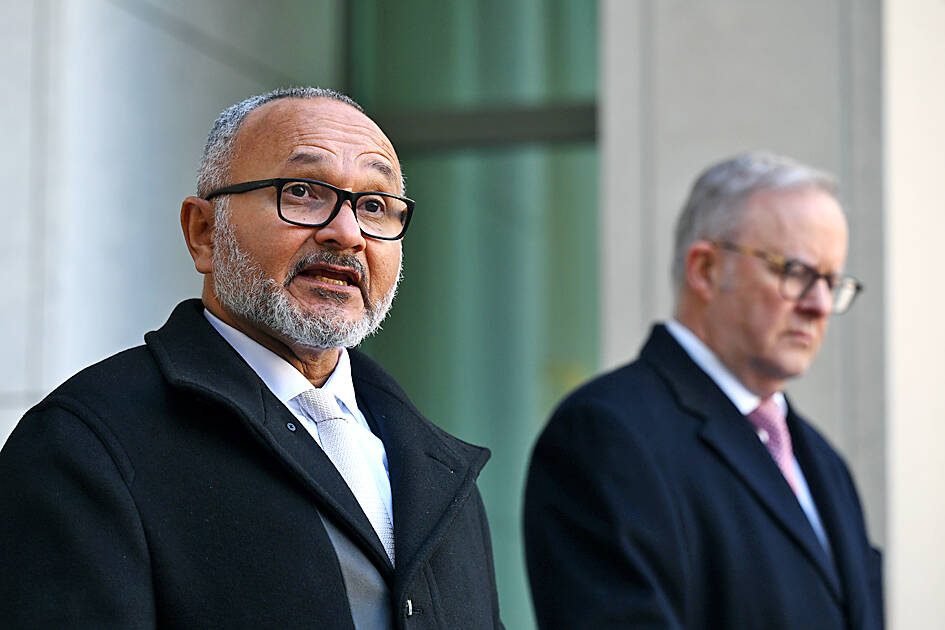
Photo: EPA
Australia and the US have been sharply critical of the 2022 deal over concerns it could allow a permanent Chinese navy presence in the South Pacific.
It was signed under one of Wale’s predecessors, former prime minister Manasseh Sogavare, who was seen as Beijing’s staunchest ally in the South Pacific. Wale said the deal contained a non-disclosure agreement and he had not seen it until just before his visit to Australia.
“I have had to remove certain people from key positions. I have not been afforded a copy, even, of that agreement, until a day before I left, so I have not had a good look at it,” he told a news conference in Canberra.
Australia is the largest aid donor to the country of 800,000 people that sits 2,000km to its north-east, and historically provided police support during crises.
After the Solomons switched diplomatic ties from Taiwan to Beijing in 2019 and struck the security pact, relations with Canberra and Washington deteriorated.
China quickly became the strategically located Pacific island state’s largest bilateral creditor, with Solomon Islands’ debt to Chinese banks for infrastructure projects doubling last year.
Seeking to counter Beijing’s influence, Australia has seized the opportunity to rebuild ties, hosting Wale on his first international visit as leader.
Albanese said the two countries would begin work on a “comprehensive” new treaty as well as deepen ties in policing, with Australia seeking to be the top security partner for the Pacific.
The treaty would be “underpinned by mutual trust, respect, and open dialogue.” the prime minister said.
“We have sought a reset in this relationship — we acknowledge there have been problems over the last few years,” Wale said.
The Pacific should turn to other countries within the region for their security, he said.
The leaders agreed to push ahead with a major police training deal.
Australia’s offer to fund the expansion of the Solomons police force had stalled under the previous Solomon Islands government, which allowed Chinese police to enter villages to collect household and biometric data.
Wale said he was in discussions with Australia and the US for financing for critical infrastructure such as ports.
Sogavare rejected US offers of infrastructure grants, instead opting to partner with Chinese state companies.
Australia has sought to bind South Pacific countries closer by striking treaties with a string of small, but strategically located island states — Tuvalu, Nauru and Papua New Guinea, offering significant economic support in return for curbs on Chinese security ties. Vanuatu and Fiji have said they are close to signing similar deals.

‘NO SECURITY RISK’: The Railway Bureau reassured the public that the technicians’ activities were limited to technical guidance and did not involve sensitive systems The Railway Bureau yesterday said it had invited eight Chinese technicians to assist with an airport MRT construction project. The bureau issued the confirmation after an Internet user said Chinese nationals had entered the construction zone of Taiwan Taoyuan International Airport’s Terminal 3 project. They asked why “individuals from an enemy state” were allowed access to such a major national infrastructure project, which raised serious concerns over Taiwan’s industrial safety, sensitive systems and information security. The bureau’s Northern Region Engineering Branch Office said subcontractor Taiwan Handle Industrial Co (台灣手把工業) of the Taoyuan airport MRT’s “Contract No. CU05 Project A14 Station Civil, MEP &

A US uncrewed surface vessel (USV) encountered multiple Chinese warships during an autonomous transit of the Taiwan Strait, US defense company Seasats said in a statement on Wednesday. Seasats announced that a Lightfish USV had completed the first autonomous transit of the Taiwan Strait. Over five days, the USV traversed the entire length of the Strait while constantly monitoring surface vessel traffic, the company said. The Lightfish encountered multiple Chinese warships, one of which was a Chinese People’s Liberation Army Navy (PLAN) Type 056 corvette, it said. The Chinese vessels were operating “well within Taiwan’s exclusive economic zone without transmitting their identity via the
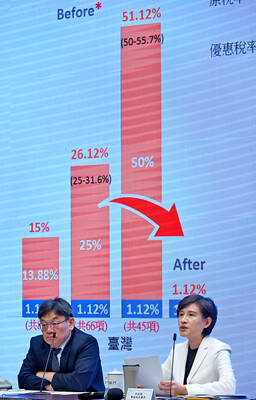
GREATER REACH? Auto parts and wood products would face tariffs of up to 15%, matching those targeting the EU, Japan and South Korea, Vice Premier said The US has announced that preferential tariff treatment for Taiwan’s non-semiconductor Section 232 goods would take effect retroactively from May 1, the Executive Yuan said yesterday. The US government yesterday posted a notice on the Federal Register’s public inspection Web site previewing tariff concessions for Taiwan under a memorandum of understanding (MOU) on Taiwan-US investment after two months of negotiations. The MOU signed on Jan. 15 stipulated three major preferential tariff arrangements: a 15 percent “reciprocal” tariff rate for Taiwan without stacking most-favored nation (MFN) rates; preferential Section 232 treatment for semiconductors and related products; and preferential Section 232 treatment for non-semiconductor
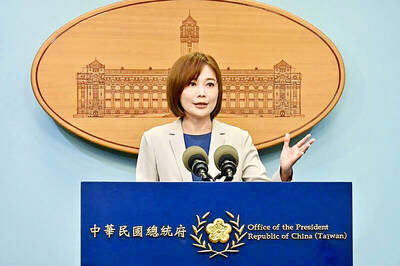
TIT-FOR-TAT: The US allegedly revoked the visa of a Chinese national working at Xinhua News Agency in the US in response to Beijing’s expulsion of Vivian Wang The Presidential Office yesterday condemned China for expelling a New York Times correspondent from Beijing following the newspaper’s interview with President William Lai (賴清德), saying the move highlighted Beijing’s suppression of press freedom and its threat to international news media. Taiwan has noted a series of recent incidents in which Beijing used similar tactics to “threaten and pressure international media outlets and journalists,” Presidential Office spokeswoman Karen Kuo (郭雅慧) said in a statement. “This concerns not only press freedom and freedom of expression, but also the safety of journalists, and Taiwan and relevant partners are paying close attention to the situation,” she


 RSS
RSS