


The Ministry of Environment (MOENV) yesterday said it collected NT$4.97 billion (US$158.1 million) in Taiwan’s first carbon fee collection cycle.
A total of 461 factories operated by 240 companies paid carbon fees, the ministry said, adding that among them, 123 semiconductor manufacturing facilities contributed about NT$2.2 billion, including 33 factories operated by Taiwan Semiconductor Manufacturing Co (, 台積電).
The electricity supply sector contributed NT$635 million through 19 facilities, while 29 steel plants paid NT$400 million and nine concrete plants contributed NT$130 million, it said.
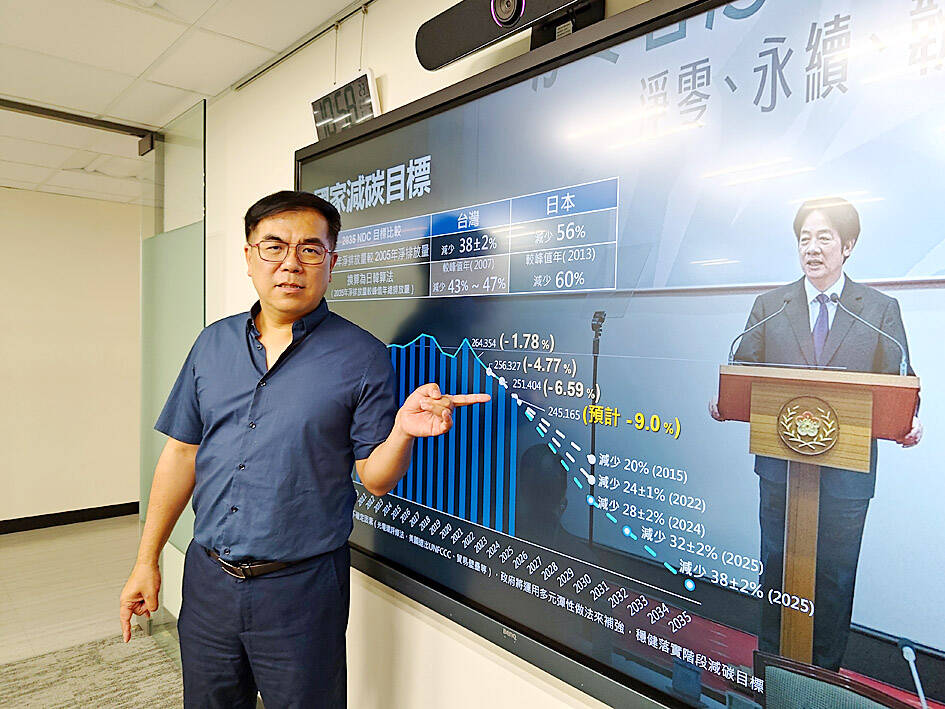
Photo: Wu Po-hsuan, Taipei Times
The ministry had estimated carbon fee revenue would be about NT$4.5 billion, but the final amount was higher because some factories that had applied for preferential rates through voluntary emissions reduction plans withdrew their applications or had been rejected, MOENV Climate Change Administration Director-General Tsai Lin-yi (蔡玲儀) said.
Tsai said that 430 factories had applied for preferential rates of NT$50 or NT$100 per tonne, but 28 either withdrew their applications or were rejected, subjecting them to the standard rate of NT$300 per tonne of carbon emissions.
Most rejections were due to proposed emissions reduction measures failing to meet regulatory standards, while some companies withdrew their plans because economic growth and expanded production capacity made their original reduction targets unattainable, she said.
The fund’s management committee has approved allocating NT$2 billion to subsidize emissions-reduction projects and climate-adaptation research by industries and local governments, and another NT$500 million to provide credit guarantees and interest subsidies for participating industries, she said.
Under the Regulations Governing the Collection of Carbon Fees (碳費收費辦法), companies that emit at least 25,000 tonnes of carbon dioxide annually are required to pay carbon fees based on their total annual emissions.
The regulations took effect on Jan. 1 last year. Emissions generated last year were subject to the first round of carbon fee calculations, with May 31 as the deadline for the first payment cycle.
Meanwhile, net greenhouse gas emissions in 2024 were reduced by 1.92 percent, declining for the third consecutive year, the ministry said yesterday, as it unveiled the National Greenhouse Gas Inventory Report on emissions.
Taiwan’s net greenhouse gas emissions in 2024 amounted to more than 251 million tonnes of carbon dioxide equivalent, 6.59 percent lower than the 2005 baseline year, the report said.
Climate Change Administration Net Zero Emissions Promotion Division Director Wen Yu-yung (溫育勇) said Taiwan’s total greenhouse gas emission reduction was better than global performance.
Domestic total greenhouse gas emissions in 2024 decreased 1.76 percent from the year before while the figure increased 2.3 percent globally, he said.
The data showed that Taiwan’s economic growth has decoupled from carbon emissions, Wen said.
While Taiwan’s GDP grew by more than 93 percent from the 2005 baseline year to 2024, the carbon dioxide emissions intensity declined by up to 48.59 percent over the same period, he said.
Taiwan is listed as one of the 35 economies with economic growth decoupled from carbon emissions in the Global Carbon Budget report released by the Global Carbon Project last year, he said.
The ministry said more than 90 percent of domestic emissions were from the energy sector, which includes emissions from energy use in industry, commerce, transportation and households.
The energy sector’s emissions in 2024 dropped 1.07 percent from 2005, the first time emissions fell below the baseline-year level since the Greenhouse Gas Reduction and Management Act (溫室氣體減量及管理法) took effect, it said.
The manufacturing and construction industries posted the largest reduction, showing that industrial energy efficiency has improved, the ministry said.

‘NO SECURITY RISK’: The Railway Bureau reassured the public that the technicians’ activities were limited to technical guidance and did not involve sensitive systems The Railway Bureau yesterday said it had invited eight Chinese technicians to assist with an airport MRT construction project. The bureau issued the confirmation after an Internet user said Chinese nationals had entered the construction zone of Taiwan Taoyuan International Airport’s Terminal 3 project. They asked why “individuals from an enemy state” were allowed access to such a major national infrastructure project, which raised serious concerns over Taiwan’s industrial safety, sensitive systems and information security. The bureau’s Northern Region Engineering Branch Office said subcontractor Taiwan Handle Industrial Co (台灣手把工業) of the Taoyuan airport MRT’s “Contract No. CU05 Project A14 Station Civil, MEP &

A US uncrewed surface vessel (USV) encountered multiple Chinese warships during an autonomous transit of the Taiwan Strait, US defense company Seasats said in a statement on Wednesday. Seasats announced that a Lightfish USV had completed the first autonomous transit of the Taiwan Strait. Over five days, the USV traversed the entire length of the Strait while constantly monitoring surface vessel traffic, the company said. The Lightfish encountered multiple Chinese warships, one of which was a Chinese People’s Liberation Army Navy (PLAN) Type 056 corvette, it said. The Chinese vessels were operating “well within Taiwan’s exclusive economic zone without transmitting their identity via the
GREATER REACH? Auto parts and wood products would face tariffs of up to 15%, matching those targeting the EU, Japan and South Korea, Vice Premier said The US has announced that preferential tariff treatment for Taiwan’s non-semiconductor Section 232 goods would take effect retroactively from May 1, the Executive Yuan said yesterday. The US government yesterday posted a notice on the Federal Register’s public inspection Web site previewing tariff concessions for Taiwan under a memorandum of understanding (MOU) on Taiwan-US investment after two months of negotiations. The MOU signed on Jan. 15 stipulated three major preferential tariff arrangements: a 15 percent “reciprocal” tariff rate for Taiwan without stacking most-favored nation (MFN) rates; preferential Section 232 treatment for semiconductors and related products; and preferential Section 232 treatment for non-semiconductor
TIT-FOR-TAT: The US allegedly revoked the visa of a Chinese national working at Xinhua News Agency in the US in response to Beijing’s expulsion of Vivian Wang The Presidential Office yesterday condemned China for expelling a New York Times correspondent from Beijing following the newspaper’s interview with President William Lai (賴清德), saying the move highlighted Beijing’s suppression of press freedom and its threat to international news media. Taiwan has noted a series of recent incidents in which Beijing used similar tactics to “threaten and pressure international media outlets and journalists,” Presidential Office spokeswoman Karen Kuo (郭雅慧) said in a statement. “This concerns not only press freedom and freedom of expression, but also the safety of journalists, and Taiwan and relevant partners are paying close attention to the situation,” she


 RSS
RSS