


Russia launched hundreds of drones and dozens of missiles against Kyiv and other Ukrainian cities overnight, killing at least 18 civilians and wounding 131 others, authorities said yesterday.
Russian President Vladimir Putin has escalated Moscow’s aerial campaign in the past few weeks in an apparent bid to take advantage of Ukraine’s shortage of US-made air defense systems and persuade an increasingly pessimistic audience at home that Moscow is prevailing in the four-year-old war.
Emergency rescue crews digging through the wreckage of apartment buildings pulled out the bodies of a three-year-old child, as well as those of a woman and her eight-year-old son in the central Ukrainian city of Dnipro, officials said.
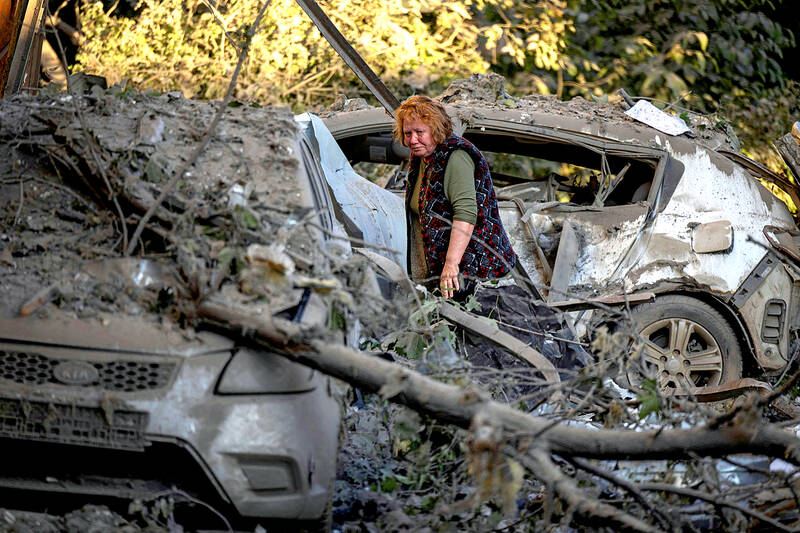
Photo: Reuters
The attack stretched past dawn, with explosions reverberating across cities. Officials said 12 people were killed in Dnipro and six in Kyiv.
Residents of the capital have been on edge for days after Russia last week warned that a massive aerial attack was coming and told foreign diplomats to leave. None appeared to heed the call and no embassies immediately reported damage yesterday.
Ukrainian President Volodymyr Zelenskiy appealed for more US and European support, describing the massive overnight attack as “an explicit statement by Russia: If Ukraine is not protected from ballistic missiles and other missile strikes, those strikes will continue.”
Putin has stepped up his aerial campaign against Ukraine, with Russian forces recently launching another of their powerful hypersonic Oreshnik ballistic missiles. Ukraine’s shortage of air defense systems, in part because of depleted US stocks from the Iran war, has left civilians especially vulnerable to ballistic missiles, even as Kyiv’s defenses stop most of Moscow’s drones.
At least 79 people were wounded in the capital, emergency services said.
Iryna Salikova, 37, spent the night lying in a bathtub for protection with her three-year-old daughter, as blasts reverberated across the city.
“Our window was broken. A cobblestone flew into the children’s room,” Salikova said, although they were not hurt. “Thank God we’re alive. Today we’re alive, today we’re lucky.”
Russia unleashed 73 missiles and 656 drones across Ukraine, the Ukrainian air force said, with the main targets including Kyiv, Dnipro and the eastern cities of Poltava, Kharkiv and Zaporizhzhia. Ukrainian air defense forces destroyed or suppressed 40 missiles and 602 drones.
Dnipro Mayor Borys Filatov proclaimed that today would be a day of mourning for the 12 dead in his city. That announcement came 20 minutes before Filatov said another drone had struck a residential building there at about 2:40pm.
Putin is keen to generate some positive news from the conflict that began with Russia’s February 2022 invasion of its neighbor and has not gone according to plan.
Western officials and analysts say Ukrainian drones are pinning down Russian troops on the front line, choking Russian supply lines in occupied regions of Ukraine and disrupting oil facilities deep inside Russia that provide vital revenue for Moscow.
That has made the war, which Moscow refers to as a “special military operation,” more visible to Russians and increased pressure on Putin.
US-led peace efforts have fizzled out as the sides made no progress on key differences and after the war in Iran grabbed Washington’s attention. Zelenskiy accepted an unconditional ceasefire demanded by US President Donald Trump, but Putin refused.
The Russian Ministry of Defense said in a statement that yesterday’s bombardment struck military-industrial facilities in the Kyiv, Zaporizhzhia, Kharkiv, Dnipropetrovsk, Poltava, Khmelnytskyi and Sumy regions.
Ukraine said residential, energy and civilian infrastructure was hit, but did not confirm or comment on damage to any military-related sites.
Putin signaled that Russia would not let up its attacks. He said that Ukraine’s May 22 drone attack on a college dormitory in Starobilsk in the Russia-controlled Luhansk region of Ukraine that killed 21 had given the war “a whole new dimension.”
Ukraine said the attack in Starobilsk hit a Russian drone pilot training center.
Hits of 30 ballistic missiles, three cruise missiles and 33 drones were recorded in at least 38 locations across Ukraine, regional authorities said. Debris from destroyed drones fell on 15 locations, the air force said.
At least four people were killed in Kyiv and 79 people were injured, including three children, Ukraine’s state emergency service said. Residential buildings and other civilian infrastructure were damaged in eight Kyiv districts.
Olena Dniprovska, 65, and her husband Yevhen, 64, were wounded in their apartment in Kyiv’s Podilskyi district.
“I went out into the corridor with the phone, and before I understood what happened, everything fell on my head, the glass, and the door blew off,” Dniprovska said, dried blood streaked across her face and a bandage on her chin. “I ran out into the front door and started calling my husband from the room, but he was also blown out by the blast wave.”
“Now I have nowhere to live, the apartment is completely destroyed, no doors, no windows, no balcony. You can step straight from the room out onto the street,” she said.
In Kharkiv, at least 19 people were wounded in residential areas in the past two days — including 11 yesterday, burying some residents in the rubble.

‘NO SECURITY RISK’: The Railway Bureau reassured the public that the technicians’ activities were limited to technical guidance and did not involve sensitive systems The Railway Bureau yesterday said it had invited eight Chinese technicians to assist with an airport MRT construction project. The bureau issued the confirmation after an Internet user said Chinese nationals had entered the construction zone of Taiwan Taoyuan International Airport’s Terminal 3 project. They asked why “individuals from an enemy state” were allowed access to such a major national infrastructure project, which raised serious concerns over Taiwan’s industrial safety, sensitive systems and information security. The bureau’s Northern Region Engineering Branch Office said subcontractor Taiwan Handle Industrial Co (台灣手把工業) of the Taoyuan airport MRT’s “Contract No. CU05 Project A14 Station Civil, MEP &

A US uncrewed surface vessel (USV) encountered multiple Chinese warships during an autonomous transit of the Taiwan Strait, US defense company Seasats said in a statement on Wednesday. Seasats announced that a Lightfish USV had completed the first autonomous transit of the Taiwan Strait. Over five days, the USV traversed the entire length of the Strait while constantly monitoring surface vessel traffic, the company said. The Lightfish encountered multiple Chinese warships, one of which was a Chinese People’s Liberation Army Navy (PLAN) Type 056 corvette, it said. The Chinese vessels were operating “well within Taiwan’s exclusive economic zone without transmitting their identity via the

‘BOOMING’: ’ The number of partners we have here is incredible. You can see from their stock prices. They’re doing so well, they’re so happy,’ Jensen Huang said Nvidia Corp’s spending in Taiwan has ballooned to about US$150 billion a year, 10 times the US$10 billion to US$15 billion the company spent five years ago, Nvidia chief executive officer Jensen Huang (黃仁勳) said yesterday, suggesting Taiwan’s strategic importance in the global artificial intelligence (AI) supply chain. “Taiwan is the epicenter of the AI revolution. This is where the chips come, packaging comes. This is where the systems are made. This is where AI supercomputers were created,” Huang said at a meeting for the company’s employees in Beitou-Shilin Technology Park (北投士林科技園區) in Taipei, the planned site of Nvidia’s Taipei headquarters. “Taiwan
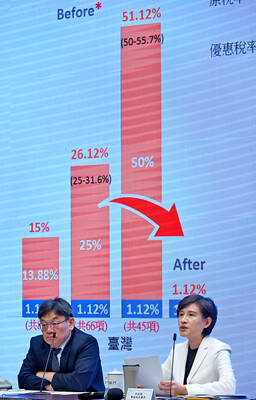
GREATER REACH? Auto parts and wood products would face tariffs of up to 15%, matching those targeting the EU, Japan and South Korea, Vice Premier said The US has announced that preferential tariff treatment for Taiwan’s non-semiconductor Section 232 goods would take effect retroactively from May 1, the Executive Yuan said yesterday. The US government yesterday posted a notice on the Federal Register’s public inspection Web site previewing tariff concessions for Taiwan under a memorandum of understanding (MOU) on Taiwan-US investment after two months of negotiations. The MOU signed on Jan. 15 stipulated three major preferential tariff arrangements: a 15 percent “reciprocal” tariff rate for Taiwan without stacking most-favored nation (MFN) rates; preferential Section 232 treatment for semiconductors and related products; and preferential Section 232 treatment for non-semiconductor


 RSS
RSS