


Taiwan has become indispensable to the development of artificial intelligence (AI) worldwide, President William Lai (賴清德) said yesterday at the opening of Computex Taipei.
Lai said global tech giants had gathered in Taiwan for this year’s Computex, with some announcing plans to continue investing in the nation, demonstrating confidence in Taiwan’s technological capabilities, industrial efficiency and democratic system.
Computex, which runs through Friday and is themed “AI Together,” features a record-breaking 6,000-plus booths from 1,500 exhibitors representing 33 countries, including Nvidia Corp, Qualcomm Inc and Intel Corp.
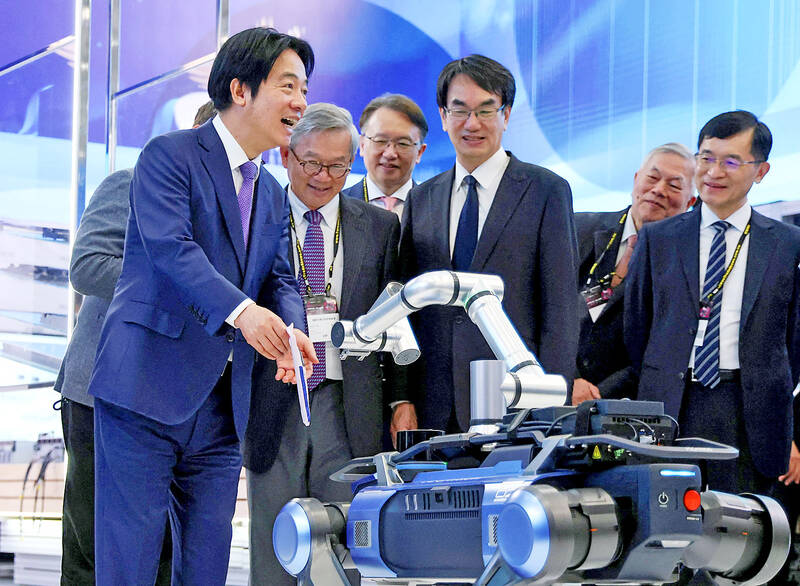
Photo: Tsai Hsin-han, Reuters
More than 60,000 visitors registered to attend the trade show.
Lai said the government welcomes investment from around the world by offering tax incentives, improving the investment environment and promoting a chip-based innovation program aimed at driving next-generation technological advances.
Taiwan will maintain peace and stability across the Taiwan Strait, he said, describing the policy as the most responsible commitment to the global supply chain.
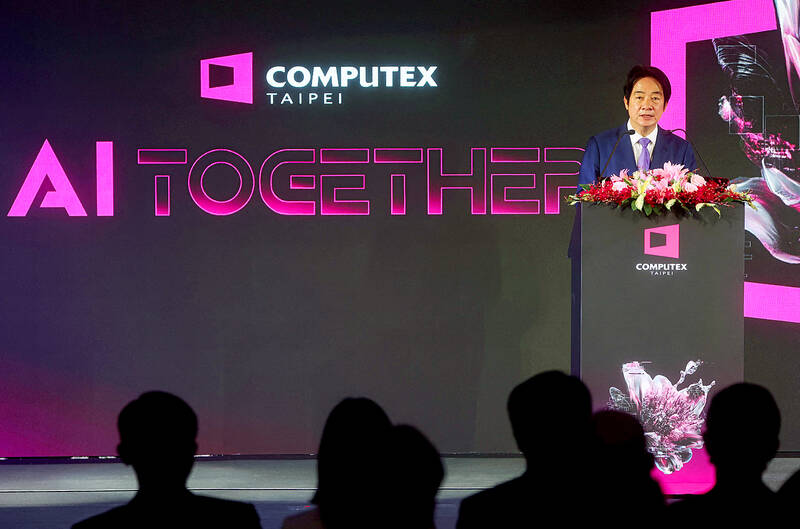
Photo: Tsai Hsin-han, Reuters
“The more the world needs AI, the more it needs a stable, trustworthy and responsible Taiwan,” Lai said. “When AI development enters its next stage, it will require collaboration among like-minded and reliable partners around the world.”
The world’s confidence in Taiwan is reflected in the nation’s strong economic performance, he said.
Taiwan’s economy expanded 14.55 percent in the first quarter, its highest quarterly growth rate in 48 years, driven by robust technology exports.
On Friday, the Directorate-General of Budget, Accounting and Statistics raised its economic growth forecast for this year from 7.71 percent to 9.64 percent, the highest level in 16 years, and projected that Taiwan would be among the world’s 20 largest economies next year.
Amid growing optimism about Taiwan, the local stock market’s capitalization surged to US$4.95 trillion last month, making it the world’s fifth-largest market, Lai said.
The achievement reflected the efforts of industries across the board and Taiwan’s work force, underscoring the nation’s critical role in global AI development, he said.
Addressing concerns about electricity shortages, Lai said Taiwan’s power supply would remain sufficient through 2032, despite rising demand from AI development.
The government will continue promoting its second phase of energy transformation to ensure a stable power supply, he said.
The initiative, launched by the Executive Yuan in 2024, aims to increase natural gas-fired power generation, diversify renewable energy sources and beef up energy storage capacity and the nationwide power grid.
Concerns over Taiwan’s power supply intensified after Nvidia founder and chief executive officer Jensen Huang (黃仁勳), who is attending this year’s Computex, last week said that Taiwan would need more electricity to support future AI development.
Alongside ensuring adequate power, Lai said the government would provide sufficient water, land and talent resources to meet rapidly growing demand for AI infrastructure, computing capacity and semiconductors.
Taiwan will continue pursuing technological innovation, strengthening economic resilience and working with international partners in AI development, Lai added.

‘NO SECURITY RISK’: The Railway Bureau reassured the public that the technicians’ activities were limited to technical guidance and did not involve sensitive systems The Railway Bureau yesterday said it had invited eight Chinese technicians to assist with an airport MRT construction project. The bureau issued the confirmation after an Internet user said Chinese nationals had entered the construction zone of Taiwan Taoyuan International Airport’s Terminal 3 project. They asked why “individuals from an enemy state” were allowed access to such a major national infrastructure project, which raised serious concerns over Taiwan’s industrial safety, sensitive systems and information security. The bureau’s Northern Region Engineering Branch Office said subcontractor Taiwan Handle Industrial Co (台灣手把工業) of the Taoyuan airport MRT’s “Contract No. CU05 Project A14 Station Civil, MEP &

A US uncrewed surface vessel (USV) encountered multiple Chinese warships during an autonomous transit of the Taiwan Strait, US defense company Seasats said in a statement on Wednesday. Seasats announced that a Lightfish USV had completed the first autonomous transit of the Taiwan Strait. Over five days, the USV traversed the entire length of the Strait while constantly monitoring surface vessel traffic, the company said. The Lightfish encountered multiple Chinese warships, one of which was a Chinese People’s Liberation Army Navy (PLAN) Type 056 corvette, it said. The Chinese vessels were operating “well within Taiwan’s exclusive economic zone without transmitting their identity via the
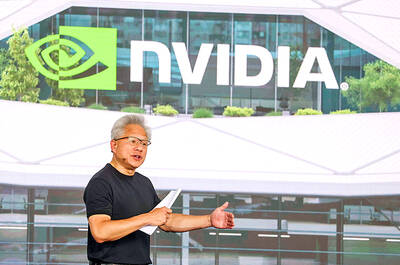
‘BOOMING’: ’ The number of partners we have here is incredible. You can see from their stock prices. They’re doing so well, they’re so happy,’ Jensen Huang said Nvidia Corp’s spending in Taiwan has ballooned to about US$150 billion a year, 10 times the US$10 billion to US$15 billion the company spent five years ago, Nvidia chief executive officer Jensen Huang (黃仁勳) said yesterday, suggesting Taiwan’s strategic importance in the global artificial intelligence (AI) supply chain. “Taiwan is the epicenter of the AI revolution. This is where the chips come, packaging comes. This is where the systems are made. This is where AI supercomputers were created,” Huang said at a meeting for the company’s employees in Beitou-Shilin Technology Park (北投士林科技園區) in Taipei, the planned site of Nvidia’s Taipei headquarters. “Taiwan
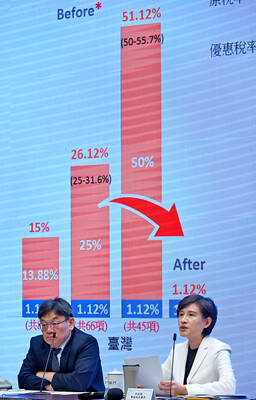
GREATER REACH? Auto parts and wood products would face tariffs of up to 15%, matching those targeting the EU, Japan and South Korea, Vice Premier said The US has announced that preferential tariff treatment for Taiwan’s non-semiconductor Section 232 goods would take effect retroactively from May 1, the Executive Yuan said yesterday. The US government yesterday posted a notice on the Federal Register’s public inspection Web site previewing tariff concessions for Taiwan under a memorandum of understanding (MOU) on Taiwan-US investment after two months of negotiations. The MOU signed on Jan. 15 stipulated three major preferential tariff arrangements: a 15 percent “reciprocal” tariff rate for Taiwan without stacking most-favored nation (MFN) rates; preferential Section 232 treatment for semiconductors and related products; and preferential Section 232 treatment for non-semiconductor


 RSS
RSS