


Right-wing Colombian Aberaldo de la Espriella on Sunday pulled ahead in Colombia’s race for the presidency in the first round of elections, capitalizing on a growing appetite for heavy-handed crackdowns on criminal groups across Latin America.
However, the second-place finisher, progressive Senator Ivan Cepeda, and his ally, Colombian President Gustavo Petro, questioned the results of the election on Sunday night, without providing evidence.
De la Espriella rapidly gained traction in the lead-up to Sunday’s election, winning nearly 44 percent of the vote, and surpassing Cepeda, who had consistently led polling throughout the campaign and won less than 41 percent of the vote.
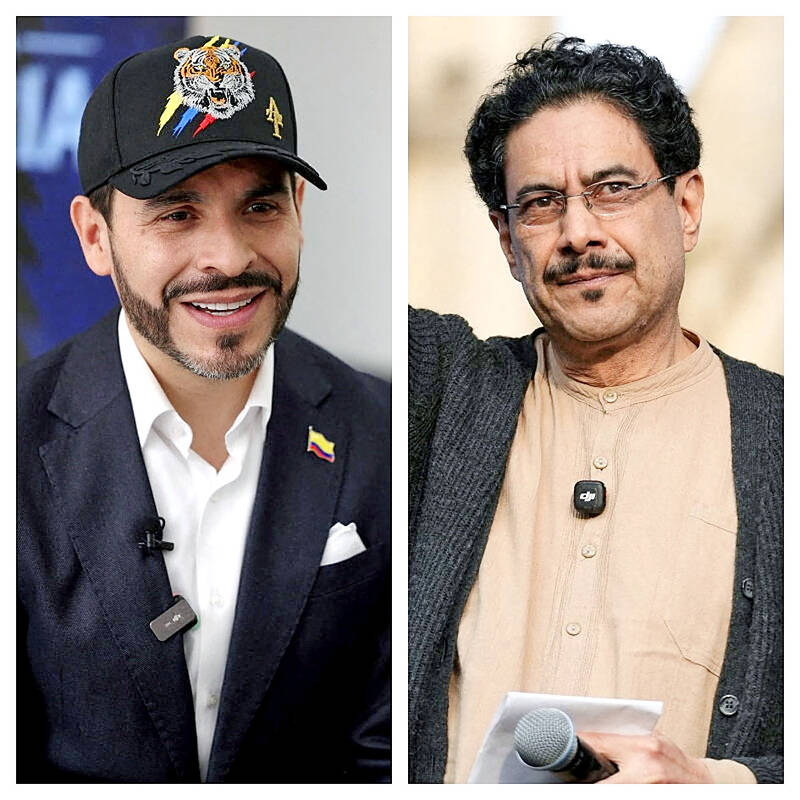
Photo: Reuters
The two are slated to continue to a runoff election on June 21, where De la Espriella is expected to scoop up additional votes from Colombians who supported other conservative candidates in the first round.
Cepeda will face an uphill battle in the runoff, political analyst Sergio Guzman said.
“Abelardo de la Espriella won the first round. In other words, that’s a shift in public opinion that is very difficult to overcome. So now Abelardo is emerging as the likely favorite to win,” he said.

Photo: Bloomberg
De la Espriella, known as “El Tigre” or “The Tiger,” has never held office in Colombia and prided himself on living a luxurious life in Italy before becoming deciding to run for president. He pitched himself as an outsider who would cozy up to US President Donald Trump and follow Salvadoran President Nayib Bukele’s war on gangs, which has driven down homicide rates, but fueled accusations of human rights abuses.
"I will wipe out narcoterrorism and those who I’ve declared a military target like cockroaches, like rats. I will unleash upon them the wrath of God never seen before,” De la Espriella said in an interview with The Associated Press in the final stretch of the campaign, where he promised to open 10 mega-prisons to fight crime.
He joins a growing number of leaders across Latin America — from Chile to Honduras — seeking to latch onto the “Bukele model,” as voters across Latin America are increasingly ditching leaders that pitched progressive policies aimed at addressing the root issues of conflict, such as lack of opportunities for young people and corruption.
De la Espriella’s rise as a presidential candidate spells trouble for Cepeda, a progressive senator who has promised to carry on Petro’s fraught plan to achieve “total peace” by negotiating peace pacts with guerrillas and criminal gangs.
Their political movement was born from a fierce rejection by many Colombians of a militarized offensive by former Colombian president Alvaro Uribe in decades past used to beat back the guerrillas of the Revolutionary Armed Forces of Colombia, or FARC, which ended in thousands of civilians being killed by Colombian forces in a scandal known as “false positives.”
De la Espriella “represents a return to the paramilitary politics and drug-trafficking — a mafia-run, plutocratic and corrupt past that the country experienced during Alvaro Uribe’s two administrations,” Cepeda said on Sunday.
Petro, a former rebel, won Colombia’s presidency in 2022 in a historic election that ended decades of right-wing domination by leaders from Uribe’s political movement. He gained massive support from rural-dwelling, indigenous and poorer Colombians who felt they had never been directly spoken to by Colombian leaders.
Now, that movement is backed into a corner.
“This is De la Espriella’s election to lose,” wrote Renata Segura, director of International Crisis Group’s Latin America and the Caribbean Program. “Cepeda thought he could win appealing squarely to the left, and that proved to be a massive mistake. How he pivots in the next month will determine if he has any chance to win.”

‘NO SECURITY RISK’: The Railway Bureau reassured the public that the technicians’ activities were limited to technical guidance and did not involve sensitive systems The Railway Bureau yesterday said it had invited eight Chinese technicians to assist with an airport MRT construction project. The bureau issued the confirmation after an Internet user said Chinese nationals had entered the construction zone of Taiwan Taoyuan International Airport’s Terminal 3 project. They asked why “individuals from an enemy state” were allowed access to such a major national infrastructure project, which raised serious concerns over Taiwan’s industrial safety, sensitive systems and information security. The bureau’s Northern Region Engineering Branch Office said subcontractor Taiwan Handle Industrial Co (台灣手把工業) of the Taoyuan airport MRT’s “Contract No. CU05 Project A14 Station Civil, MEP &

A US uncrewed surface vessel (USV) encountered multiple Chinese warships during an autonomous transit of the Taiwan Strait, US defense company Seasats said in a statement on Wednesday. Seasats announced that a Lightfish USV had completed the first autonomous transit of the Taiwan Strait. Over five days, the USV traversed the entire length of the Strait while constantly monitoring surface vessel traffic, the company said. The Lightfish encountered multiple Chinese warships, one of which was a Chinese People’s Liberation Army Navy (PLAN) Type 056 corvette, it said. The Chinese vessels were operating “well within Taiwan’s exclusive economic zone without transmitting their identity via the

Taiwan is still in the process of assessing the possibility of recruiting workers from Eswatini, the Ministry of Foreign Affairs said yesterday, adding that its goal is to help Eswatini upgrade its vocational training centers. If there are plans to recruit workers from Eswatini, safeguarding national security, protecting public health and ensuring the employment rights of Taiwanese would be prerequisites, Department of West Asian and African Affairs Director-General Yen Chia-liang (顏嘉良) told a news conference. Key considerations would also include filling labor shortages in specific industries, and fostering bilateral professional and technical exchanges, he said. Yen was asked about the progress of labor

‘BOOMING’: ’ The number of partners we have here is incredible. You can see from their stock prices. They’re doing so well, they’re so happy,’ Jensen Huang said Nvidia Corp’s spending in Taiwan has ballooned to about US$150 billion a year, 10 times the US$10 billion to US$15 billion the company spent five years ago, Nvidia chief executive officer Jensen Huang (黃仁勳) said yesterday, suggesting Taiwan’s strategic importance in the global artificial intelligence (AI) supply chain. “Taiwan is the epicenter of the AI revolution. This is where the chips come, packaging comes. This is where the systems are made. This is where AI supercomputers were created,” Huang said at a meeting for the company’s employees in Beitou-Shilin Technology Park (北投士林科技園區) in Taipei, the planned site of Nvidia’s Taipei headquarters. “Taiwan


 RSS
RSS