


Taiwan’s indigenous submarine prototype, the Hai Kun (Narwhal, 海鯤), is aiming for delivery to the navy later this year, while two upgraded Chien Lung-class submarines are expected to undergo combat-system validation next year, significantly enhancing the navy’s undersea warfare capabilities.
The Hai Kun departed from the Port of Kaohsiung yesterday morning for its latest round of sea trials, including diving tests.
It would be the submarine’s 15th sea trial and ninth submerged navigation test, the Military News Agency reported.
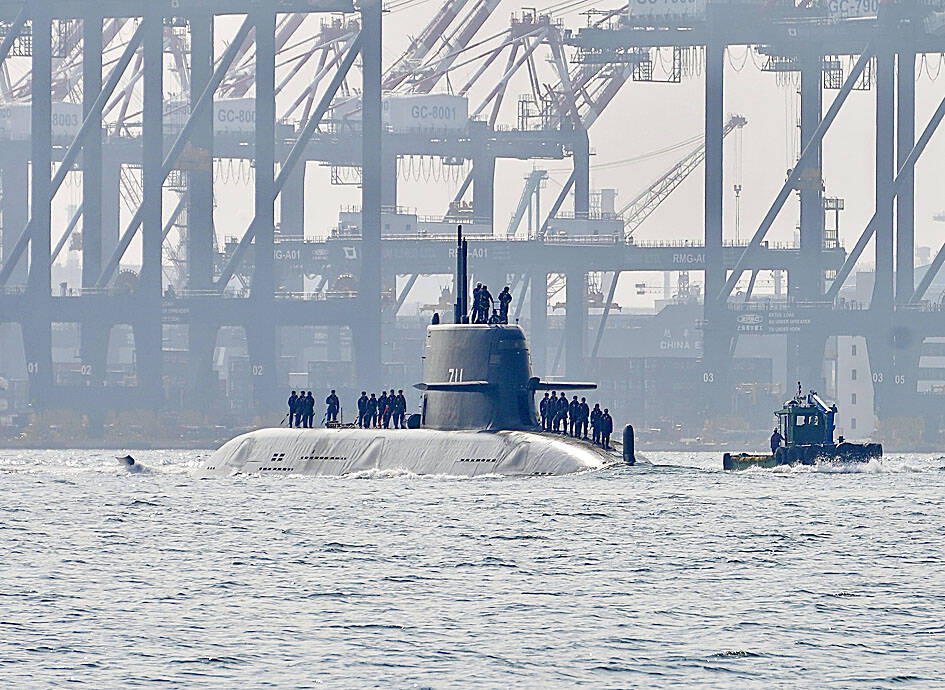
Photo: CNA
The tests came after a sea trial scheduled for Friday that was postponed due to poor weather conditions.
Shipbuilder CSBC Corp, Taiwan (台灣國際造船) has been accumulating fines since missing its deadline in November last year due to “testing delays,” but indicated in February that it hoped to deliver the submarine to the navy this month.
Minister of National Defense Wellington Koo (顧立雄) yesterday reiterated that testing would proceed according to established procedures, with safety and quality taking precedence and with the aim of meeting defense capability requirements.
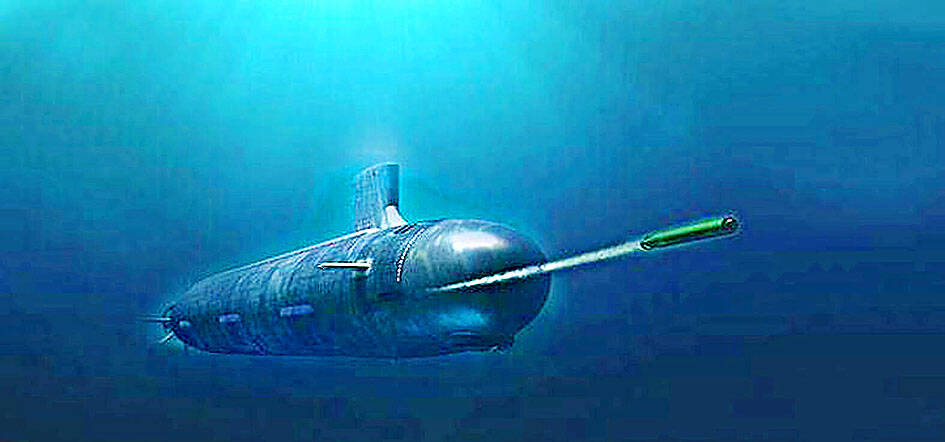
Photo courtesy of Raytheon Co
Military expert Chi Tung-yun (紀東昀) said that testing requires the collection of key performance parameters, and that minimizing environmental variables helps ensure greater accuracy in the data obtained.
Hai Kun’s upcoming tests include highly anticipated seaworthiness and deep-diving trials, including overnight evaluations, Chi said.
If the submarine successfully completes those remaining tests, delivery could likely take place anytime between next month and September, he added.
The Chien Lung (劍龍) class consists of two submarines built in the Netherlands for Taiwan in the 1980s — the Hai Lung (Sea Dragon, 海龍) and the Hai Hu(Sea Tiger, 海虎) — which form Taiwan’s submarine fleet.
The vessels are modified versions of the Dutch navy’s Zwaardvis-class submarines, which were themselves derived from the US-built Barbel-class design. They are expected to be gradually replaced by submarines built under Taiwan’s Indigenous Defense Submarine program.
According to Ministry of National Defense documents and Legislative Yuan budget reports, both submarines have undergone extensive modernization, including upgrades to combat-management, sonar, fire-control, communications and navigation systems, as well as the integration of new torpedo weapons.
The Hai Lung has completed its upgrades and sea trials, while major work on the Hai Hu has also been completed. Both submarines are expected to undergo combat-system validation and operational assessments next year.
The upgrades coincide with the expected delivery of US-made MK 48 Mod 6 Advanced Technology heavyweight torpedoes, which are scheduled to begin arriving next year. The MK 48 is the primary heavyweight torpedo used by the US Navy, and offers greater speed, range and guidance capabilities than the German-made SUT torpedoes currently used by Taiwan’s navy.
According to publicly available specifications, the MK 48 Mod 6 is about 5.8m, 533mm in circumference and weighs more than 1.6 tonnes. It carries a high explosive warhead weighing about 295kg, can travel at 55 knots (101.9kph) and has a range of more than 38km. Military analysts have described the weapon as a significant improvement over the SUT torpedo in terms of range, accuracy and destructive power.
The navy is scheduled to receive 28 MK 48 Mod 6 warshot torpedoes over the next two years, with training torpedoes already delivered. The MK 48 is expected to become a key weapon for the Hai Lung, Hai Hu and Hai Kun.
Chungshan Institute of Science and Technology president Lee Shih-chiang (李世強) told lawmakers that the upgraded Hai Lung has successfully completed qualification testing using SUT and MK 48 training torpedoes. The arrival of the new torpedoes and the completion of the Chien Lung-class upgrade program are expected to substantially strengthen Taiwan’s undersea deterrence capabilities, as it continues to expand and modernize its submarine fleet.

‘NO SECURITY RISK’: The Railway Bureau reassured the public that the technicians’ activities were limited to technical guidance and did not involve sensitive systems The Railway Bureau yesterday said it had invited eight Chinese technicians to assist with an airport MRT construction project. The bureau issued the confirmation after an Internet user said Chinese nationals had entered the construction zone of Taiwan Taoyuan International Airport’s Terminal 3 project. They asked why “individuals from an enemy state” were allowed access to such a major national infrastructure project, which raised serious concerns over Taiwan’s industrial safety, sensitive systems and information security. The bureau’s Northern Region Engineering Branch Office said subcontractor Taiwan Handle Industrial Co (台灣手把工業) of the Taoyuan airport MRT’s “Contract No. CU05 Project A14 Station Civil, MEP &

A US uncrewed surface vessel (USV) encountered multiple Chinese warships during an autonomous transit of the Taiwan Strait, US defense company Seasats said in a statement on Wednesday. Seasats announced that a Lightfish USV had completed the first autonomous transit of the Taiwan Strait. Over five days, the USV traversed the entire length of the Strait while constantly monitoring surface vessel traffic, the company said. The Lightfish encountered multiple Chinese warships, one of which was a Chinese People’s Liberation Army Navy (PLAN) Type 056 corvette, it said. The Chinese vessels were operating “well within Taiwan’s exclusive economic zone without transmitting their identity via the
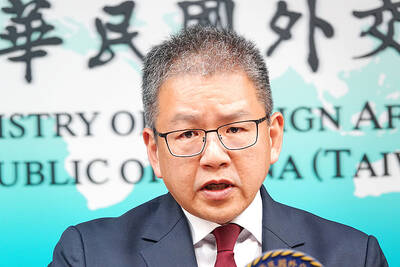
Taiwan is still in the process of assessing the possibility of recruiting workers from Eswatini, the Ministry of Foreign Affairs said yesterday, adding that its goal is to help Eswatini upgrade its vocational training centers. If there are plans to recruit workers from Eswatini, safeguarding national security, protecting public health and ensuring the employment rights of Taiwanese would be prerequisites, Department of West Asian and African Affairs Director-General Yen Chia-liang (顏嘉良) told a news conference. Key considerations would also include filling labor shortages in specific industries, and fostering bilateral professional and technical exchanges, he said. Yen was asked about the progress of labor
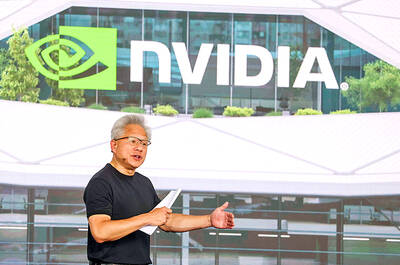
‘BOOMING’: ’ The number of partners we have here is incredible. You can see from their stock prices. They’re doing so well, they’re so happy,’ Jensen Huang said Nvidia Corp’s spending in Taiwan has ballooned to about US$150 billion a year, 10 times the US$10 billion to US$15 billion the company spent five years ago, Nvidia chief executive officer Jensen Huang (黃仁勳) said yesterday, suggesting Taiwan’s strategic importance in the global artificial intelligence (AI) supply chain. “Taiwan is the epicenter of the AI revolution. This is where the chips come, packaging comes. This is where the systems are made. This is where AI supercomputers were created,” Huang said at a meeting for the company’s employees in Beitou-Shilin Technology Park (北投士林科技園區) in Taipei, the planned site of Nvidia’s Taipei headquarters. “Taiwan


 RSS
RSS