


Nvidia Corp yesterday unveiled the company’s first chip to power a new breed of laptops on Microsoft Corp’s operating system, addressing growing demand for agentic artificial intelligence (AI) capabilities on edge devices for consumers.
During the company’s GTC event in Taipei, Nvidia CEO Jensen Huang (黃仁勳) announced a series of Windows-based laptops that use its new RTX Spark chip, known internally as the N1X chip, featuring a Blackwell RTX graphics processing unit (GPU).
The N1X, a custom 20-core Grace central processing unit (CPU), is built in partnership with chip designer MediaTek Inc (聯發科), and produced utilizing Taiwan Semiconductor Manufacturing Co’s (台積電) 3-nanometer process technology, Huang said.
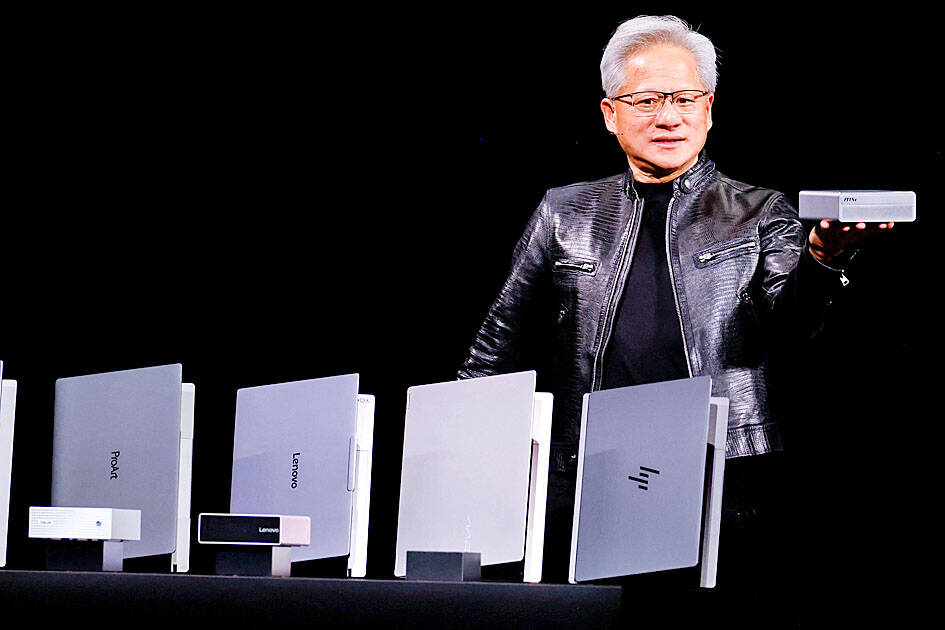
Photo: Ann Wang, Reuters
It took more than three years for Microsoft and Nvidia to completely reinvent how the PC is going to work, Huang said.
“The PC is being reinvented” for creating and gaming, Huang said. “When it has an autonomous [AI] agent, an agent that’s helping you, that understands you, you could talk to it. It could look at you. You could ask it to read files, go help you do some research. It could do a lot more,” he said.
“Local agents. Frontier models. Creative workflows. RTX games. All on a laptop. This is the new PC. The personal AI computer,” he said, describing it as the first major reinvention of the PC in four decades.
Microsoft said in a separate statement that the PCs running on Nvidia’s RTX superchips would be able to support “highly capable AI models” and complex workloads.
RTX Spark laptops and compact desktops would be available this fall from leading manufacturers including Asustek Computer Inc (華碩), Dell Technologies Inc, HP Inc, Lenovo Group Ltd (聯想), Microsoft Surface and Micro-Star International Co (MSI, 微星), with models from Acer Inc (宏碁) and Gigabyte Technology Co (技嘉) to follow.
Huang also said that the company’s new Vera CPUs for data centers are in full production and are “going to be our new major growth driver” on the back of the AI agent boom, with early customers expected to include Anthropic PBC, OpenAI and SpaceXAI.
However, a major theme of the nearly two-hour speech was the idea that AI agents could eventually become a form of digital labor.
“There’ll be a lot more agents than there are people,” Huang said, predicting that billions of AI agents would one day operate across businesses, industries and households.
Huang said he expects future AI systems to do far more than answer questions. Equipped with memory, reasoning capabilities and the ability to use software tools, they would increasingly perform tasks on behalf of users, functioning more like digital workers than chatbots.
Huang said he could envision “an AI supercomputer in your house” running multiple agents and assistants around the clock.
Such systems could help users conduct research, complete work assignments and manage everyday activities, he said.
Additional reporting by AP and CNA

‘NO SECURITY RISK’: The Railway Bureau reassured the public that the technicians’ activities were limited to technical guidance and did not involve sensitive systems The Railway Bureau yesterday said it had invited eight Chinese technicians to assist with an airport MRT construction project. The bureau issued the confirmation after an Internet user said Chinese nationals had entered the construction zone of Taiwan Taoyuan International Airport’s Terminal 3 project. They asked why “individuals from an enemy state” were allowed access to such a major national infrastructure project, which raised serious concerns over Taiwan’s industrial safety, sensitive systems and information security. The bureau’s Northern Region Engineering Branch Office said subcontractor Taiwan Handle Industrial Co (台灣手把工業) of the Taoyuan airport MRT’s “Contract No. CU05 Project A14 Station Civil, MEP &

A US uncrewed surface vessel (USV) encountered multiple Chinese warships during an autonomous transit of the Taiwan Strait, US defense company Seasats said in a statement on Wednesday. Seasats announced that a Lightfish USV had completed the first autonomous transit of the Taiwan Strait. Over five days, the USV traversed the entire length of the Strait while constantly monitoring surface vessel traffic, the company said. The Lightfish encountered multiple Chinese warships, one of which was a Chinese People’s Liberation Army Navy (PLAN) Type 056 corvette, it said. The Chinese vessels were operating “well within Taiwan’s exclusive economic zone without transmitting their identity via the

Taiwan is still in the process of assessing the possibility of recruiting workers from Eswatini, the Ministry of Foreign Affairs said yesterday, adding that its goal is to help Eswatini upgrade its vocational training centers. If there are plans to recruit workers from Eswatini, safeguarding national security, protecting public health and ensuring the employment rights of Taiwanese would be prerequisites, Department of West Asian and African Affairs Director-General Yen Chia-liang (顏嘉良) told a news conference. Key considerations would also include filling labor shortages in specific industries, and fostering bilateral professional and technical exchanges, he said. Yen was asked about the progress of labor
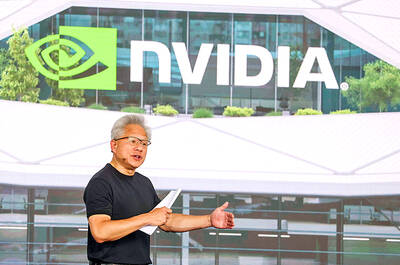
‘BOOMING’: ’ The number of partners we have here is incredible. You can see from their stock prices. They’re doing so well, they’re so happy,’ Jensen Huang said Nvidia Corp’s spending in Taiwan has ballooned to about US$150 billion a year, 10 times the US$10 billion to US$15 billion the company spent five years ago, Nvidia chief executive officer Jensen Huang (黃仁勳) said yesterday, suggesting Taiwan’s strategic importance in the global artificial intelligence (AI) supply chain. “Taiwan is the epicenter of the AI revolution. This is where the chips come, packaging comes. This is where the systems are made. This is where AI supercomputers were created,” Huang said at a meeting for the company’s employees in Beitou-Shilin Technology Park (北投士林科技園區) in Taipei, the planned site of Nvidia’s Taipei headquarters. “Taiwan


 RSS
RSS