


The Cabinet is considering ways to fund key weapons programs excluded from a supplementary budget bill passed by the legislature last week, Premier Cho Jung-tai (卓榮泰) said yesterday.
The options include proposing another supplementary budget or increasing the Ministry of National Defense’s annual budget, Cabinet spokeswoman Michelle Lee (李慧芝) quoted Cho as saying at a weekly Cabinet news conference.
The legislature last week passed an opposition-backed supplementary budget bill to fund purchases of US weapons systems, including High Mobility Artillery Rocket Systems (HIMARS), M109A7 self-propelled howitzers, TOW 2B missiles, Altius-700M and 600 drones, and Javelin anti-armor missiles.
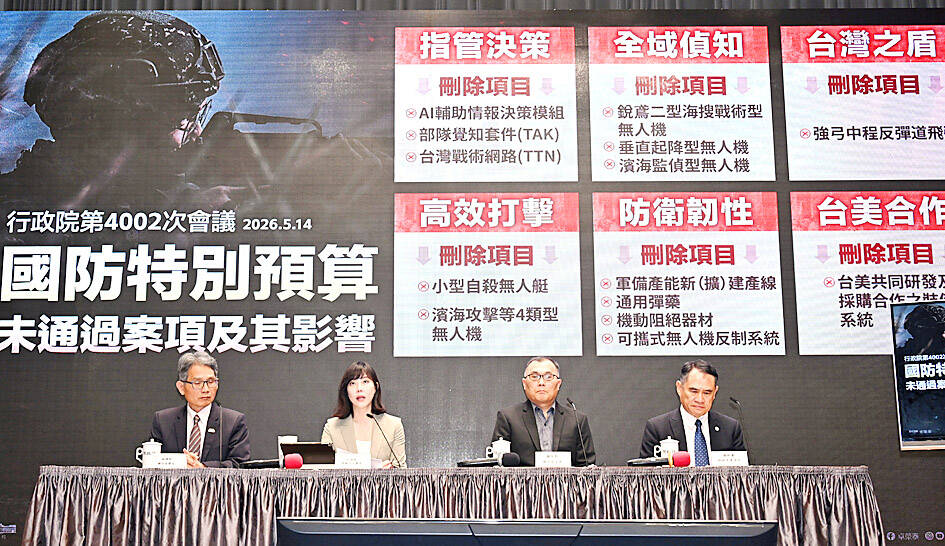
Photo: Fang Pin-chao, Taipei Times
However, the NT$780 billion (US$24.75 billion) bill excluded funding for domestic contract production programs and foreign direct commercial sales.
Department of Strategic Planning head Huang Wen-chi (黃文啟) told the news conference that the legislature’s decision to cut funding for person-portable counterdrone systems would significantly weaken Taiwan’s ability to respond to attacks by swarms of small drones.
Swarms are an expected threat in modern warfare, Huang said, citing their use in the Russia-Ukraine war.
The exclusion of funding for domestically produced littoral warfare attack drones and small kamikaze uncrewed surface vessels had hurt Taiwan’s defense industry, as reflected in the weak performance of local defense stocks in the past few days, he said.
Chiang Kung (強弓, “Strong Bow”) anti-ballistic missiles, which have a higher interception altitude than PAC-3 MSE missiles and are made in Taiwan, would improve the nation’s ability to intercept incoming strikes, Huang said.
Excluding funding for the Chiang Kung system has weakened Taiwan’s air defense, he added.
Cho urged lawmakers to quickly approve funding for the HIMARS, which the US has approved for sale to Taiwan, as required under the supplementary budget bill signed into law by President William Lai (賴清德) on Monday, Lee said.
The legislation stipulates that approved and future arms sales must still receive legislative approval before funding can be disbursed.
Taiwan must make its first HIMARS payment by the end of this month, after the US agreed to extend the original March 30 deadline amid a legislative deadlock over the Cabinet’s supplementary budget proposal.
Deputy Minister of National Defense Chen Wen-hsing (陳文星) said that the ministry is prepared to use its first reserve fund or request access to the Cabinet’s second reserve fund as a backup if the legislature does not approve the disbursement.

‘NO SECURITY RISK’: The Railway Bureau reassured the public that the technicians’ activities were limited to technical guidance and did not involve sensitive systems The Railway Bureau yesterday said it had invited eight Chinese technicians to assist with an airport MRT construction project. The bureau issued the confirmation after an Internet user said Chinese nationals had entered the construction zone of Taiwan Taoyuan International Airport’s Terminal 3 project. They asked why “individuals from an enemy state” were allowed access to such a major national infrastructure project, which raised serious concerns over Taiwan’s industrial safety, sensitive systems and information security. The bureau’s Northern Region Engineering Branch Office said subcontractor Taiwan Handle Industrial Co (台灣手把工業) of the Taoyuan airport MRT’s “Contract No. CU05 Project A14 Station Civil, MEP &

A US uncrewed surface vessel (USV) encountered multiple Chinese warships during an autonomous transit of the Taiwan Strait, US defense company Seasats said in a statement on Wednesday. Seasats announced that a Lightfish USV had completed the first autonomous transit of the Taiwan Strait. Over five days, the USV traversed the entire length of the Strait while constantly monitoring surface vessel traffic, the company said. The Lightfish encountered multiple Chinese warships, one of which was a Chinese People’s Liberation Army Navy (PLAN) Type 056 corvette, it said. The Chinese vessels were operating “well within Taiwan’s exclusive economic zone without transmitting their identity via the
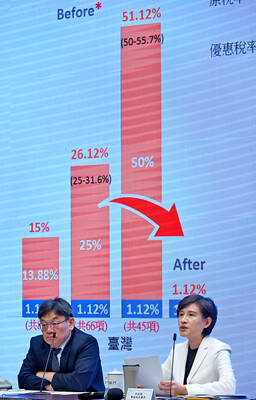
GREATER REACH? Auto parts and wood products would face tariffs of up to 15%, matching those targeting the EU, Japan and South Korea, Vice Premier said The US has announced that preferential tariff treatment for Taiwan’s non-semiconductor Section 232 goods would take effect retroactively from May 1, the Executive Yuan said yesterday. The US government yesterday posted a notice on the Federal Register’s public inspection Web site previewing tariff concessions for Taiwan under a memorandum of understanding (MOU) on Taiwan-US investment after two months of negotiations. The MOU signed on Jan. 15 stipulated three major preferential tariff arrangements: a 15 percent “reciprocal” tariff rate for Taiwan without stacking most-favored nation (MFN) rates; preferential Section 232 treatment for semiconductors and related products; and preferential Section 232 treatment for non-semiconductor
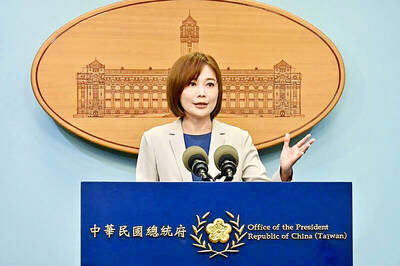
TIT-FOR-TAT: The US allegedly revoked the visa of a Chinese national working at Xinhua News Agency in the US in response to Beijing’s expulsion of Vivian Wang The Presidential Office yesterday condemned China for expelling a New York Times correspondent from Beijing following the newspaper’s interview with President William Lai (賴清德), saying the move highlighted Beijing’s suppression of press freedom and its threat to international news media. Taiwan has noted a series of recent incidents in which Beijing used similar tactics to “threaten and pressure international media outlets and journalists,” Presidential Office spokeswoman Karen Kuo (郭雅慧) said in a statement. “This concerns not only press freedom and freedom of expression, but also the safety of journalists, and Taiwan and relevant partners are paying close attention to the situation,” she


 RSS
RSS