


US President Donald Trump and Chinese President Xi Jinping (習近平) yesterday met in Beijing for talks, discussing economic cooperation, the Iran war and other issues.
The pair met for about two hours behind closed doors at the Great Hall of the People and discussed trade and other issues.
Trump told Xi ahead of the summit that “you’re a great leader. Sometimes people don’t like me saying it, but I say it anyway, because it’s true.”
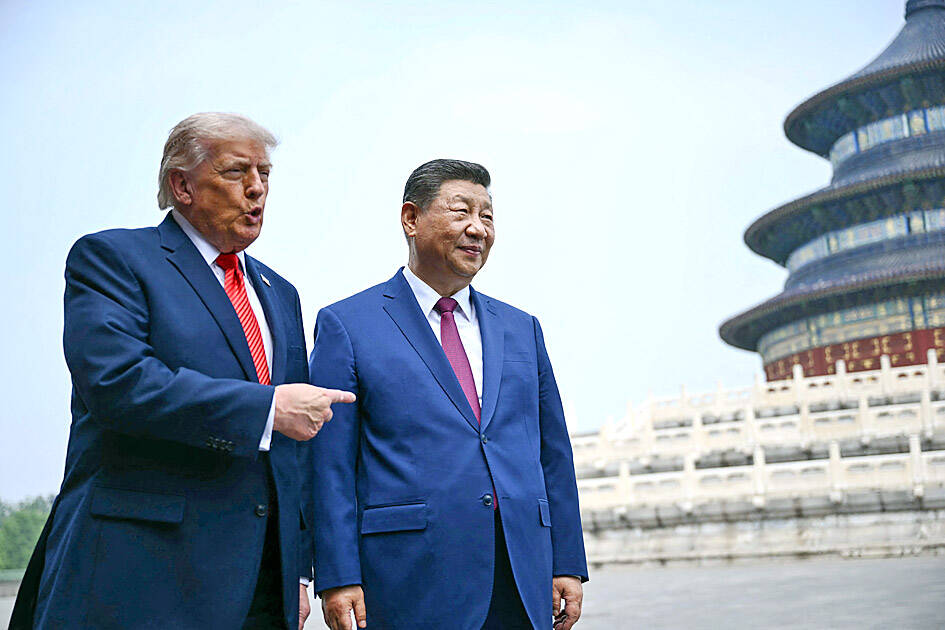
Photo: AFP
“The relationship between China and the USA is going to be better than ever before,” he added.
Xi in his opening remarks, expressed hope that the US and China could avoid conflict and asked “whether the two countries can transcend the Thucydides trap and forge a new model for relations between major powers.”
He used a term popular in foreign policy studies, referring to the idea that when a rising power threatens to displace an established power, the result is often war.
“Cooperation benefits both sides, while confrontation harms both,” Xi said. “The two countries should be partners rather than rivals.”
Trump was welcomed before the meeting with an elaborate ceremony featuring booming cannons and a band playing The Star-Spangled Banner and China’s national anthem.
Hundreds of children performed a welcome routine, jumping as the girls waved flowers and the boys hoisted US and Chinese flags while Trump and Xi walked past them.
After the meeting, the leaders visited the Temple of Heaven, a religious complex dating to the 15th century.
Trump later attended a state banquet with Xi.
Trump did not immediately offer comments on what was said during the closed portion of the meeting, but Xi said that, together with Trump, the two agreed to establish a new orientation for US-China relations, one that is “constructive, strategic and stable” the official Xinhua news agency reported.
The White House has said that Trump would not be making the trip without an eye toward securing results before he leaves, suggesting that there could be announcements to be made on trade today.
That could include a Chinese commitment to buy US soybeans, beef and aircraft.
Trump administration officials also want to work toward establishing a board of trade with China to address commercial differences between the countries.
In the meeting, the leaders discussed trade, with Xi saying that China’s door of opportunity would open wider.
Xi also met with a collection of US business leaders who accompanied Trump to China.
Trump extended a Sept. 24 invitation to Xi and his wife, Peng Liyuan (彭麗媛), during his toast.
“And we look forward to it,” Trump said.
He also thanked Xi for his hospitality.
“This has been an amazing period of time,” Trump said.
Chinese Premier Li Qiang (李強) stressed the need for friendship and cooperation in US-China ties as he spoke with US business leaders accompanying Trump.
Li met with executives including Tesla’s Elon Musk, Apple’s Tim Cook and Nvidia chief executive officer Jensen Huang (黃仁勳) on the sidelines of the summit.
“China and the United States have been able to maintain frank and smooth dialogue and communication, and actively safeguard a stable and healthy bilateral relationship” despite international turbulence, Li said.
Collaboration is needed for “mutual success and shared prosperity,” he added.
The leaders were in agreement that the Strait of Hormuz needs to be opened to support global energy needs, a readout of their meeting by a White House official showed.
Xi also opposed any implementation of tolls on vessels crossing the strait, which effectively has closed since the start of the US-Israel war against Iran.
Xi expressed interest in China purchasing more US oil to reduce future Chinese dependence on Gulf oil, said the White House official, who was not authorized to comment publicly and spoke on condition of anonymity.
Chinese Vice Premier He Lifeng (何立峰) and US Secretary of the Treasury Scott Bessent in South Korea on Wednesday engaged in “candid, in-depth and constructive” exchanges, He said.
For the next step, China is willing to work with the US to expand their cooperation based on the principles of equality, respect and mutual benefit, he added.
They would also shorten the problem list while promoting healthy economic and trade ties between the sides, he said.
Economic ties between the US and China are mutually beneficial and win-win in nature, Xi told Trump during their talks, Xinhua reported.
“Yesterday, our economic and trade teams produced generally balanced and positive outcomes. This is good news for the people of the two countries and the world,” Xi said.
There are no winners in trade wars, Xi said, calling on both sides to jointly sustain the good momentum they have worked hard to build, Xinhua reported.
“Where disagreements and frictions exist, equal-footed consultation is the only right choice,” he said.
Trump is expected to leave just after midday today after a final private meeting with Xi.

‘NO SECURITY RISK’: The Railway Bureau reassured the public that the technicians’ activities were limited to technical guidance and did not involve sensitive systems The Railway Bureau yesterday said it had invited eight Chinese technicians to assist with an airport MRT construction project. The bureau issued the confirmation after an Internet user said Chinese nationals had entered the construction zone of Taiwan Taoyuan International Airport’s Terminal 3 project. They asked why “individuals from an enemy state” were allowed access to such a major national infrastructure project, which raised serious concerns over Taiwan’s industrial safety, sensitive systems and information security. The bureau’s Northern Region Engineering Branch Office said subcontractor Taiwan Handle Industrial Co (台灣手把工業) of the Taoyuan airport MRT’s “Contract No. CU05 Project A14 Station Civil, MEP &

A US uncrewed surface vessel (USV) encountered multiple Chinese warships during an autonomous transit of the Taiwan Strait, US defense company Seasats said in a statement on Wednesday. Seasats announced that a Lightfish USV had completed the first autonomous transit of the Taiwan Strait. Over five days, the USV traversed the entire length of the Strait while constantly monitoring surface vessel traffic, the company said. The Lightfish encountered multiple Chinese warships, one of which was a Chinese People’s Liberation Army Navy (PLAN) Type 056 corvette, it said. The Chinese vessels were operating “well within Taiwan’s exclusive economic zone without transmitting their identity via the
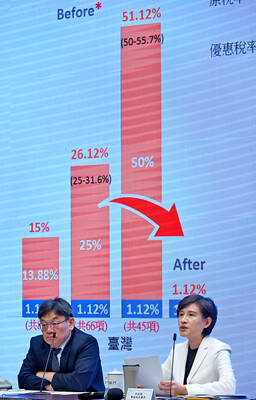
GREATER REACH? Auto parts and wood products would face tariffs of up to 15%, matching those targeting the EU, Japan and South Korea, Vice Premier said The US has announced that preferential tariff treatment for Taiwan’s non-semiconductor Section 232 goods would take effect retroactively from May 1, the Executive Yuan said yesterday. The US government yesterday posted a notice on the Federal Register’s public inspection Web site previewing tariff concessions for Taiwan under a memorandum of understanding (MOU) on Taiwan-US investment after two months of negotiations. The MOU signed on Jan. 15 stipulated three major preferential tariff arrangements: a 15 percent “reciprocal” tariff rate for Taiwan without stacking most-favored nation (MFN) rates; preferential Section 232 treatment for semiconductors and related products; and preferential Section 232 treatment for non-semiconductor

TIT-FOR-TAT: The US allegedly revoked the visa of a Chinese national working at Xinhua News Agency in the US in response to Beijing’s expulsion of Vivian Wang The Presidential Office yesterday condemned China for expelling a New York Times correspondent from Beijing following the newspaper’s interview with President William Lai (賴清德), saying the move highlighted Beijing’s suppression of press freedom and its threat to international news media. Taiwan has noted a series of recent incidents in which Beijing used similar tactics to “threaten and pressure international media outlets and journalists,” Presidential Office spokeswoman Karen Kuo (郭雅慧) said in a statement. “This concerns not only press freedom and freedom of expression, but also the safety of journalists, and Taiwan and relevant partners are paying close attention to the situation,” she


 RSS
RSS