

The Mainland Affairs Council (MAC) on Tuesday condemned Beijing for urging local media firms to “expose” Taiwan independence activities, saying that local media representatives could face prosecution if they help China target Taiwanese.
Chinese authorities have “summoned certain Taiwanese media outlets to Beijing for instructions and urged them to ‘jointly expose Taiwan independence separatist activities,’” it said in a statement.
The move “essentially amounts to asking Taiwanese media to cooperate with the Chinese Communist Party’s [CCP] transnational repression against Taiwan and restrict the freedoms of the Taiwanese people through intimidation,” the MAC said.
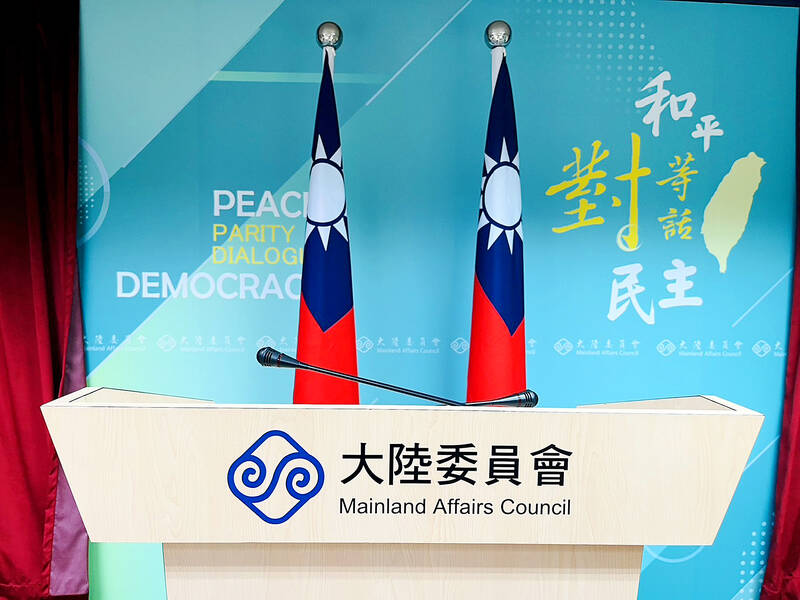
Photo: Taipei Times
In Taiwan, peaceful advocacy of independence is protected as free speech and is not illegal, it said.
The council described Beijing’s tactics as “using Taiwan to control Taiwan.”
The statement came after Wu Xi (吳璽), deputy head of China’s Taiwan Affairs Office, made remarks on the role of cross-strait media at the seventh edition of the cross-strait media summit in Beijing earlier on Tuesday.
“Taiwan independence separatist forces” have been spreading false information and malicious remarks to incite anti-China sentiment, and create cross-strait confrontation, seriously undermining peace and stability in the Taiwan Strait, Wu said.
Media professionals from both sides ahould “use truthful reporting and rational commentary to expose the harmfulness and danger of Taiwan independence activities and external interference,” he said.
The MAC said Taiwanese media firms that sent representatives to the event might contravene laws such as the Anti-Infiltration Act (反滲透法) and the National Security Act (國家安全法) if they cooperate with Beijing as “local collaborators” in its campaign to “punish Taiwan independence.”
Examples of such conduct include following Beijing’s instructions to “exploit press freedom” by accusing specific people of being independence advocates, providing the personal information of Taiwanese or disseminating bounty notices, it said.
The laws carry a maximum prison sentence of more than seven years, it added.
Executive Yuan spokeswoman Michelle Lee (李慧芝) warned the public to be wary of China’s growing “united front” infiltration, saying that anyone caught aiding Beijing’s efforts would face strict prosecution under the law.
While the government has consistently supported healthy and orderly cross-strait exchanges, it firmly opposes any “united front” actions aimed at interfering with Taiwan’s internal affairs and democratic operations, Lee said.
China’s state-run Xinhua news agency reported that more than 100 media executives and journalists attended the summit, including Chou Hsi-wei (周錫瑋), vice chairman of the Want Want China Times Media Group (旺旺中時媒體集團), which owns media firms such as CTi Television Inc (中天電視) and the China Times.
An exclusive report by the Liberty Times (sister paper of the Taipei Times) on Tuesday cited national security sources as saying that other Taiwanese attendees included representatives from the United Daily News, TVBS News and the Observer magazine.
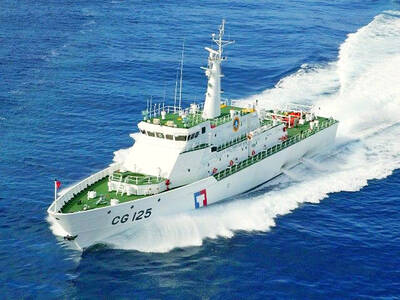
GEOPOLITICAL SIGNIFICANCE: The CGA’s nonmilitary role makes it a tool to avert diplomatic issues, an official said, while confirming the donation of a ship to Manila Coast Guard Administration (CGA) ships are scheduled to sail to the Philippines bearing the words “Taiwan Coast Guard” in a high-profile visit in October next year, the first such visit by a Taiwanese maritime law enforcement vessel to the Southeast Asian nation, the agency said yesterday. The CGA also confirmed that it had donated one of its decommissioned patrol vessels to the Philippines in a rare transfer of a retired ship to a nondiplomatic ally. The Republic of China (ROC) Navy last made such a visit in 1974, shortly before the Philippines switched diplomatic recognition to the People’s Republic of China in

‘GLOBAL WARNING’: The infiltration is not just a local problem, as Beijing has been deploying the same tactics worldwide against Western democracies, a report said Between 50,000 and 100,000 Chinese spies are operating in Taiwan, far more than the National Security Bureau’s previous estimate of 5,000, German journalist and author Jurgen Kremb said on Monday. Kremb presented his research, titled “The War of Spies: How China’s Intelligence Services Are Infiltrating Taiwan — and What Europe Must Learn from It,” at a joint event held by the Taiwan offices of the Friedrich Naumann Foundation and the European Values Center for Security Policy. The report was published in June in the Ministry of Justice Investigation Bureau’s Prospect & Exploration Monthly (展望與探索月刊). By spies, he said he was referring to informants,
CALL FOR CHANGE: They urged the UN to facilitate Taiwan’s involvement in the body, recognize its peace efforts and to work with members in preventing military conflict Representatives to the UN from five of Taiwan’s diplomatic allies sent a joint letter to UN Secretary-General Antonio Guterres on Friday, calling for the country’s inclusion in the body. Allies in the letter sent ahead of the 81st session of the UN General Assembly General Debate made three demands in support of Taiwan: inclusion, recognition and camaraderie. They implored the UN to seek an appropriate way to facilitate Taiwan’s meaningful involvement in the world governing body, saying that UN Resolution 2758, which accepted the People’s Republic of China (PRC) as a member of the UN, does not exclude Taiwan. Beijing claims that the

PRICE STABILIZATION: The Ministry of Economic Affairs has urged the legislature to support the Cabinet’s supplementary budget for state-owned energy companies State-owned oil supplier CPC Corp, Taiwan (CPC, 台灣中油) on Saturday announced that it would raise domestic gasoline prices by NT$0.7 (US$0.02) per liter and diesel prices by NT$0.6 per liter this week after international crude oil prices rose above US$100 per barrel last week. Formosa Petrochemical Corp (台塑石化) yesterday said that it matched CPC’s price adjustments for this week. The decisions end a six-week period during which CPC and Formosa kept fuel prices in Taiwan unchanged. Retail gasoline prices this week would rise to NT$31.2, NT$32.7 and NT$34.7 per liter for 92, 95 and 98-octane unleaded gasoline respectively at CPC


 RSS
RSS