


Taiwan will continue to work with the US to protect peace and stability in the region by building strong deterrence, the Ministry of Foreign Affairs (MOFA) said yesterday, adding that China’s opposition to US arms sales to Taiwan is unreasonable, groundless and an attempt to distort the truth.
MOFA spokesman Hsiao Kuang-wei (蕭光偉) made the remarks at a news conference in Taipei in response to a question about US President Donald Trump and Chinese President Xi Jinping’s (習近平) scheduled meeting in Beijing this week.
The Trump-Xi meeting is being closely followed not only in Taiwan, but also around the world, as high-level US-China interactions carry significant geopolitical and economic implications, he said.
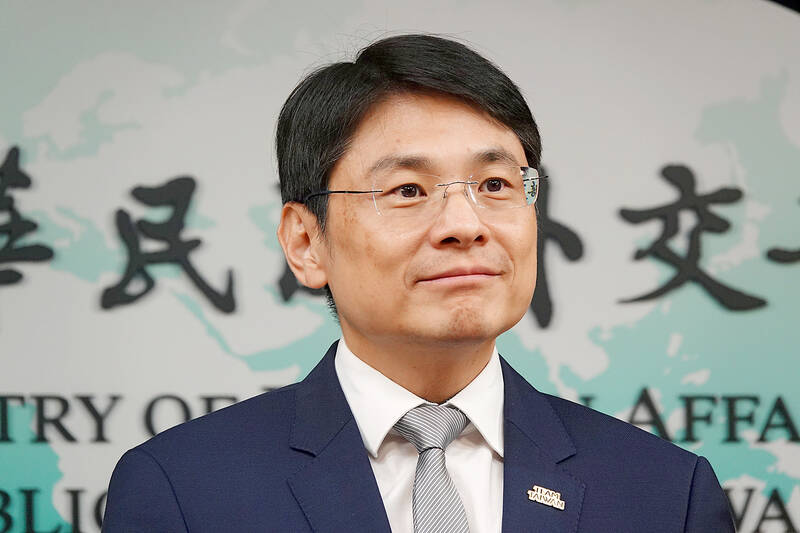
Photo: CNA
“Taiwan will maintain communication with the US, seeking to maintain the steady deepening of Taiwan-US relations and safeguard Taiwan’s interests,” Hsiao said.
The ministry also welcomed US Secretary of State Marco Rubio’s statements reiterating that the US policy on Taiwan remains unchanged and stressing the importance of maintaining stability across the Taiwan Strait, he said.
Trump on Monday told reporters at the White House that he would discuss the topic of arms sales to Taiwan during his meeting with Xi, as he suggested his personal chemistry with counterpart Xi Jinping would prevent a Chinese invasion of the island.
Asked if the United States should keep selling weapons to Taiwan, a key irritant for Beijing, Trump said: “President Xi would like us not to, and I’ll have that discussion. That’s one of the many things I’ll be talking about.”
Trump, after referencing Russia’s invasion of Ukraine, said of Taiwan, “I don’t think it’ll happen. I think we’ll be fine. I have a very good relationship with President Xi. He knows I don’t want that to happen.”
The MOFA spokesman was yesterday asked whether such a discussion would violate the “six assurances,” one of which is that the US will not hold prior consultations with Beijing regarding arms sales to Taiwan.
Hsiao did not answer directly, but said that since Trump took office, his administration has repeatedly stressed US support for Taiwan and taken concrete actions to implement long-standing and consistent US policy toward Taiwan, including in December last year announcing US$11.1 billion in arms sales, the largest-ever package approved for Taiwan.
Despite being aware that democratic countries support peace and stability in the Taiwan Strait as Beijing increasingly threatens Taiwan as well as regional security and stability, China continues to oppose US arms sales to Taiwan, he said.
In bilateral meetings with the US, China “continues to express such an unreasonable and groundless stance, attempting to mislead and distort the truth,” he said.
Taiwan is a critical component of the First Island Chain and a key node driving global economic growth, he said, adding that “we believe that strengthening our self-defense capabilities is the only way to preserve the peace and prosperity we have worked so hard to achieve.”
“Taiwan will continue to strengthen cooperation with the US to build up an effective deterrence and jointly safeguard peace across the Taiwan Strait,” Hsiao said.
“We also hope to demonstrate to the world Taiwan’s firm resolve in defending our nation and maintaining the current status quo,” he added.
Meanwhile, President William Lai (賴清德) yesterday thanked the US for helping Taiwan bolster its defense capabilities in an English-language video message to the Copenhagen Democracy Summit in Denmark.
He did not directly mention the Trump-Xi meeting.
Three decades ago Taiwan held its first free presidential election under the threat of missiles from China, and Taiwan is an important beacon of democracy in Asia, Lai said.
“The people of Taiwan have never backed down in the face of mounting external challenges, and they will never bow to pressure. Taiwan is a sovereign, independent nation,” he said.
“The Taiwanese people have every right to engage with the international community, and they are more than capable of contributing to it. No attempt to isolate Taiwan will alter our determination to participate in the international community,” Lai added.
Additional reporting by Reuters

‘NO SECURITY RISK’: The Railway Bureau reassured the public that the technicians’ activities were limited to technical guidance and did not involve sensitive systems The Railway Bureau yesterday said it had invited eight Chinese technicians to assist with an airport MRT construction project. The bureau issued the confirmation after an Internet user said Chinese nationals had entered the construction zone of Taiwan Taoyuan International Airport’s Terminal 3 project. They asked why “individuals from an enemy state” were allowed access to such a major national infrastructure project, which raised serious concerns over Taiwan’s industrial safety, sensitive systems and information security. The bureau’s Northern Region Engineering Branch Office said subcontractor Taiwan Handle Industrial Co (台灣手把工業) of the Taoyuan airport MRT’s “Contract No. CU05 Project A14 Station Civil, MEP &

A US uncrewed surface vessel (USV) encountered multiple Chinese warships during an autonomous transit of the Taiwan Strait, US defense company Seasats said in a statement on Wednesday. Seasats announced that a Lightfish USV had completed the first autonomous transit of the Taiwan Strait. Over five days, the USV traversed the entire length of the Strait while constantly monitoring surface vessel traffic, the company said. The Lightfish encountered multiple Chinese warships, one of which was a Chinese People’s Liberation Army Navy (PLAN) Type 056 corvette, it said. The Chinese vessels were operating “well within Taiwan’s exclusive economic zone without transmitting their identity via the
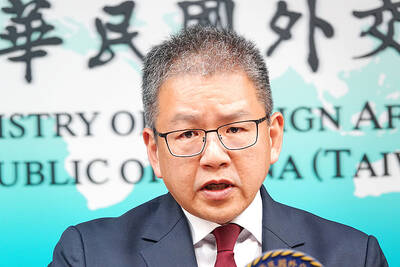
Taiwan is still in the process of assessing the possibility of recruiting workers from Eswatini, the Ministry of Foreign Affairs said yesterday, adding that its goal is to help Eswatini upgrade its vocational training centers. If there are plans to recruit workers from Eswatini, safeguarding national security, protecting public health and ensuring the employment rights of Taiwanese would be prerequisites, Department of West Asian and African Affairs Director-General Yen Chia-liang (顏嘉良) told a news conference. Key considerations would also include filling labor shortages in specific industries, and fostering bilateral professional and technical exchanges, he said. Yen was asked about the progress of labor
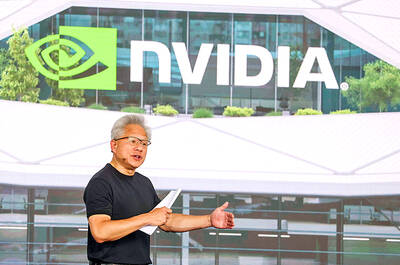
‘BOOMING’: ’ The number of partners we have here is incredible. You can see from their stock prices. They’re doing so well, they’re so happy,’ Jensen Huang said Nvidia Corp’s spending in Taiwan has ballooned to about US$150 billion a year, 10 times the US$10 billion to US$15 billion the company spent five years ago, Nvidia chief executive officer Jensen Huang (黃仁勳) said yesterday, suggesting Taiwan’s strategic importance in the global artificial intelligence (AI) supply chain. “Taiwan is the epicenter of the AI revolution. This is where the chips come, packaging comes. This is where the systems are made. This is where AI supercomputers were created,” Huang said at a meeting for the company’s employees in Beitou-Shilin Technology Park (北投士林科技園區) in Taipei, the planned site of Nvidia’s Taipei headquarters. “Taiwan


 RSS
RSS