


Philippine lawmakers yesterday voted by a wide margin to impeach Phlilippine Vice President Sara Duterte, setting the stage for a Senate trial that could end her 2028 presidential bid.
The articles of impeachment accuse the daughter of former Philippine president Rodrigo Duterte of graft, corruption, bribery and an alleged assassination plot against former ally, Philippine President Ferdinand Marcos Jr.
Under the Philippine constitution, a guilty verdict in the Senate would remove Sara Duterte from office and bar her from elected office for life.
“This is no longer just about politics. This is about conscience, duty and the future of our nation,” Philippine Representative Bienvenido Abante said immediately following the vote.
“This is not about 2028, this is not about political alliances, this is about whether we still believe that no one is above the law,” Abante said.
Lawmakers voted by a margin of 255 to 26 — with nine abstentions — to impeach.
The articles focus on misappropriation of public funds, unexplained assets, bribery of public officials, and an alleged death threat against Marcos and other family members.
The threat against Marcos stemmed from a late-night news conference in which Sara Duterte claimed to have hired an assassin to kill the president should he have her cut down first.
She later said her comments had been misinterpreted.
In a statement released after yesterday’s vote, Sara Duterte’s defense counsel said the burden of proof now lay with her accusers.
“We are fully prepared to defend the vice president before the Senate sitting as an Impeachment Court,” the statement said.
Sara Duterte and Marcos have been engaged in a high-stakes political brawl that erupted within weeks of their 2022 presidential election victory, when the vice president was denied her desired defense portfolio and instead named secretary of education.
The feud exploded into open warfare last year with her first impeachment, and the subsequent arrest and transfer of her father to face charges at the International Criminal Court in The Hague, Netherlands, tied to his deadly drug war.
It marks the second time the vice president has been impeached on mostly the same charges.
The Senate trial that followed her first impeachment saw senators don robes and convene a court on live television, only to send the case back to the House, a decision one lawmaker called a “functional dismissal.”
The upper chamber is now even more solidly stacked in Sara Duterte’s favor after a slate of candidates loyal to her outperformed expectations in May last year’s midterm elections, winning five of 12 open seats.
As the House impeachment vote got under way yesterday, longtime ally Philippine Senator Alan Peter Cayetano was voted in as the new Senate president in an election that had not been tipped beforehand.
Dennis Coronacion, chair of the political science department at Manila’s University of Santo Tomas, said before Cayetano’s election that he believed an acquittal was “highly possible” given the Senate’s new makeup.
However, the impeachment process and presentation of evidence against her were still likely to take a toll on Sara Duterte’s presidential hopes, he said.

‘NO SECURITY RISK’: The Railway Bureau reassured the public that the technicians’ activities were limited to technical guidance and did not involve sensitive systems The Railway Bureau yesterday said it had invited eight Chinese technicians to assist with an airport MRT construction project. The bureau issued the confirmation after an Internet user said Chinese nationals had entered the construction zone of Taiwan Taoyuan International Airport’s Terminal 3 project. They asked why “individuals from an enemy state” were allowed access to such a major national infrastructure project, which raised serious concerns over Taiwan’s industrial safety, sensitive systems and information security. The bureau’s Northern Region Engineering Branch Office said subcontractor Taiwan Handle Industrial Co (台灣手把工業) of the Taoyuan airport MRT’s “Contract No. CU05 Project A14 Station Civil, MEP &

A US uncrewed surface vessel (USV) encountered multiple Chinese warships during an autonomous transit of the Taiwan Strait, US defense company Seasats said in a statement on Wednesday. Seasats announced that a Lightfish USV had completed the first autonomous transit of the Taiwan Strait. Over five days, the USV traversed the entire length of the Strait while constantly monitoring surface vessel traffic, the company said. The Lightfish encountered multiple Chinese warships, one of which was a Chinese People’s Liberation Army Navy (PLAN) Type 056 corvette, it said. The Chinese vessels were operating “well within Taiwan’s exclusive economic zone without transmitting their identity via the
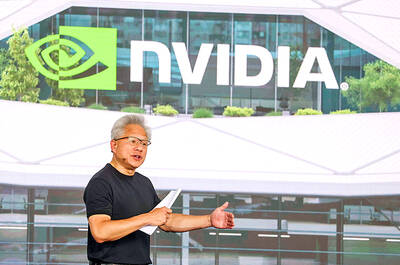
‘BOOMING’: ’ The number of partners we have here is incredible. You can see from their stock prices. They’re doing so well, they’re so happy,’ Jensen Huang said Nvidia Corp’s spending in Taiwan has ballooned to about US$150 billion a year, 10 times the US$10 billion to US$15 billion the company spent five years ago, Nvidia chief executive officer Jensen Huang (黃仁勳) said yesterday, suggesting Taiwan’s strategic importance in the global artificial intelligence (AI) supply chain. “Taiwan is the epicenter of the AI revolution. This is where the chips come, packaging comes. This is where the systems are made. This is where AI supercomputers were created,” Huang said at a meeting for the company’s employees in Beitou-Shilin Technology Park (北投士林科技園區) in Taipei, the planned site of Nvidia’s Taipei headquarters. “Taiwan
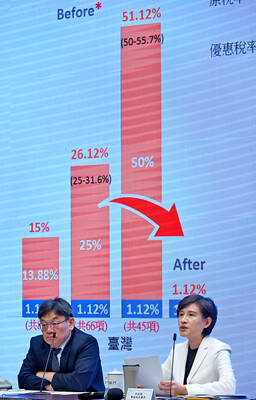
GREATER REACH? Auto parts and wood products would face tariffs of up to 15%, matching those targeting the EU, Japan and South Korea, Vice Premier said The US has announced that preferential tariff treatment for Taiwan’s non-semiconductor Section 232 goods would take effect retroactively from May 1, the Executive Yuan said yesterday. The US government yesterday posted a notice on the Federal Register’s public inspection Web site previewing tariff concessions for Taiwan under a memorandum of understanding (MOU) on Taiwan-US investment after two months of negotiations. The MOU signed on Jan. 15 stipulated three major preferential tariff arrangements: a 15 percent “reciprocal” tariff rate for Taiwan without stacking most-favored nation (MFN) rates; preferential Section 232 treatment for semiconductors and related products; and preferential Section 232 treatment for non-semiconductor


 RSS
RSS