


US senators have reportedly urged US President Donald Trump to move ahead with a Taiwan arms sale package that has been delayed ahead of his upcoming visit to China.
Trump is scheduled to visit China from tomorrow through Friday, during which he is expected to hold a summit with Chinese President Xi Jinping (習近平). A proposed US$14 billion arms package for Taiwan — the framework of which Trump approved last year — has been stalled ahead of the meeting.
The New York Times yesterday reported that US officials familiar with the approval process said the White House had paused the arms package in part to avoid disrupting Trump’s upcoming meeting with Xi.
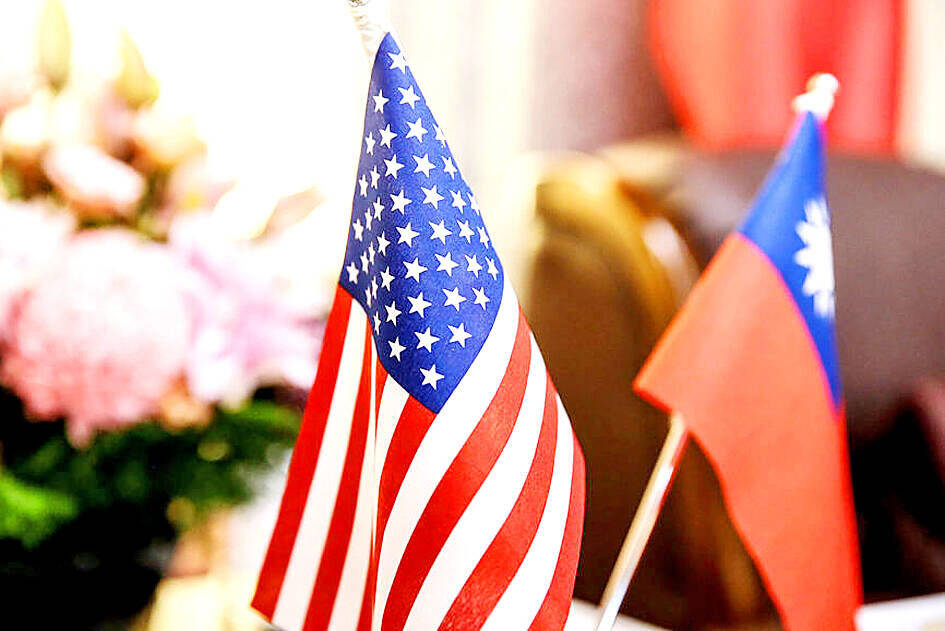
Photo: Cheng I-hwa, Bloomberg
In a letter cited by the newspaper that it said was sent on Friday last week, a group of eight bipartisan senators urged Trump to reaffirm the US’ commitment to Taiwan ahead of the summit, adding that Washington’s support for the nation should remain “inviolable.”
The lawmakers also warned against allowing Taiwan to be used as leverage in wider economic or diplomatic negotiations with Beijing.
“American support for Taiwan is not up for negotiation,” they were quoted as saying in the letter.
Referring to the special defense budget bill passed by the Legislative Yuan on Friday last week, the senators were quoted as saying that the vote showed a positive response to calls for Taipei to increase its own military spending.
“Just as Taiwan’s leaders demonstrated unity in support of their people’s defense, so too must we move ahead with pending US arms sales vital to our own national interests,” they were quoted as saying.
The New York Times article reported that “while support for Taiwan has long had strong backing in Congress, lawmakers in both parties have grown uneasy in Mr Trump’s second term over what some say are mixed signals from the White House.”
A report by CBS News on Sunday said that Taiwan remains Xi’s central focus for the summit despite wider geopolitical tensions.
CBS reported that Trump has indicated a willingness to discuss the US$14 billion package with Xi, raising concern in Taipei that Taiwan’s defense needs could become part of broader US-China negotiations.
CBS also reported that Beijing is pressing Washington to shift its official wording on Taiwan from “not supporting Taiwan independence” to the stronger formulation of “opposing Taiwan independence.”
Analysts cited in the report said that even subtle changes in diplomatic language could have significant implications for Taiwan’s security, as Beijing continues to describe “reunification” as “inevitable” and has not ruled out the use of force.
The report said that there are concerns in Taiwan that Trump could soften US support in exchange for trade concessions or broader cooperation with Beijing, and cited remarks by Trump that Taiwan’s future was “up to” Xi, although he has also said he would be “very unhappy” if China changed the “status quo” by force.
Deputy Minister of Foreign Affairs Chen Ming-chi (陳明祺), speaking to CBS, said he was not concerned that the US would abandon Taiwan, describing Washington as Taiwan’s “most reliable partner.”
Chen said Taiwan produces about 90 percent of the world’s advanced semiconductors, making Taiwan-US cooperation mutually beneficial.
He added that Taiwanese overwhelmingly reject Beijing’s “one country, two systems” model, saying China’s 2019 crackdown in Hong Kong had fundamentally shaped the public’s attitude toward the Chinese Communist Party.
“Taiwanese have never lived under Chinese Communist Party rule, even for one day,” Chen said, adding that democracy is deeply valued in Taiwan.

‘NO SECURITY RISK’: The Railway Bureau reassured the public that the technicians’ activities were limited to technical guidance and did not involve sensitive systems The Railway Bureau yesterday said it had invited eight Chinese technicians to assist with an airport MRT construction project. The bureau issued the confirmation after an Internet user said Chinese nationals had entered the construction zone of Taiwan Taoyuan International Airport’s Terminal 3 project. They asked why “individuals from an enemy state” were allowed access to such a major national infrastructure project, which raised serious concerns over Taiwan’s industrial safety, sensitive systems and information security. The bureau’s Northern Region Engineering Branch Office said subcontractor Taiwan Handle Industrial Co (台灣手把工業) of the Taoyuan airport MRT’s “Contract No. CU05 Project A14 Station Civil, MEP &

A US uncrewed surface vessel (USV) encountered multiple Chinese warships during an autonomous transit of the Taiwan Strait, US defense company Seasats said in a statement on Wednesday. Seasats announced that a Lightfish USV had completed the first autonomous transit of the Taiwan Strait. Over five days, the USV traversed the entire length of the Strait while constantly monitoring surface vessel traffic, the company said. The Lightfish encountered multiple Chinese warships, one of which was a Chinese People’s Liberation Army Navy (PLAN) Type 056 corvette, it said. The Chinese vessels were operating “well within Taiwan’s exclusive economic zone without transmitting their identity via the

Taiwan is still in the process of assessing the possibility of recruiting workers from Eswatini, the Ministry of Foreign Affairs said yesterday, adding that its goal is to help Eswatini upgrade its vocational training centers. If there are plans to recruit workers from Eswatini, safeguarding national security, protecting public health and ensuring the employment rights of Taiwanese would be prerequisites, Department of West Asian and African Affairs Director-General Yen Chia-liang (顏嘉良) told a news conference. Key considerations would also include filling labor shortages in specific industries, and fostering bilateral professional and technical exchanges, he said. Yen was asked about the progress of labor
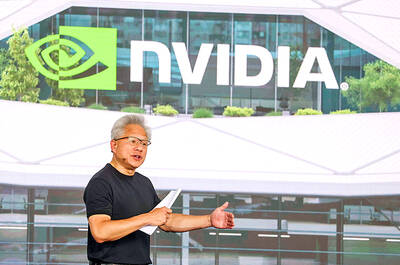
‘BOOMING’: ’ The number of partners we have here is incredible. You can see from their stock prices. They’re doing so well, they’re so happy,’ Jensen Huang said Nvidia Corp’s spending in Taiwan has ballooned to about US$150 billion a year, 10 times the US$10 billion to US$15 billion the company spent five years ago, Nvidia chief executive officer Jensen Huang (黃仁勳) said yesterday, suggesting Taiwan’s strategic importance in the global artificial intelligence (AI) supply chain. “Taiwan is the epicenter of the AI revolution. This is where the chips come, packaging comes. This is where the systems are made. This is where AI supercomputers were created,” Huang said at a meeting for the company’s employees in Beitou-Shilin Technology Park (北投士林科技園區) in Taipei, the planned site of Nvidia’s Taipei headquarters. “Taiwan


 RSS
RSS