


While welcoming the Legislative Yuan’s approval of a supplementary defense budget, the US Department of State said that further delays to Taiwan military spending are a “concession” to China.
The remarks came after the legislature on Friday passed the budget bill to fund the purchase of separate packages of military equipment from the US, with total spending capped at NT$780 billion (US$24.82 billion).
One package allocates NT$300 billion for arms sales approved by the US for Taiwan on Dec. 17 last year, while the other sets aside NT$480 billion for an arms package expected to be announced by Washington.
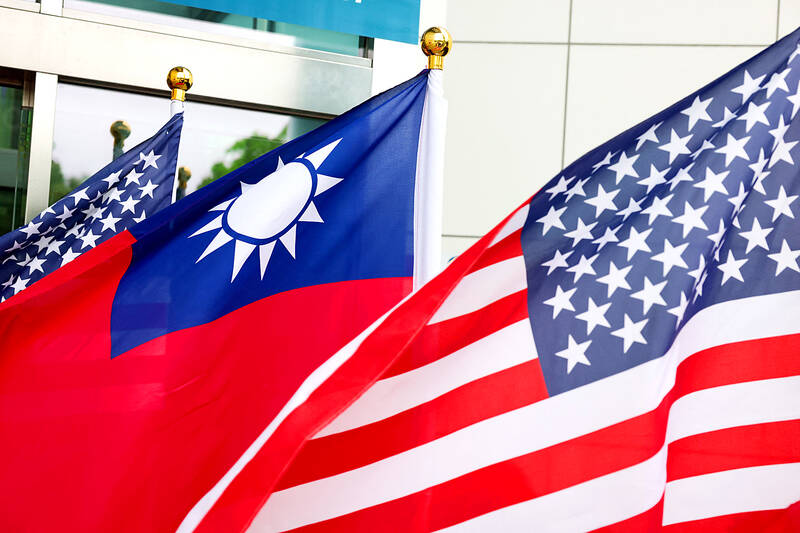
Photo: I-Hwa Cheng, AFP
The bill, which fell short of the NT$1.25 trillion requested by the ruling Democratic Progressive Party government, passed by a 59-0 margin with 48 abstentions in the 113-seat legislature.
The opposition said that while it supports defense spending, it would not sign “blank checks,” adding that the Cabinet’s proposal was vague in places and could open the door to corruption.
A US state department spokesperson said Washington supports Taiwan’s acquisition of critical defense capabilities “commensurate with the threat it faces” and consistent with the Taiwan Relations Act and more than 45 years of commitment across multiple US administrations.
“While we are encouraged by the passage of this special defense budget after unhelpful stalling, the United States notes that further delays in funding the remaining proposed capabilities are a concession to the Chinese Communist Party [CCP],” the spokesperson said.
The US is Taiwan’s most important international backer and arms supplier, despite the lack of formal diplomatic ties, and has supported increased military spending. Beijing has repeatedly demanded an end to weapons sales.
In a joint statement, Democratic US Senator Jeanne Shaheen and Republican US Senator John Curtis also welcomed the move, saying it would bolster Taiwan’s deterrence capabilities against growing aggression from the People’s Republic of China.
“Taiwan’s approval of this supplementary defense budget sends a strong signal of resolve at a critical moment for peace and stability across the Indo-Pacific,” they said.
The vote shows Taiwan is taking seriously the urgent need to strengthen its defenses amid growing Chinese military coercion and pressure campaigns, they added.
Taiwan’s investment in long-term deterrence demonstrates the nation’s unity and preparedness, the senators said.
“We also look forward to additional steps by Taiwan’s leaders to further strengthen investments in asymmetric capabilities and domestic defense production, which remain essential to long-term deterrence,” they added.
In Taipei, an American Institute in Taiwan (AIT) spokesperson said it welcomes the approval of the special defense budget and urged swift passage of the remaining funds needed for drones and integrated air and missile defense systems.
Any delay in these investments would weaken Taiwan’s security and play into the hands of the CCP, the spokesperson said.
A Taiwanese defense official yesterday said the US is highly concerned about the portions of investment in “asymmetric capabilities” that were excluded, describing Washington’s message as “very strong.”
While the US welcomed Friday’s approved NT$780 billion defense budget, the original comprehensive plan was underfunded after NT$480 billion was cut from it, said the official who declined to be named.
The US believes the remaining gaps must be filled to maintain the integrity of Taiwan’s full defense systems and ensure no critical capabilities are left out, they said.
Bolstering long-term deterrence is essential for countering China’s growing military pressure and preserving the “status quo” in the Taiwan Strait, they added.
Additional reporting by Su Yung-yao

SILENCING CRITICS: In addition to blocking Taiwan, China aimed to prevent rights activists from speaking out against authoritarian states, a Cabinet department said The Ministry of Foreign Affairs (MOFA) yesterday condemned transnational repression by Beijing after RightsCon, a major digital human rights conference scheduled to be held in Zambia this week, was abruptly canceled due to Chinese pressure over Taiwanese participation. This year’s RightsCon, the world’s largest conference discussing issues “at the intersection of human rights and technology,” was scheduled to take place from tomorrow to Friday in Lusaka, and expected to draw 2,600 in-person attendees from 150 countries, along with 1,100 online participants. However, organizers were forced to cancel the event due to behind-the-scenes pressure from China, the ministry said, expressing its “strongest condemnation”
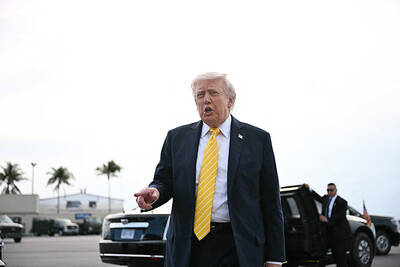
Iran’s Islamic Revolutionary Guard Corp (IRGC) yesterday said the US faced a choice between an “impossible” military operation or a “bad deal” with Tehran, after US President Donald Trump disparaged Iran’s latest peace proposal. Negotiations between the two countries have been deadlocked since a ceasefire came into effect on April 8, with only one round of direct peace talks held so far. Iran’s Tasnim and Fars news agencies reported that Tehran had submitted a 14-point proposal to mediator Pakistan, but Trump was quick to cast doubt on it. “I will soon be reviewing the plan that Iran has just sent to us, but

A group affiliated with indicted Chinese immigrant Xu Chunying (徐春鶯) is to be dissolved for monitoring Chinese immigrants in Taiwan, a source said yesterday. Xu, the secretary-general of the Cross-Strait Marriage and Family Service Alliance, was indicted on March 24 on charges of violating the Anti-Infiltration Act (反滲透法). The alliance “illegally monitored" Chinese immigrants living in Taiwan on behalf of the Chinese Communist Party (CCP) and the Ministry of the Interior is expected to dissolve the organization in the coming days under provisions of the Civil Associations Act (人民團體法), the source said. Xu, who married a Taiwanese in 1993 and became a Republic
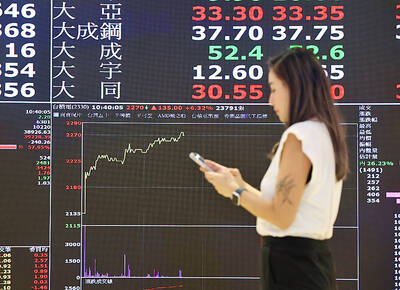
Taiwanese shares yesterday posted a record daily gain of more than 1,700 points to close above 40,000 points for the first time, led by large-cap semiconductor stocks such as Taiwan Semiconductor Manufacturing Co (TSMC, 台積電) and MediaTek Inc (聯發科) amid optimism about the artificial intelligence (AI) boom. The TAIEX ended up 1,778.51 points, or 4.57 percent, at 40,705.14 after moving between 39,228.39 and 40,755.52, while the New Taiwan dollar closed up NT$0.038 at NT$31.610 per US dollar, ending three consecutive sessions of declines. Turnover on the main board totaled NT$1.007 trillion (US$31.9 billion), with foreign institutional investors buying a net NT$66.98 billion


 RSS
RSS