

Taiwanese shares yesterday posted a record daily gain of more than 1,700 points to close above 40,000 points for the first time, led by large-cap semiconductor stocks such as Taiwan Semiconductor Manufacturing Co (TSMC, 台積電) and MediaTek Inc (聯發科) amid optimism about the artificial intelligence (AI) boom.
The TAIEX ended up 1,778.51 points, or 4.57 percent, at 40,705.14 after moving between 39,228.39 and 40,755.52, while the New Taiwan dollar closed up NT$0.038 at NT$31.610 per US dollar, ending three consecutive sessions of declines.
Turnover on the main board totaled NT$1.007 trillion (US$31.9 billion), with foreign institutional investors buying a net NT$66.98 billion of shares, the sixth-largest on record, while domestic investment trust firms bought a net NT$2.12 billion and proprietary traders acquired a net NT$8.94 billion of local equities, Taiwan Stock Exchange data showed.
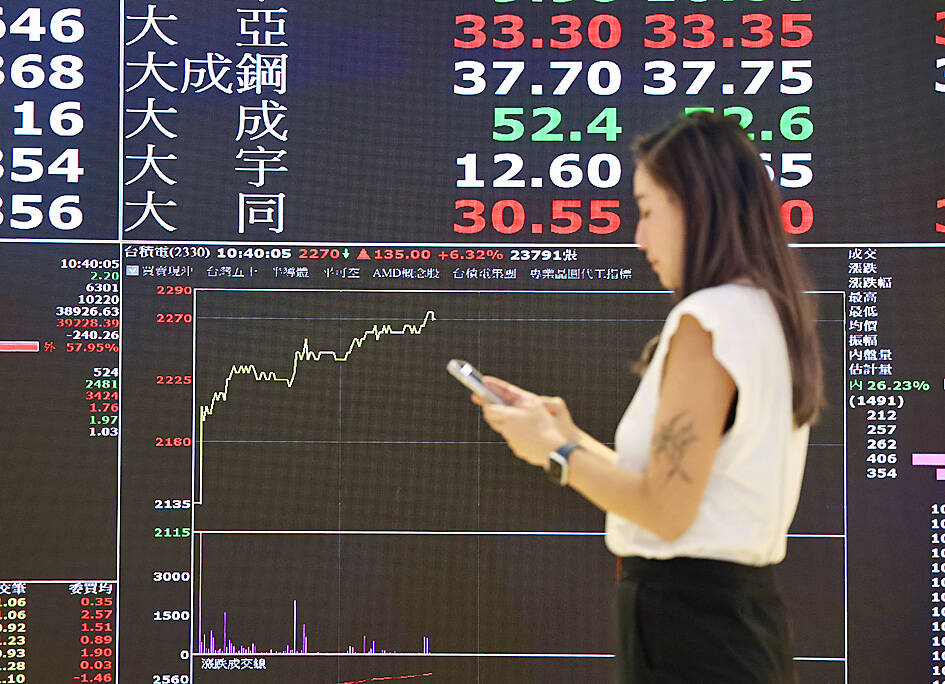
Photo: CNA
“Buying in the semiconductor industry was sparked by massive spending proposed by major US cloud service providers (CSPs) to enhance their AI infrastructure,” Concord Securities Co (康和證券) analyst Kerry Huang (黃志祺) said.
The four major US CSPs — Alphabet Inc’s Google, Amazon.com Inc, Microsoft Corp and Meta Platforms Inc — last week announced aggregate capital expenditure of US$725 billion for this year, up 77 percent year-on-year.
Investors were cheered by solid earnings from mega-cap tech companies, which saw the S&P 500 Index extend a record-breaking streak on Friday to a fifth week of gains.
“TSMC is the largest beneficiary of the trend, so investors rushed to pick up shares, driving the TAIEX sharply higher,” Huang said.
TSMC, which accounts for more than 40 percent of total market value, rose 6.56 percent to close at a high of NT$2,275. The stock’s gains contributed about 1,110 points to the TAIEX’s rise.
Smartphone chip designer MediaTek, which is expected to benefit from its efforts in application-specific integrated circuit development to meet demand for AI devices, soared 10 percent, the maximum daily increase.
Memory supplier Nanya Technology Corp (南亞科技) surged 10 percent on a supply shortage, and chip packaging and testing service firm ASE Technology Holding Co (日月光投控) jumped 10 percent on robust AI applications.
Outside the semiconductor industry, iPhone assembler and AI server maker Hon Hai Precision Industry Co (鴻海精密) gained 3.64 percent and Quanta Computer Inc (廣達電腦), another AI server supplier, added 1.76 percent.
Electric machinery stocks rose on the need for resilient electricity supply infrastructure to support AI, with Shihlin Electric & Engineering Corp (士林電機) up 6.3 percent and Allis Electric Co (亞力電機) up 10 percent.
As investors’ confidence recovers, the market’s focus should shift to firms’ revenue data for last month and their first-quarter financial results, equity analysts said.
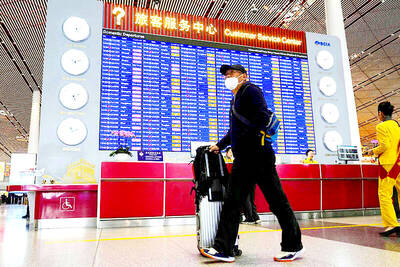
Taiwanese travelers could face exit restrictions as China expands government control under new regulations, an analyst said yesterday. China’s State Council has released new exit and entry regulations that expand the authorities’ power to restrict travel. Hung Pu-chao (洪浦釗), deputy head of Tunghai University’s Center for Mainland China and Regional Development Research, said the new regulations focus on managing cross-border activities as a whole, bringing the movement of talent, technology, information and social networks under the scope of national security oversight. The 19-part rules, which take effect on Sept. 15, were issued by Beijing for “regulating exit and entry management, protecting legitimate

Japan’s Defense White Paper released yesterday highlighted Taiwan Strait security as a major concern, saying China has expanded military activities around Taiwan, used repeated drills to normalize the presence of the Chinese People’s Liberation Army (PLA), and strengthened blockade, precision strike, and joint operation capabilities. Chinese military aircraft entering Taiwan’s surrounding airspace surpassed 3,700 sorties last year, a sharp increase from about 970 in 2021, the paper said, adding that Chinese naval activity around Taiwan also rose to about 2,600 sorties. Since 2022, Beijing has repeatedly conducted large-scale military drills around Taiwan, said the paper, which is titled Security for the Future. The
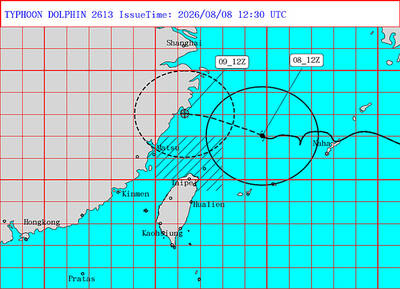
Typhoon Dolphin was expected to make its closest approach to Taiwan yesterday afternoon through today before continuing west toward China, the Central Weather Administration (CWA) said yesterday, forecasting that mountainous areas of Hsinchu and Miaoli could receive the heaviest rainfall, with precipitation expected to reach 350mm to 500mm. The rain could fall within a single day, raising the risk of torrential downpours, the agency warned. The likelihood of a land warning for Taiwan proper has been ruled out, while the chance of a land warning for outlying Lienchiang County has fallen from the previous day’s estimate, it added. If Dolphin’s track and
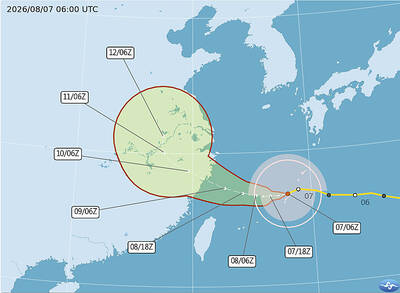
The Central Weather Administration (CWA) issued a sea warning for Typhoon Dolphin at 2:30pm yesterday, as the storm steadily moved toward the waters north of Taiwan, with heavy or extremely heavy rain expected over the weekend in the central mountains and the north. As of 5pm yesterday, Dolphin was about 680km east-northeast of Taipei and moving west at 10kph, with maximum sustained winds of 144kph and a storm radius of 280km, CWA data showed. While the typhoon has slowed slightly, it remains within forecast expectations and would not be longer than previously predicted, CWA forecaster Chu Mei-lin (朱美霖) told a news conference. The


 RSS
RSS