


China is slowing its efforts to repatriate Chinese nationals who are in the US illegally, a senior US official said, warning that Washington was prepared to increase travel restrictions on the country if Beijing did not reverse course.
The new US threat toward China comes just days before US President Donald Trump’s visit next week to Beijing, where he is expected to raise the deportation issue during meetings with Chinese President Xi Jinping (習近平).
The trip is an important one for Trump, who is hoping to win trade concessions from Beijing that he can present to voters ahead of November’s midterm elections that polls suggest could deliver losses for the Republican Party.

Photo: Reuters
Since returning to the White House early last year, Trump has threatened tariffs and sanctions on numerous countries for failing to accept deportees, a central pillar of his campaign for the White House and hard-line immigration policies.
China for years has resisted US requests to take back tens of thousands of its citizens who have overstayed or illegally entered the US.
When Trump took office, China had suggested it was willing to repatriate “confirmed Chinese nationals” following verification. However, it has said that doing so takes time.
After accepting about 3,000 deportees via charter and commercial flights early last year, China has scaled back cooperation in the past six months, the senior US official said on condition of anonymity.
China “refuses to fully cooperate with the United States to take back its citizens,” the official said, calling it a contravention of China’s international obligations and responsibility toward its people.
If China did not increase cooperation on deportations, the US would consider increased cash bonds accompanying visa applications, as well as denying more visas and blocking more entries at the border, the official said.
“Inaction by the Chinese government will jeopardize future travel for law-abiding Chinese citizens,” the official said.
The Chinese embassy in Washington did not immediately respond to a request for comment.
There are now more than 100,000 undocumented Chinese nationals in the US, the official said.
More than 30,000 have final orders of removal, and of those, authorities have detained more than 1,500 awaiting deportation. Most in this last category have committed other crimes, the official said.
Independent estimates of the number of undocumented Chinese nationals in the US vary. The Migration Policy Institute said that in mid-2022, as many as 239,000 Chinese immigrants were not authorized to be in the country.
The US wants Beijing to provide travel documents and approve US Customs and Border Protection charter flights with deportees, paid for by the US, to land in the country.
Under Section 243(d) of the Immigration and Nationality Act the US can place visa sanctions on countries deemed “recalcitrant” in complying with repatriation requests, a label the US Department of Homeland Security has routinely applied to China.
US authorities going back to former US president Barack Obama’s administration have said they believe China slow rolls the issuance of new travel documents for the deportees because it does not want to take them back or sees the issue as a useful point of leverage with Washington.
US law enforcement officials have told Reuters that China at times seeks to link Washington’s requests on deportations to Beijing’s requests to extradite economic or political fugitives who have fled to the US.

‘NO SECURITY RISK’: The Railway Bureau reassured the public that the technicians’ activities were limited to technical guidance and did not involve sensitive systems The Railway Bureau yesterday said it had invited eight Chinese technicians to assist with an airport MRT construction project. The bureau issued the confirmation after an Internet user said Chinese nationals had entered the construction zone of Taiwan Taoyuan International Airport’s Terminal 3 project. They asked why “individuals from an enemy state” were allowed access to such a major national infrastructure project, which raised serious concerns over Taiwan’s industrial safety, sensitive systems and information security. The bureau’s Northern Region Engineering Branch Office said subcontractor Taiwan Handle Industrial Co (台灣手把工業) of the Taoyuan airport MRT’s “Contract No. CU05 Project A14 Station Civil, MEP &

A US uncrewed surface vessel (USV) encountered multiple Chinese warships during an autonomous transit of the Taiwan Strait, US defense company Seasats said in a statement on Wednesday. Seasats announced that a Lightfish USV had completed the first autonomous transit of the Taiwan Strait. Over five days, the USV traversed the entire length of the Strait while constantly monitoring surface vessel traffic, the company said. The Lightfish encountered multiple Chinese warships, one of which was a Chinese People’s Liberation Army Navy (PLAN) Type 056 corvette, it said. The Chinese vessels were operating “well within Taiwan’s exclusive economic zone without transmitting their identity via the

Taiwan is still in the process of assessing the possibility of recruiting workers from Eswatini, the Ministry of Foreign Affairs said yesterday, adding that its goal is to help Eswatini upgrade its vocational training centers. If there are plans to recruit workers from Eswatini, safeguarding national security, protecting public health and ensuring the employment rights of Taiwanese would be prerequisites, Department of West Asian and African Affairs Director-General Yen Chia-liang (顏嘉良) told a news conference. Key considerations would also include filling labor shortages in specific industries, and fostering bilateral professional and technical exchanges, he said. Yen was asked about the progress of labor
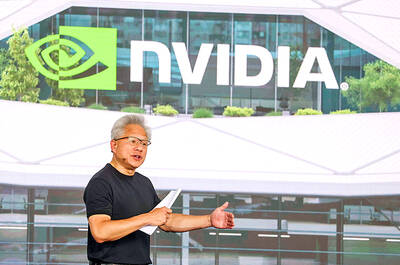
‘BOOMING’: ’ The number of partners we have here is incredible. You can see from their stock prices. They’re doing so well, they’re so happy,’ Jensen Huang said Nvidia Corp’s spending in Taiwan has ballooned to about US$150 billion a year, 10 times the US$10 billion to US$15 billion the company spent five years ago, Nvidia chief executive officer Jensen Huang (黃仁勳) said yesterday, suggesting Taiwan’s strategic importance in the global artificial intelligence (AI) supply chain. “Taiwan is the epicenter of the AI revolution. This is where the chips come, packaging comes. This is where the systems are made. This is where AI supercomputers were created,” Huang said at a meeting for the company’s employees in Beitou-Shilin Technology Park (北投士林科技園區) in Taipei, the planned site of Nvidia’s Taipei headquarters. “Taiwan


 RSS
RSS