


UN Security Council members were yesterday to begin talks on a US-Bahrain-backed draft resolution that could lead to sanctions against Iran, and potentially authorize force, if Tehran fails to halt attacks and threats to commercial shipping in the Strait of Hormuz, three Western diplomats said.
Fresh exchanges of fire on Monday underscored the stakes as the US and Iran struggle for control of the narrow waterway, a vital artery for global energy and trade, shaking a fragile four-week-old truce and reinforcing rival maritime blockades.
The US diplomatic push at the UN is in stark contrast to the past few months during which it has largely acted outside the UN framework, launching military strikes against Iran without seeking council authorization and pressing allies to join ad hoc naval patrols to enforce freedom of navigation.
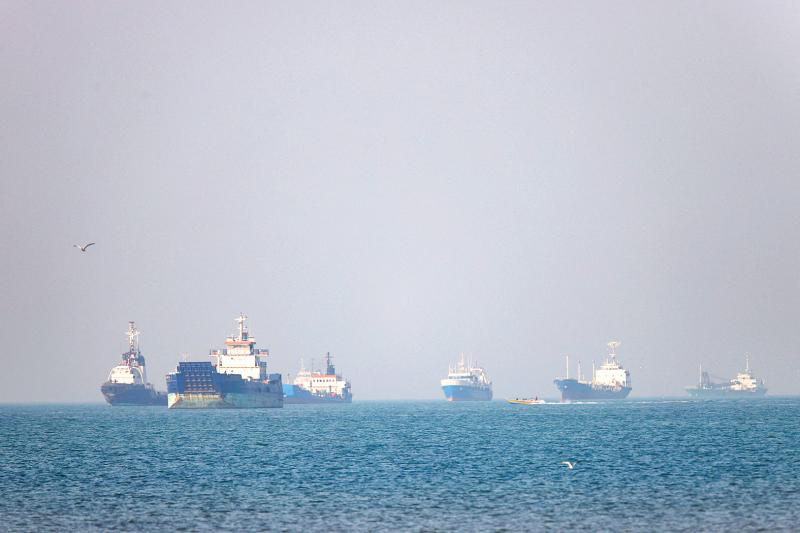
Photo: Amirhosein Khorgooi / ISNA / WANA via Reuters
That approach drew resistance from partners wary of open-ended conflict and legal exposure, prompting sharp criticism from US President Donald Trump against countries he accused of failing to align with US-led efforts.
Monday’s escalation, in which the US said it destroyed six Iranian small boats and Iranian missiles hit a United Arab Emirates oil port, followed Washington’s launch of “Project Freedom,” a US-led effort to move stranded tankers and other vessels through Hormuz.
Against that backdrop, the draft resolution forms part of what the diplomats described as a strategy to pressure Iran diplomatically and plan for a post-conflict situation.
Washington has also circulated a proposal, seen by Reuters, to partners for a new multinational maritime coalition, the Maritime Freedom Construct (MFC), aimed at establishing a post-conflict security architecture for the Middle East and reopening the strait once conditions stabilize.
An earlier Bahraini resolution that was backed by the US and appeared to open a path to legitimize its military action against Iran failed after Russia and China blocked it.
The new draft takes a more cautious approach, avoiding explicit language authorizing force while still operating under Chapter VII of the UN Charter, which allows the Security Council to impose measures ranging from sanctions to military action.
It condemns Iran’s alleged violations of the ceasefire and its “continuing actions and threats aimed at closing, obstructing, tolling, or otherwise interfering with the lawful exercise of navigational rights and freedoms through the Strait of Hormuz,” including the laying of sea mines.
It describes those actions as a threat to international peace and security and demands Iran immediately cease attacks, disclose the locations of any mines and not impede clearance operations.
The text also calls on Tehran to cooperate with UN efforts to establish a humanitarian corridor through the Strait, citing the disruption of aid deliveries, fertilizer shipments and other essential goods.
The UN secretary-general would report back within 30 days on compliance with the measures. The Security Council would reconvene to consider additional steps, including possible sanctions, if Iran failed to implement the resolution.
Diplomats said Washington hopes to close negotiations quickly, with the aim of circulating a final draft by May 8 and holding a vote early next week, although Russia and China still have a competing text under consideration.

‘NO SECURITY RISK’: The Railway Bureau reassured the public that the technicians’ activities were limited to technical guidance and did not involve sensitive systems The Railway Bureau yesterday said it had invited eight Chinese technicians to assist with an airport MRT construction project. The bureau issued the confirmation after an Internet user said Chinese nationals had entered the construction zone of Taiwan Taoyuan International Airport’s Terminal 3 project. They asked why “individuals from an enemy state” were allowed access to such a major national infrastructure project, which raised serious concerns over Taiwan’s industrial safety, sensitive systems and information security. The bureau’s Northern Region Engineering Branch Office said subcontractor Taiwan Handle Industrial Co (台灣手把工業) of the Taoyuan airport MRT’s “Contract No. CU05 Project A14 Station Civil, MEP &

A US uncrewed surface vessel (USV) encountered multiple Chinese warships during an autonomous transit of the Taiwan Strait, US defense company Seasats said in a statement on Wednesday. Seasats announced that a Lightfish USV had completed the first autonomous transit of the Taiwan Strait. Over five days, the USV traversed the entire length of the Strait while constantly monitoring surface vessel traffic, the company said. The Lightfish encountered multiple Chinese warships, one of which was a Chinese People’s Liberation Army Navy (PLAN) Type 056 corvette, it said. The Chinese vessels were operating “well within Taiwan’s exclusive economic zone without transmitting their identity via the
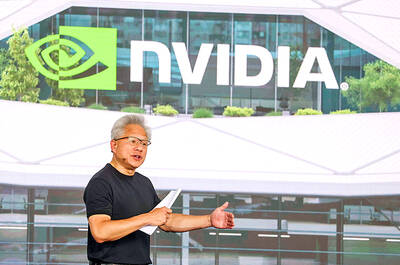
‘BOOMING’: ’ The number of partners we have here is incredible. You can see from their stock prices. They’re doing so well, they’re so happy,’ Jensen Huang said Nvidia Corp’s spending in Taiwan has ballooned to about US$150 billion a year, 10 times the US$10 billion to US$15 billion the company spent five years ago, Nvidia chief executive officer Jensen Huang (黃仁勳) said yesterday, suggesting Taiwan’s strategic importance in the global artificial intelligence (AI) supply chain. “Taiwan is the epicenter of the AI revolution. This is where the chips come, packaging comes. This is where the systems are made. This is where AI supercomputers were created,” Huang said at a meeting for the company’s employees in Beitou-Shilin Technology Park (北投士林科技園區) in Taipei, the planned site of Nvidia’s Taipei headquarters. “Taiwan
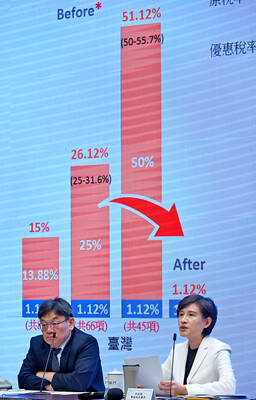
GREATER REACH? Auto parts and wood products would face tariffs of up to 15%, matching those targeting the EU, Japan and South Korea, Vice Premier said The US has announced that preferential tariff treatment for Taiwan’s non-semiconductor Section 232 goods would take effect retroactively from May 1, the Executive Yuan said yesterday. The US government yesterday posted a notice on the Federal Register’s public inspection Web site previewing tariff concessions for Taiwan under a memorandum of understanding (MOU) on Taiwan-US investment after two months of negotiations. The MOU signed on Jan. 15 stipulated three major preferential tariff arrangements: a 15 percent “reciprocal” tariff rate for Taiwan without stacking most-favored nation (MFN) rates; preferential Section 232 treatment for semiconductors and related products; and preferential Section 232 treatment for non-semiconductor


 RSS
RSS