


Japanese Prime Minister Sanae Takaichi yesterday vowed to do more to ensure a “free and open Indo-Pacific,” using a speech in communist Vietnam to tout a regional strategy that has long rankled neighboring China.
“I am renewing my determination to fulfill Japan’s responsibilities and... to play an even more proactive role than ever before in building an international order based on freedom, openness, diversity, inclusiveness and the rule of law,” she said in an address at a Hanoi university.
In an era of “intensifying geopolitical competition, accelerating technological innovation,” Takaichi called for Asian countries to cultivate “resilience” and the ability to “determine their own future.”
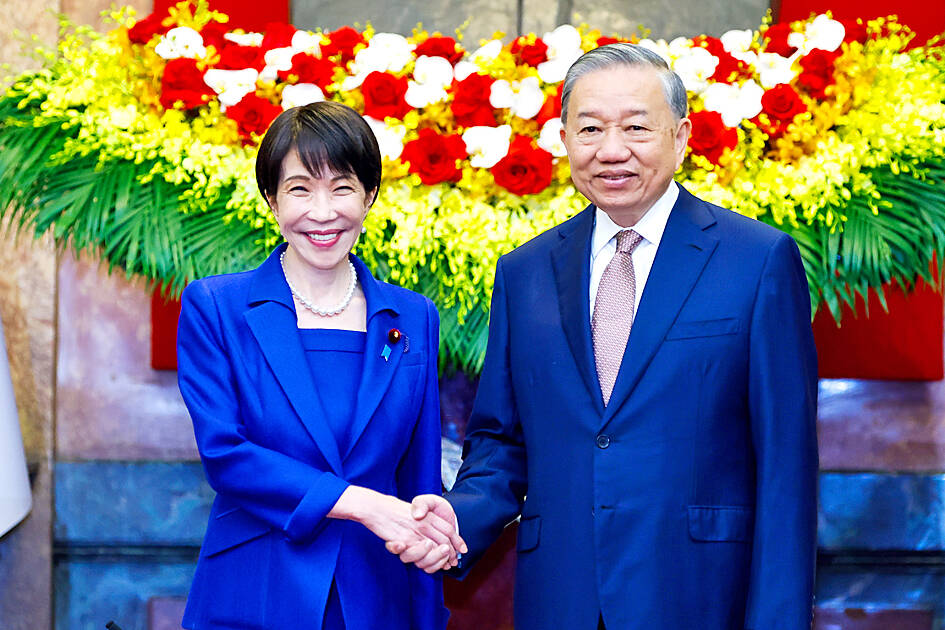
Photo: EPA
Japan and Vietnam share common concerns about China’s territorial claims in the East and South China seas, and have sought to hedge against US-driven trade disruptions by broadening economic and security ties.
However, Hanoi aims to stay on good terms with all global powers through its traditional “bamboo diplomacy” approach, while Tokyo has seen its already frosty relations with Beijing deteriorate markedly in recent months.
That makes Vietnam a striking choice of venue for a Japanese foreign policy speech touting a strategy backed by Washington and closely associated with US President Donald Trump.
First articulated a decade ago by Takaichi’s mentor, former Japanese prime minister Shinzo Abe, the idea of a “free and open” Indo-Pacific region has since been embraced by multiple US partners and allies seeking to curb China’s influence in the region.
Beijing has slammed the initiative as veiled attempt to promote bloc confrontation, with Chinese Ministry of Foreign Affairs spokesman Lin Jian (林劍) accusing Tokyo of “stirring up confrontation between camps.”
Takaichi said she was updating the diplomatic vision for a “challenging” new era.
Without naming Beijing directly, she warned against “excessive dependence on a single country for critical goods,” saying this often results from “unduly low prices” and calling for a “level playing field.”
She also underscored the importance of open shipping lanes, saying “regional supply chains are underpinned by the safe and open navigation of sea.”
Long considered a China hawk, Takaichi drew a sharp rebuke from Beijing in November last year when she suggested that Japan might intervene militarily to thwart any Chinese attempt to take Taiwan.
China summoned Japan’s ambassador, warned Chinese citizens against visiting Japan and imposed trade restrictions.
Japan, which like others in the region has territorial disputes with China, has moved to deepen security cooperation ties, in particular with the Philippines.
Takaichi, on her first visit to Vietnam since becoming prime minister in October last year, aims to deepen bilateral cooperation on energy security and supply chain resilience amid major disruptions stemming from the Middle East crisis.
Japan is Vietnam’s largest provider of official development assistance, and a key investor and trading partner, with two-way trade surpassing US$50 billion for the first time last year.
Takaichi met with Vietnamese Prime Minister Le Minh Hung and Vietnamese President To Lam yesterday.
They agreed to advance their high-level strategic partnership to a “new phase of development,” Hung said.
They also inked six agreements spanning technology, climate preparedness, and information and communication.
The two sides agreed to deepen security cooperation and “reaffirmed the importance of resolving disputes in the South China Sea through peaceful means based on international law,” Hung said.
Prior to her speech, Takaichi said “Vietnam highlights strategic self-reliance with a positive and active external foreign policy.”
“Therefore, increasing cooperation with Vietnam is extremely important for the realization and progress of [a] free and open Indo-Pacific.”
Takaichi is to travel to Australia after departing Vietnam today.

‘NO SECURITY RISK’: The Railway Bureau reassured the public that the technicians’ activities were limited to technical guidance and did not involve sensitive systems The Railway Bureau yesterday said it had invited eight Chinese technicians to assist with an airport MRT construction project. The bureau issued the confirmation after an Internet user said Chinese nationals had entered the construction zone of Taiwan Taoyuan International Airport’s Terminal 3 project. They asked why “individuals from an enemy state” were allowed access to such a major national infrastructure project, which raised serious concerns over Taiwan’s industrial safety, sensitive systems and information security. The bureau’s Northern Region Engineering Branch Office said subcontractor Taiwan Handle Industrial Co (台灣手把工業) of the Taoyuan airport MRT’s “Contract No. CU05 Project A14 Station Civil, MEP &

A signaling system malfunction disrupted high-speed rail (HSR) services beginning at 8am today, with trains temporarily reduced to three northbound and three southbound trains per hour as authorities conduct inspections. The malfunction occurred on a section of track in Miaoli County during pre-operation checks early this morning, forcing northbound and southbound trains to use a single track, the HSR operator said. The regular schedule has been replaced with three hourly trains offering only nonreserved seating in each direction, stopping at every station, it said, adding that business class cars would still have reserved seating. Departures from terminal stations are scheduled at the top

Taiwan is still in the process of assessing the possibility of recruiting workers from Eswatini, the Ministry of Foreign Affairs said yesterday, adding that its goal is to help Eswatini upgrade its vocational training centers. If there are plans to recruit workers from Eswatini, safeguarding national security, protecting public health and ensuring the employment rights of Taiwanese would be prerequisites, Department of West Asian and African Affairs Director-General Yen Chia-liang (顏嘉良) told a news conference. Key considerations would also include filling labor shortages in specific industries, and fostering bilateral professional and technical exchanges, he said. Yen was asked about the progress of labor

A US uncrewed surface vessel (USV) encountered multiple Chinese warships during an autonomous transit of the Taiwan Strait, US defense company Seasats said in a statement on Wednesday. Seasats announced that a Lightfish USV had completed the first autonomous transit of the Taiwan Strait. Over five days, the USV traversed the entire length of the Strait while constantly monitoring surface vessel traffic, the company said. The Lightfish encountered multiple Chinese warships, one of which was a Chinese People’s Liberation Army Navy (PLAN) Type 056 corvette, it said. The Chinese vessels were operating “well within Taiwan’s exclusive economic zone without transmitting their identity via the


 RSS
RSS