


British Prime Minister Keir Starmer’s decision last month to let the British military board ships of Russia’s so-called “shadow fleet” has had no clear effect on the number passing through UK waters, a Reuters analysis showed.
In the month after Starmer’s March 25 threat, at least 98 Russian vessels subject to UK sanctions transited its waters, about the same as each of the past three months.
There has been no announcement of any boarding or detention of the ships, which typically have an opaque ownership structure and can transport oil, grains and arms, often in support of Russia’s war in Ukraine.
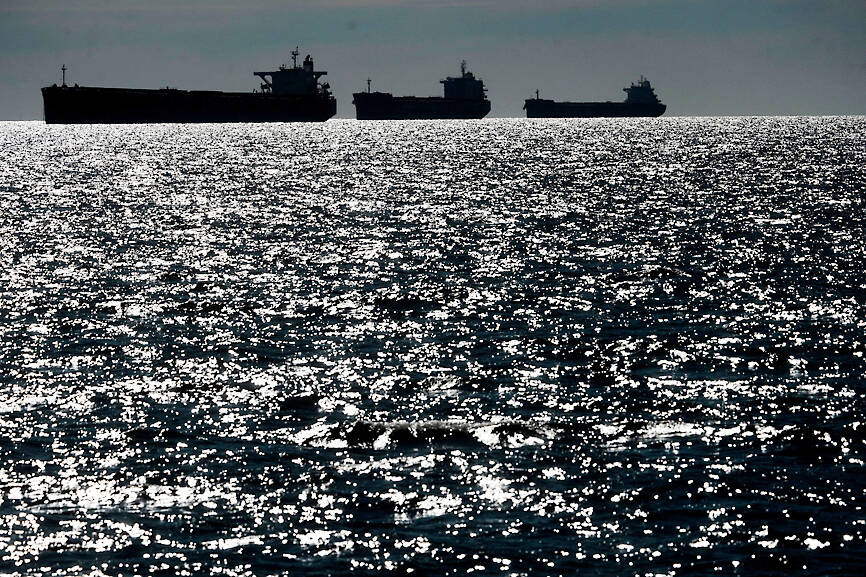
Photo: Reuters
Tracking data from LSEG — a London-based provider of financial data, analytics, news and index products — showed that 63 ships passed within 12 nautical miles (22.2km) of the coastline in the English Channel, the most direct route between the Baltic Sea and southern Europe.
Another 35 traveled through Britain’s exclusive economic zone, which extends up to 200 nautical miles from the coast, mainly around north Scotland.
“You have to quickly follow up with boardings or otherwise those vessels will conclude that it was an empty threat — and that is the regrettable situation we are in now,” said Elisabeth Braw, a maritime security expert at the Washington-based Atlantic Council.
Other European countries, including France, Belgium and Sweden, have in the past few months boarded and detained vessels in the Russian “shadow fleet.”
The British Ministry of Defence did not respond to a request for comment on its relative inaction.
Once a fabled sea power, Britain’s navy is the smallest it has been since the 17th century, yet its military is facing requests from allies to support operations in eastern Europe, the arctic and the Middle East.
London has 544 vessels linked to Russia’s “shadow fleet” on its sanctions list.
The data suggested that at least 10 ships passing through had engaged in “spoofing” — turning off or manipulating their tracking systems — when crossing British waters.
The Kremlin says sanctions against its ships are illegal and called Britain’s latest policy a “deeply hostile move” that could draw retaliation.
Analysts say that the UK’s lack of follow-through reflects several challenges, including lack of a dedicated coast guard with law-enforcement powers — unlike France or Sweden — plus the legal and economic complications of dealing with so many ships.

A signaling system malfunction disrupted high-speed rail (HSR) services beginning at 8am today, with trains temporarily reduced to three northbound and three southbound trains per hour as authorities conduct inspections. The malfunction occurred on a section of track in Miaoli County during pre-operation checks early this morning, forcing northbound and southbound trains to use a single track, the HSR operator said. The regular schedule has been replaced with three hourly trains offering only nonreserved seating in each direction, stopping at every station, it said, adding that business class cars would still have reserved seating. Departures from terminal stations are scheduled at the top

‘NO SECURITY RISK’: The Railway Bureau reassured the public that the technicians’ activities were limited to technical guidance and did not involve sensitive systems The Railway Bureau yesterday said it had invited eight Chinese technicians to assist with an airport MRT construction project. The bureau issued the confirmation after an Internet user said Chinese nationals had entered the construction zone of Taiwan Taoyuan International Airport’s Terminal 3 project. They asked why “individuals from an enemy state” were allowed access to such a major national infrastructure project, which raised serious concerns over Taiwan’s industrial safety, sensitive systems and information security. The bureau’s Northern Region Engineering Branch Office said subcontractor Taiwan Handle Industrial Co (台灣手把工業) of the Taoyuan airport MRT’s “Contract No. CU05 Project A14 Station Civil, MEP &

Taiwan is still in the process of assessing the possibility of recruiting workers from Eswatini, the Ministry of Foreign Affairs said yesterday, adding that its goal is to help Eswatini upgrade its vocational training centers. If there are plans to recruit workers from Eswatini, safeguarding national security, protecting public health and ensuring the employment rights of Taiwanese would be prerequisites, Department of West Asian and African Affairs Director-General Yen Chia-liang (顏嘉良) told a news conference. Key considerations would also include filling labor shortages in specific industries, and fostering bilateral professional and technical exchanges, he said. Yen was asked about the progress of labor

A US uncrewed surface vessel (USV) encountered multiple Chinese warships during an autonomous transit of the Taiwan Strait, US defense company Seasats said in a statement on Wednesday. Seasats announced that a Lightfish USV had completed the first autonomous transit of the Taiwan Strait. Over five days, the USV traversed the entire length of the Strait while constantly monitoring surface vessel traffic, the company said. The Lightfish encountered multiple Chinese warships, one of which was a Chinese People’s Liberation Army Navy (PLAN) Type 056 corvette, it said. The Chinese vessels were operating “well within Taiwan’s exclusive economic zone without transmitting their identity via the


 RSS
RSS