


The US Department of Defense yesterday said its forces boarded a vessel in the Indian Ocean that was transporting oil from Iran, as disruption from a standoff with the Islamic republic continued to batter the world economy.
The announcement came hours after a senior Iranian official said the country had banked the first proceeds from tolls it is exacting on shipping through the Strait of Hormuz, a waterway that has become the focal point of the confrontation with the US.
With planned peace talks hanging in the balance, more fuel-hungry airlines canceled flights, oil prices opened higher and the keenly watched S&P Global PMI index showed eurozone business activity shrinking for the first time in 16 months.
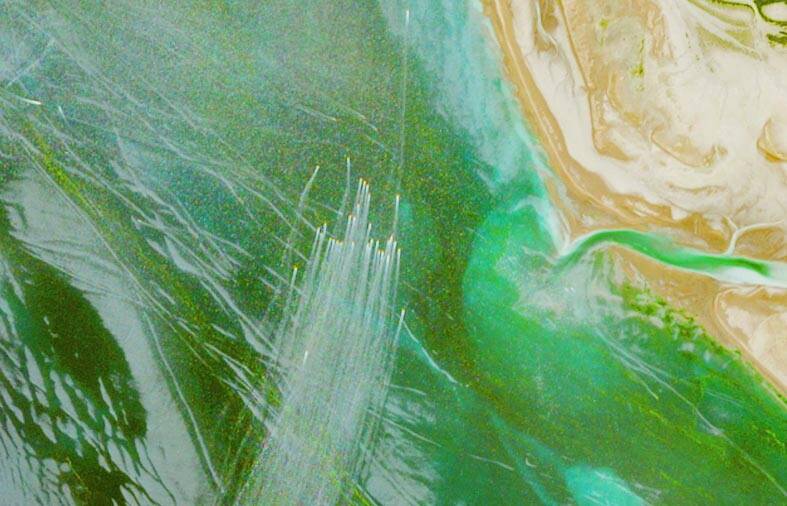
Photo: European Union / Copernicus Sentinel-2 via Reuters
Iran vowed it would keep the strait closed to all but a trickle of approved vessels for as long as the US blockaded its ports, brushing off demands from US President Donald Trump to reopen Hormuz and surrender its enriched uranium.
The US earlier this month responded by imposing its own blockade of Iranian ports, and yesterday the Pentagon announced on X that US forces had “carried out a maritime interdiction and right-of-visit boarding of the sanctioned stateless vessel M/T Majestic X transporting oil from Iran, in the Indian Ocean.”
The post included footage of US military personnel rappelling from helicopters onto the deck of a large tanker.
The US would “continue global maritime enforcement to disrupt illicit networks and interdict vessels providing material support to Iran, wherever they operate,” the statement said.
While strikes across the region have mostly ceased since the two-week-old truce began, there has been no letup in the confrontation over Hormuz, with both sides seeking economic leverage — only for Trump to announce an indefinite ceasefire to create space for more talks.
“A complete ceasefire only has meaning if it is not violated through a naval blockade,” said Iranian Parliamentary Speaker Mohammad Bagher Ghalibaf, who led Tehran’s delegation at a first round of talks in Pakistan. “Reopening the Strait of Hormuz is not possible amid a blatant violation of the ceasefire.”
Ghalibaf’s deputy, Hamidreza Hajibabaei, said Iran received its first revenue from tolls it is imposing on ships seeking to cross Hormuz, a route that in peacetime accounts for one-fifth of the world’s oil and gas flows, and other vital commodities.
Analysts said Tehran, in particular its leaders associated with the Islamic Revolutionary Guards Corps, believes that Iran’s blockade gives it sufficient economic leverage to force Washington to back down on its main demands in peace talks.
Some, such as Danny Citrinowicz, a senior researcher at the Institute for National Security Studies in Tel Aviv, criticized Israel and the US for misreading the Iranian government’s position.
“Tehran has consistently demonstrated a willingness to absorb economic pain while holding firm on what it views as core national interests. There is little reason to believe this time will be different,” he wrote on social media.
“Rather than moving toward concession, Iran is positioning itself to escalate,” he said.

‘NO SECURITY RISK’: The Railway Bureau reassured the public that the technicians’ activities were limited to technical guidance and did not involve sensitive systems The Railway Bureau yesterday said it had invited eight Chinese technicians to assist with an airport MRT construction project. The bureau issued the confirmation after an Internet user said Chinese nationals had entered the construction zone of Taiwan Taoyuan International Airport’s Terminal 3 project. They asked why “individuals from an enemy state” were allowed access to such a major national infrastructure project, which raised serious concerns over Taiwan’s industrial safety, sensitive systems and information security. The bureau’s Northern Region Engineering Branch Office said subcontractor Taiwan Handle Industrial Co (台灣手把工業) of the Taoyuan airport MRT’s “Contract No. CU05 Project A14 Station Civil, MEP &

A US uncrewed surface vessel (USV) encountered multiple Chinese warships during an autonomous transit of the Taiwan Strait, US defense company Seasats said in a statement on Wednesday. Seasats announced that a Lightfish USV had completed the first autonomous transit of the Taiwan Strait. Over five days, the USV traversed the entire length of the Strait while constantly monitoring surface vessel traffic, the company said. The Lightfish encountered multiple Chinese warships, one of which was a Chinese People’s Liberation Army Navy (PLAN) Type 056 corvette, it said. The Chinese vessels were operating “well within Taiwan’s exclusive economic zone without transmitting their identity via the
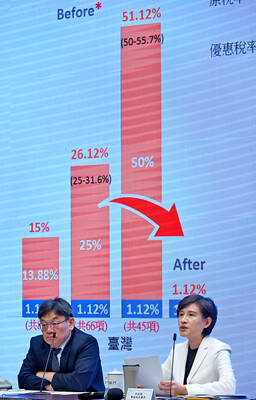
GREATER REACH? Auto parts and wood products would face tariffs of up to 15%, matching those targeting the EU, Japan and South Korea, Vice Premier said The US has announced that preferential tariff treatment for Taiwan’s non-semiconductor Section 232 goods would take effect retroactively from May 1, the Executive Yuan said yesterday. The US government yesterday posted a notice on the Federal Register’s public inspection Web site previewing tariff concessions for Taiwan under a memorandum of understanding (MOU) on Taiwan-US investment after two months of negotiations. The MOU signed on Jan. 15 stipulated three major preferential tariff arrangements: a 15 percent “reciprocal” tariff rate for Taiwan without stacking most-favored nation (MFN) rates; preferential Section 232 treatment for semiconductors and related products; and preferential Section 232 treatment for non-semiconductor
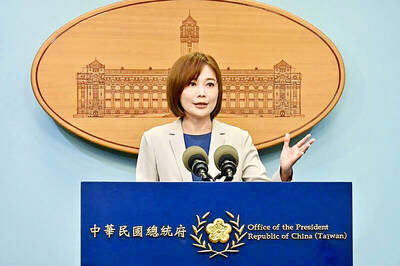
TIT-FOR-TAT: The US allegedly revoked the visa of a Chinese national working at Xinhua News Agency in the US in response to Beijing’s expulsion of Vivian Wang The Presidential Office yesterday condemned China for expelling a New York Times correspondent from Beijing following the newspaper’s interview with President William Lai (賴清德), saying the move highlighted Beijing’s suppression of press freedom and its threat to international news media. Taiwan has noted a series of recent incidents in which Beijing used similar tactics to “threaten and pressure international media outlets and journalists,” Presidential Office spokeswoman Karen Kuo (郭雅慧) said in a statement. “This concerns not only press freedom and freedom of expression, but also the safety of journalists, and Taiwan and relevant partners are paying close attention to the situation,” she


 RSS
RSS