

South Korean President Lee Jae-myung has rejected as “absurd” claims that his minister overseeing relations with North Korea revealed classified information provided by the US on Pyongyang’s nuclear facilities.
South Korean media have reported that the US has stopped sharing some intelligence on North Korea, partly because South Korean Minister of Unification Chung Dong-young spoke publicly about a previously unconfirmed uranium enrichment facility in the country.
Chung and his ministry have said his comments last month about the facility in an area called Kusong in North Korea were based on publicly available information, including research reports.
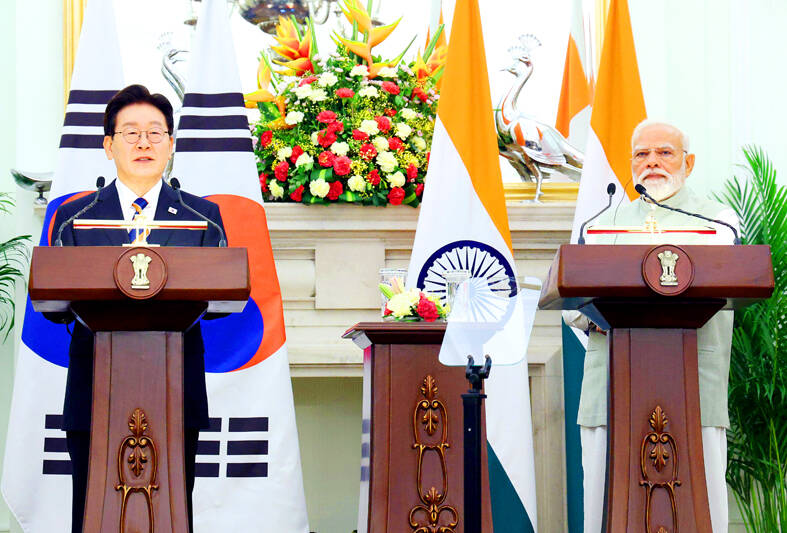
Photo: EPA
“It’s a clear fact that the existence of the Kusong nuclear facility was widely known globally even before Chung’s public comments through various research reports and news media,” Lee wrote on X late on Monday.
“Any claim or action based on the idea that Minister Chung ‘leaked classified information provided by the US’ is wrong. I’ll be looking closely into why something as absurd as this is happening,” he wrote.
Asked for comment, the US embassy in Seoul said it did not discuss details of diplomatic conversations.
The South Korean Ministry of National Defense yesterday said that US and South Korean intelligence authorities were maintaining close communication, including on North Korean missile launches, and that a robust intelligence-
sharing system between the allies remained in place.
Intelligence sharing between the allies was conducted on a mutually complementary basis, the ministry said, adding that analysis of North Korea’s ballistic missile launch on Sunday was conducted through the exchange and cross-verification of information by both sides.
The ministry also rejected an allegation raised by an opposition lawmaker calling for Chung’s dismissal, including a claim that the commander of US Forces Korea had protested strongly to South Korea’s defense minister over the issue.
Chung told a parliamentary committee last month that North Korea had been enriching weapons-grade uranium at Kusong, as well as in previously confirmed or suspected sites in Yongbyon and Kangson.
Yonhap News Agency yesterday reported that the US had limited sharing of some intelligence gathered from spy satellites.
The two countries have a defense treaty and the US has a major military presence in South Korea, including 28,500 troops.
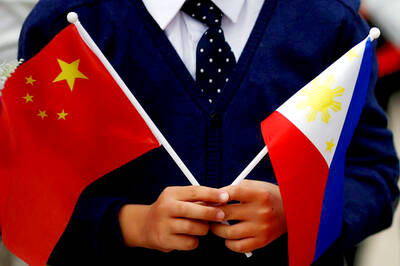
The Philippine Coast Guard yesterday said it has deployed its largest vessel and an aircraft to challenge a Chinese research ship operating off northern Batanes near Taiwan, adding that a Chinese coast guard vessel had also moved in. The Philippine operation “disrupted the vessel’s unauthorized marine scientific research and compelled it to leave its loitering position,” said Jay Tarriela, Philippine Coast Guard spokesperson on South China Sea issues. The Philippine Coast Guard said the BRP Teresa Magbanua and an aircraft were deployed to counter the Chinese vessel, which it said had remained about 37 nautical miles northwest of Itbayat Island since Monday. The
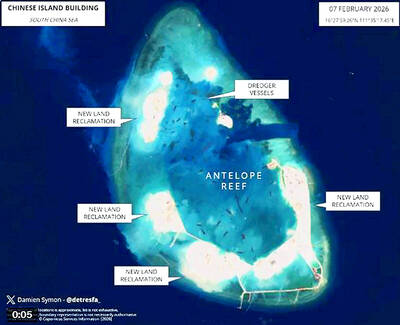
RUNWAY: Analysts said the first aircraft landing is expected by the middle of next year, while Chinese state media said it would serve civilian needs Chinese construction of a runway on Antelope Reef (Lingyang Reef, 羚羊礁) in the Paracel Islands (Xisha Islands, 西沙群島), is well under way with analysts estimating it could be completed by the middle of next year, strengthening Beijing’s military control over the disputed South China Sea. Satellite images reviewed by Reuters show grading work, piles of gravel and concrete, and compaction cranes in operation to build a full-scale runway that military attaches and security analysts say could be one of China’s most important offshore bases in the region. The images, taken on Friday last week by commercial satellite imagery provider Vantor, also show

SHIFTING COOPERATION: With the new arrangement, US representatives would be able to participate directly in defense discussions, including weapons procurement Taiwan-US military cooperation is deepening, with the Pentagon expected to station personnel at the Ministry of National Defense (MND), sources said. The NT$470 million (US$14.77 million) joint program is scheduled to run from this year through 2028, under which the Pentagon would dispatch representatives from the Office of the Under Secretary of Defense for Policy and the Institute for Defense Analyses, a senior military official said on condition of anonymity, adding that one representative from each organization would be stationed at the ministry’s headquarters. The Office of the Under Secretary of Defense for Policy is one of the US’ bodies responsible for
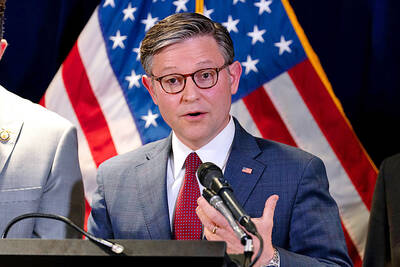
DEFENSE: The US House speaker dismissed speculation that Trump is using arms sales as a negotiating tactic with Beijing amid concern over delayed deliveries Taiwan is a partner whose “stability and independence” are important to US national security and the economy, US House of Representatives Speaker Mike Johnson said on Monday when asked about arms sales to Taipei in an interview with Fox Business. Asked whether US President Donald Trump was using a long-delayed US$14 billion arms deal as a negotiating tactic for trade with Beijing, Johnson said that he “wouldn’t read too much into that.” The delayed arms package is “related to the Iran conflict” and the need for missile stocks in the Middle East, he said. “If you look over [Trump’s] two terms, he will


 RSS
RSS