


Japan yesterday unveiled its biggest overhaul of defense export rules in decades, scrapping restrictions on overseas arms sales, and opening the way for exports of warships, missiles and other weapons.
The move aimed at strengthening Japan’s defense industrial base marks another step away from the pacifist restraints that have shaped its postwar security policy. It has been made in tandem with efforts to deepen ties with other Asian nations to counter China’s growing regional influence.
Wars in Ukraine and the Middle East are also straining US arms production, expanding opportunities for Japan. At the same time, US allies in Europe and Asia are looking to diversify suppliers as Washington’s long-held security commitments look less certain under US President Donald Trump.
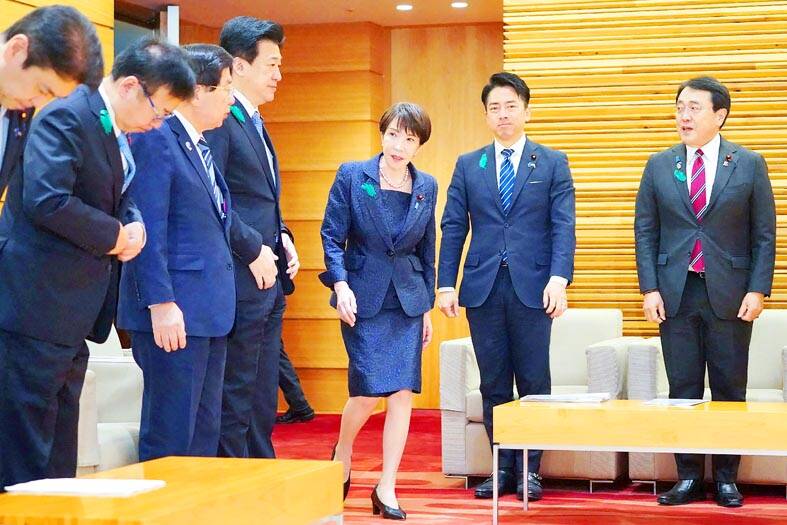
Photo: AFP
“No single country can now protect its own peace and security alone, and partner countries that support each other in terms of defense equipment are necessary,” Japanese Prime Minister Sanae Takaichi wrote on X.
“China is deeply concerned about this,” Chinese Ministry of Foreign Affairs spokesman Guo Jiakun (郭嘉昆) told a daily news conference, adding that Beijing “will remain highly vigilant and resolutely resist any reckless actions by Japan towards a new form of militarism.”
The revision removes five export categories that had limited most military exports to rescue, transport, warning, surveillance and mine-sweeping equipment. Ministers and officials would instead assess the merits of each proposed sale.
Japan would keep in place three export principles that commit it to strict screening, controls on transfers to third countries and a ban on sales to countries involved in conflict. However, the government said exceptions could be made when deemed necessary for national security.
Countries ranging from Poland to the Philippines are exploring procurement opportunities as they modernize their forces, Japanese officials and foreign diplomats said. One of the first deals could be the export of used warships to Manila, two of the sources said.
Philippine Secretary of Defense Gilberto Teodoro welcomed Japan’s rule change, saying in a statement that it would provide access to defense “articles of the highest quality” that would “strengthen domestic resilience” and “contribute to regional stability through deterrence.”
The Philippines, together with Japan’s southwestern island chain, forms part of what military planners call the first island chain, a string of islands that hems in China’s access from its coastal waters to the Western Pacific.
Manila and Tokyo signed an agreement in September last year making it easier for their forces to operate in each other’s territory and in January eased rules for exchanging military supplies.
US Ambassador to Japan George Glass heralded the export rule change in a post on X as a “historic step” to strengthen collective defense.
German Ambassador to Japan Petra Sigmund said it created opportunities for deeper cooperation “with the aim of enhancing global stability.”
Tokyo hopes defense exports would shore up its industrial base by boosting production volumes, lowering per-unit costs and adding manufacturing capacity it could draw on in a military crisis.
Contractors such as Mitsubishi Heavy Industries can build advanced systems, including submarines, fighter aircraft and missiles, but for decades have depended on small orders from a single customer, Japan’s Self-Defense Forces.
Japan is pressing ahead with unprecedented efforts to bolster its military — buying missiles, stealth jets and drones it says are needed to deter any threat posed by China, including around its islands near Taiwan.
Beijing has said its intentions in East Asia and elsewhere are peaceful.
Tokyo is also developing a next-generation fighter jet with Britain and Italy for deployment in the mid-2030s, part of a strategy to share development costs and gain access to new technology.
Japan has steadily increased defense spending in recent years to 2 percent of GDP, and Takaichi’s government is expected to announce further increases this year when it releases a new security strategy.

‘NO SECURITY RISK’: The Railway Bureau reassured the public that the technicians’ activities were limited to technical guidance and did not involve sensitive systems The Railway Bureau yesterday said it had invited eight Chinese technicians to assist with an airport MRT construction project. The bureau issued the confirmation after an Internet user said Chinese nationals had entered the construction zone of Taiwan Taoyuan International Airport’s Terminal 3 project. They asked why “individuals from an enemy state” were allowed access to such a major national infrastructure project, which raised serious concerns over Taiwan’s industrial safety, sensitive systems and information security. The bureau’s Northern Region Engineering Branch Office said subcontractor Taiwan Handle Industrial Co (台灣手把工業) of the Taoyuan airport MRT’s “Contract No. CU05 Project A14 Station Civil, MEP &

A US uncrewed surface vessel (USV) encountered multiple Chinese warships during an autonomous transit of the Taiwan Strait, US defense company Seasats said in a statement on Wednesday. Seasats announced that a Lightfish USV had completed the first autonomous transit of the Taiwan Strait. Over five days, the USV traversed the entire length of the Strait while constantly monitoring surface vessel traffic, the company said. The Lightfish encountered multiple Chinese warships, one of which was a Chinese People’s Liberation Army Navy (PLAN) Type 056 corvette, it said. The Chinese vessels were operating “well within Taiwan’s exclusive economic zone without transmitting their identity via the
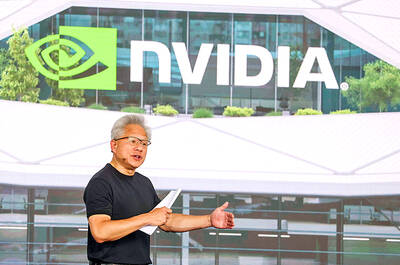
‘BOOMING’: ’ The number of partners we have here is incredible. You can see from their stock prices. They’re doing so well, they’re so happy,’ Jensen Huang said Nvidia Corp’s spending in Taiwan has ballooned to about US$150 billion a year, 10 times the US$10 billion to US$15 billion the company spent five years ago, Nvidia chief executive officer Jensen Huang (黃仁勳) said yesterday, suggesting Taiwan’s strategic importance in the global artificial intelligence (AI) supply chain. “Taiwan is the epicenter of the AI revolution. This is where the chips come, packaging comes. This is where the systems are made. This is where AI supercomputers were created,” Huang said at a meeting for the company’s employees in Beitou-Shilin Technology Park (北投士林科技園區) in Taipei, the planned site of Nvidia’s Taipei headquarters. “Taiwan
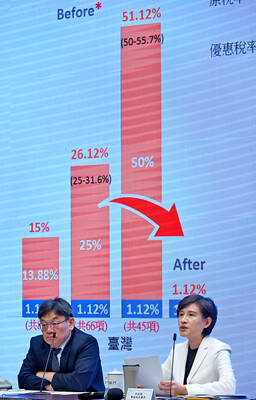
GREATER REACH? Auto parts and wood products would face tariffs of up to 15%, matching those targeting the EU, Japan and South Korea, Vice Premier said The US has announced that preferential tariff treatment for Taiwan’s non-semiconductor Section 232 goods would take effect retroactively from May 1, the Executive Yuan said yesterday. The US government yesterday posted a notice on the Federal Register’s public inspection Web site previewing tariff concessions for Taiwan under a memorandum of understanding (MOU) on Taiwan-US investment after two months of negotiations. The MOU signed on Jan. 15 stipulated three major preferential tariff arrangements: a 15 percent “reciprocal” tariff rate for Taiwan without stacking most-favored nation (MFN) rates; preferential Section 232 treatment for semiconductors and related products; and preferential Section 232 treatment for non-semiconductor


 RSS
RSS