


Philippine and US forces are to carry out maritime strike drills on a remote Philippine island near Taiwan during annual exercises that started yesterday, which the Philippine military chief said would test their readiness under “real-world conditions.”
The exercises known as “Balikatan,” or “shoulder-to-shoulder,” which are to run until May 8, would be the largest yet in terms of participating countries, with Australia included again and Canada, France, New Zealand and Japan joining as active participants for the first time, highlighting Manila’s widening network of security partnerships.
The exercises are to involve practising precision strike and interdiction operations in coastal waters of the Philippines, and are to feature integrated air and missile defense exercises, multinational maritime operations, and counterlanding live-fire drills.
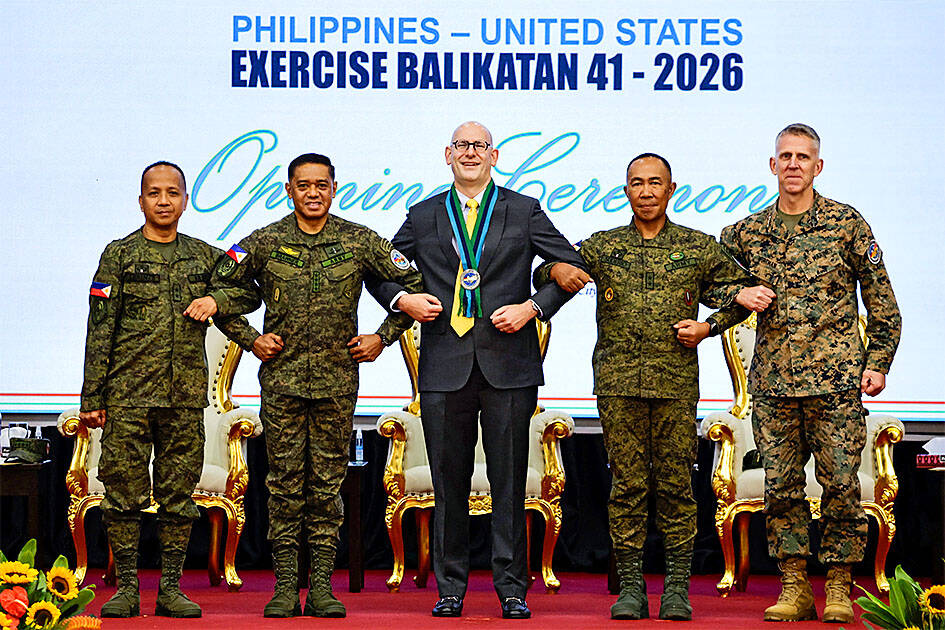
Photo: EPA
Launching the exercises, Armed Forces of the Philippines Chief of Staff Romeo Brawner said their purpose was to reaffirm the strength of their alliance and their responsibility to secure the region.
“We train across the breadth of our archipelago ... testing our readiness in real-world conditions across all domains,” Brawner said.
“Regardless of the challenges elsewhere in the world, the United States focus on the Indo-Pacific and our ironclad commitment to the Philippines remains unwavering,” US Marine Lieutenant General Christian Wortman said at the opening ceremony.
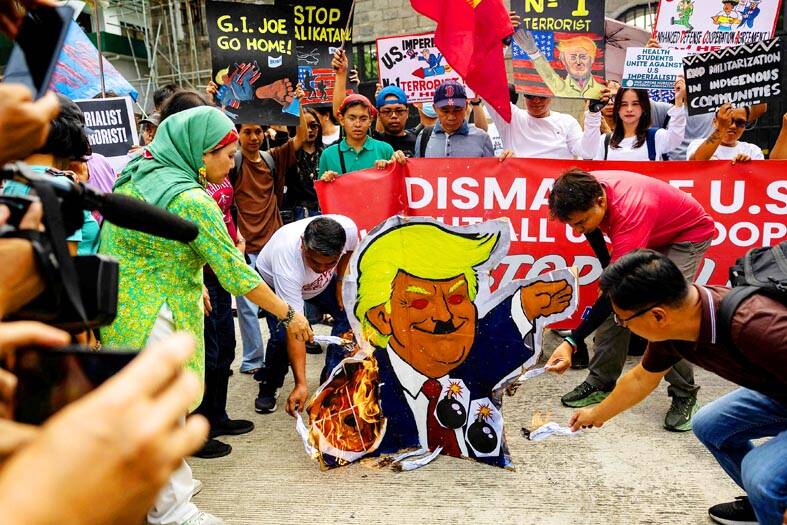
Photo: Reuters
More than 17,000 troops are taking part, including about 10,000 from defense treaty ally the US, even as Washington remains heavily engaged in the Middle East.
The exercises are to showcase newly acquired Philippine hardware, such as the BrahMos missiles, and allied capabilities that include Japan’s Type 88 anti-ship missile, to be used during a live-fire sinking drill.
The counterlanding live-fire drills are to take place in Zambales province on the South China Sea, about 230km from the hotly contested Scarborough Shoal (Huangyan Island, 黃岩島), a strategic atoll controlled by China, but which Taiwan and the Philippines also claim.
The Philippines and US are for the first time to hold maritime strike drills on the island of Itbayat , the northernmost point of the Philippines about 155km from Taiwan, demonstrating the area’s strategic location as tensions simmer over Taiwan.
China has repeatedly criticized the Philippines for conducting defense exercises with its allies, saying they risk raising regional tensions.
Asked about the drills during a regular briefing, Chinese Ministry of Foreign Affairs spokesman Guo Jiakun (郭嘉昆) said the Asia-Pacific region needed peace and tranquillity, not external forces that create division and confrontation.
“We would like to remind the relevant countries that persisting in tying themselves together on security will only lead to setting themselves on fire and backfiring,” Guo said.
Wortman said that Balikatan had “no target nation” in mind.
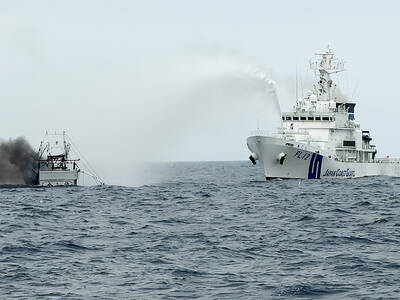
CREDIT-GRABBER: China said its coast guard rescued the crew of a fishing vessel that caught fire, who were actually rescued by a nearby Taiwanese boat and the CGA Maritime search and rescue operations do not have borders, and China should not use a shipwreck to infringe upon Taiwanese sovereignty, the Coast Guard Administration (CGA) said yesterday. The coast guard made the statement in response to the China Coast Guard (CCG) saying it saved a Taiwanese fishing boat. The Chuan Yu No. 6 (全漁6號), a fishing vessel registered in Keelung, on Thursday caught fire and sank in waters northeast of Diaoyutai Islands (釣魚台). The vessel left Keelung’s Badouzih Fishing Harbor (八斗子漁港) at 3:35pm on Sunday last week, with seven people on board — a 62-year-old Taiwanese captain surnamed Chang (張) and six
RISKY BUSINESS: The ‘incentives’ include initiatives that get suspended for no reason, creating uncertainty and resulting in considerable losses for Taiwanese, the MAC said China’s “incentives” failed to sway sentiment in Taiwan, as willingness to work in China hit a record low of 1.6 percent, a Ministry of Labor survey showed. The Directorate-General of Budget, Accounting and Statistics (DGBAS) also reported that the number of Taiwanese workers in China has nearly halved from a peak of 430,000 in 2012 to an estimated 231,000 in 2024. That marked a new low in the proportion of Taiwanese going abroad to work. The ministry’s annual survey on “Labor Life and Employment Status” includes questions respondents’ willingness to seek employment overseas. Willingness to work in China has steadily declined from

The Legislative Yuan’s Finance Committee yesterday approved proposed amendments to the Amusement Tax Act (娛樂稅法) that would abolish taxes on films, cultural activities and competitive sporting events, retaining the fee only for dance halls and golf courses. The proposed changes would set the maximum tax rate for dance halls and golf courses at 50 and 20 percent respectively, with local governments authorized to suspend the levies. Article 2 of the act says that “amusement tax shall be levied on tickets sold or fees charged by amusement places, facilities or activities” in six categories: “Cinema; professional singing, story-telling, dancing, circus, magic show, acrobatics
INFLATION UP? The IMF said CPI would increase to 1.5 percent this year, while the DGBAS projected it would rise to 1.68 percent, with GDP per capita of US$44,181 The IMF projected Taiwan’s real GDP would grow 5.2 percent this year, up from its 2.1 percent outlook in January, despite fears of global economic disruptions sparked by the US-Iran conflict. Taiwan’s consumer price index (CPI) is projected to increase to 1.5 percent, while unemployment would be 3.4 percent, roughly in line with estimates for Asia as a whole, the international body wrote in its Global Economic Outlook Report published in the US on Monday. The figures are comparatively better than the IMF outlook for the rest of the world, which pegged real GDP growth at 3.1 percent, down from 3.3 percent


 RSS
RSS