


Burmese President Win Myint, detained since a 2021 military coup, was yesterday freed under a mass amnesty which, according to a source close to pro-democracy leader Aung San Suu Kyi, also reduced her sentence.
Win Myint and Aung San Suu Kyi, the 80-year-old Nobel Peace Prize laureate, led Myanmar during a decade-long experiment with civilian rule that was abruptly halted by the coup.
The president, who served from 2018, was pardoned of convictions handed down during the post-putsch period of military rule and released yesterday, a spokesman for his party said.
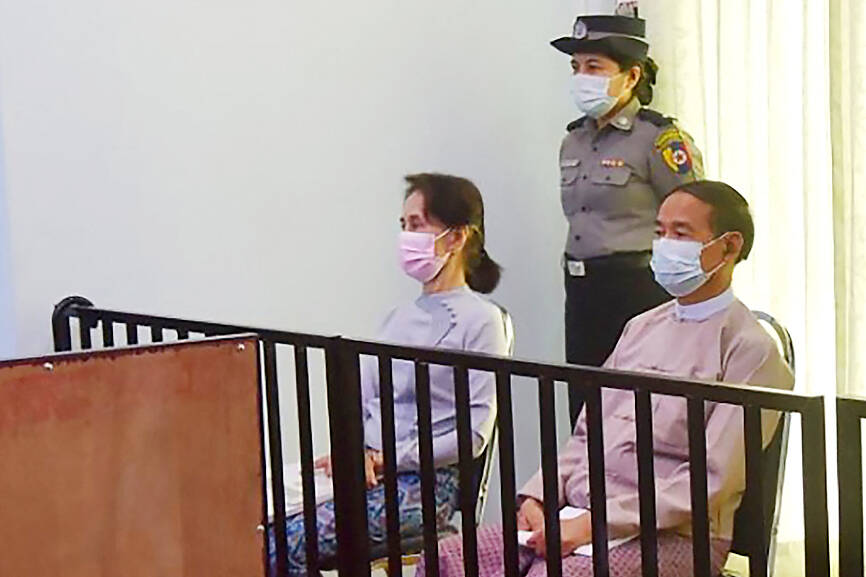
Photo: AFP
Aung San Suu Kyi remains detained, serving a sentence rights groups decry as a politically motivated move to hobble her National League for Democracy (NLD) party.
A source close to her legal case, requesting anonymity for security reasons, said that Aung San Suu Kyi’s 27-year sentence had been cut as part of the amnesty.
The order announced by Min Aung Hlaing — the coup leader who ousted Aung San Suu Kyi’s government and was sworn in last week as civilian president — to reduce the remaining terms of all sentences under 40 years by one-sixth “also applies to her,” the source said.
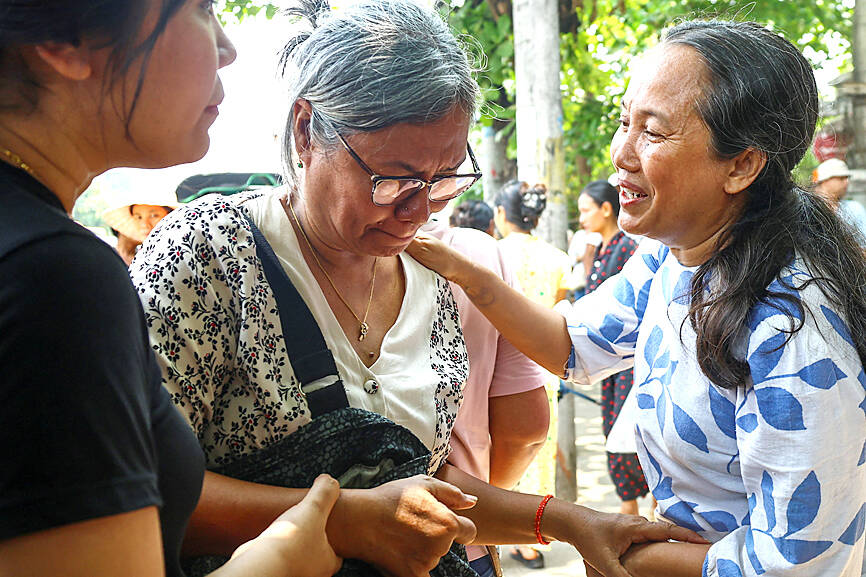
Photo: Reuters
It is unclear how much of her term was considered served before the commutation order.
High Commissioner for Human Rights Volker Turk said that “all those detained unjustly since the coup — including state counselor Aung San Suu Kyi — need to be released immediately and unconditionally.”
Myo Nyunt, spokesman for the NLD, which was dissolved after the coup, said he had visited the president at his daughter’s house in the capital, Naypyidaw, and he was “in good health.”
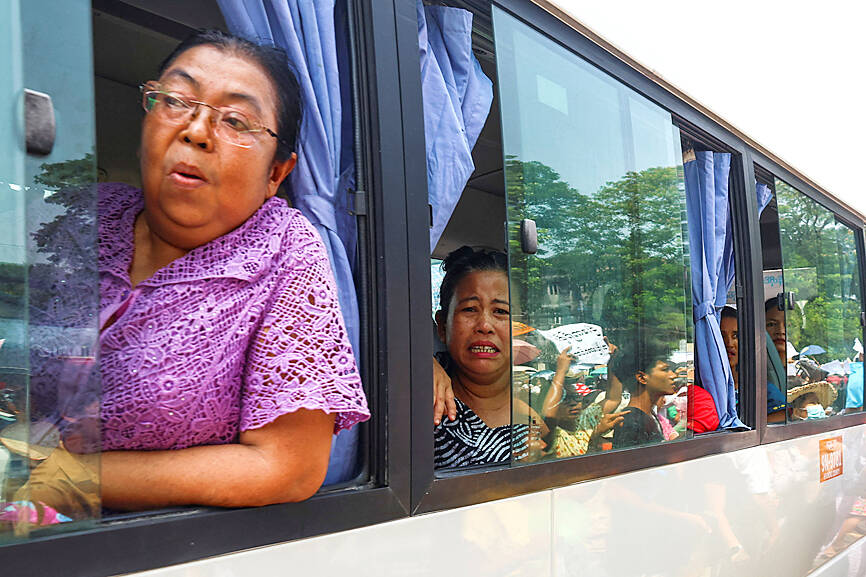
Photo: Reuters
After five years ruling as armed forces chief, Min Aung Hlaing was installed on Friday last week as civilian leader in a transition democracy watchdogs have described as a rebranding of military rule.
The shift has been accompanied by rollbacks of some of the junta’s post-coup crackdown measures — steps the leadership tout as reconciliation, but which critics describe as cosmetic measures to aid the rebranding effort.
Min Aung Hlaing yesterday also commuted all death sentences and ordered the release of more than 4,300 prisoners in an amnesty to mark Myanmar’s new year — one of many public holidays when mass pardons are commonly made.
Outside the barbed-wire boundary of Yangon’s Insein prison, journalists saw award-winning filmmaker Shin Daewe released.
She was given a life sentence in 2024 — later commuted to 15 years — for “complicity in terrorism,” according to Reporters Without Borders, which called her initial term the “harshest” post-coup sentencing of a journalist.
“Even though I was fortunate, my unlucky friends were left behind in tears. Even as I return to my family, I am returning with tears in my eyes,” the documentarian said.
Less than 14 percent of those released in successive rounds of amnesties since the coup were political prisoners, think tank the Institute for Strategy and Policy Myanmar said late last year.
Other gaggles of families waited in the sweltering heat, hoping their relatives were among those freed.
“My brother has been imprisoned for a political case,” said 38-year-old Aung Htet Naing, who was prepared for disappointment.
“We cannot expect much, because he wasn’t included in previous pardons,” Aung Htet Naing said.
More than 30,000 people have been detained for political reasons since the coup, the Assistance Association for Political Prisoners said.

‘NO SECURITY RISK’: The Railway Bureau reassured the public that the technicians’ activities were limited to technical guidance and did not involve sensitive systems The Railway Bureau yesterday said it had invited eight Chinese technicians to assist with an airport MRT construction project. The bureau issued the confirmation after an Internet user said Chinese nationals had entered the construction zone of Taiwan Taoyuan International Airport’s Terminal 3 project. They asked why “individuals from an enemy state” were allowed access to such a major national infrastructure project, which raised serious concerns over Taiwan’s industrial safety, sensitive systems and information security. The bureau’s Northern Region Engineering Branch Office said subcontractor Taiwan Handle Industrial Co (台灣手把工業) of the Taoyuan airport MRT’s “Contract No. CU05 Project A14 Station Civil, MEP &

A US uncrewed surface vessel (USV) encountered multiple Chinese warships during an autonomous transit of the Taiwan Strait, US defense company Seasats said in a statement on Wednesday. Seasats announced that a Lightfish USV had completed the first autonomous transit of the Taiwan Strait. Over five days, the USV traversed the entire length of the Strait while constantly monitoring surface vessel traffic, the company said. The Lightfish encountered multiple Chinese warships, one of which was a Chinese People’s Liberation Army Navy (PLAN) Type 056 corvette, it said. The Chinese vessels were operating “well within Taiwan’s exclusive economic zone without transmitting their identity via the

Taiwan is still in the process of assessing the possibility of recruiting workers from Eswatini, the Ministry of Foreign Affairs said yesterday, adding that its goal is to help Eswatini upgrade its vocational training centers. If there are plans to recruit workers from Eswatini, safeguarding national security, protecting public health and ensuring the employment rights of Taiwanese would be prerequisites, Department of West Asian and African Affairs Director-General Yen Chia-liang (顏嘉良) told a news conference. Key considerations would also include filling labor shortages in specific industries, and fostering bilateral professional and technical exchanges, he said. Yen was asked about the progress of labor
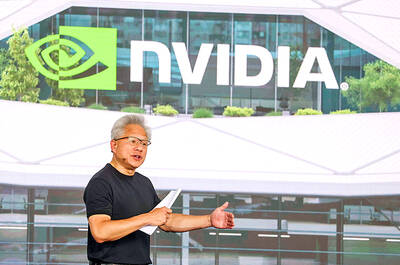
‘BOOMING’: ’ The number of partners we have here is incredible. You can see from their stock prices. They’re doing so well, they’re so happy,’ Jensen Huang said Nvidia Corp’s spending in Taiwan has ballooned to about US$150 billion a year, 10 times the US$10 billion to US$15 billion the company spent five years ago, Nvidia chief executive officer Jensen Huang (黃仁勳) said yesterday, suggesting Taiwan’s strategic importance in the global artificial intelligence (AI) supply chain. “Taiwan is the epicenter of the AI revolution. This is where the chips come, packaging comes. This is where the systems are made. This is where AI supercomputers were created,” Huang said at a meeting for the company’s employees in Beitou-Shilin Technology Park (北投士林科技園區) in Taipei, the planned site of Nvidia’s Taipei headquarters. “Taiwan


 RSS
RSS