


Taiwan’s importance is rising as a key to artificial intelligence (AI) hardware resilience, with Taiwan Semiconductor Manufacturing Co (TSMC, 台積電) holding the lifeline of the global AI hardware supply chain, according to this year’s AI Index report released this week by Stanford University’s Institute for Human-Centered AI.
Compared with previous editions, which largely treated Taiwan as part of broader statistical listings, the latest report places greater emphasis on Taiwan’s economic data and its critical role in global supply chains.
While the US had a total of 5,427 data centers last year, more than 10 times any other country, nearly all cutting-edge AI chips are manufactured by a single company — TSMC, the report said.
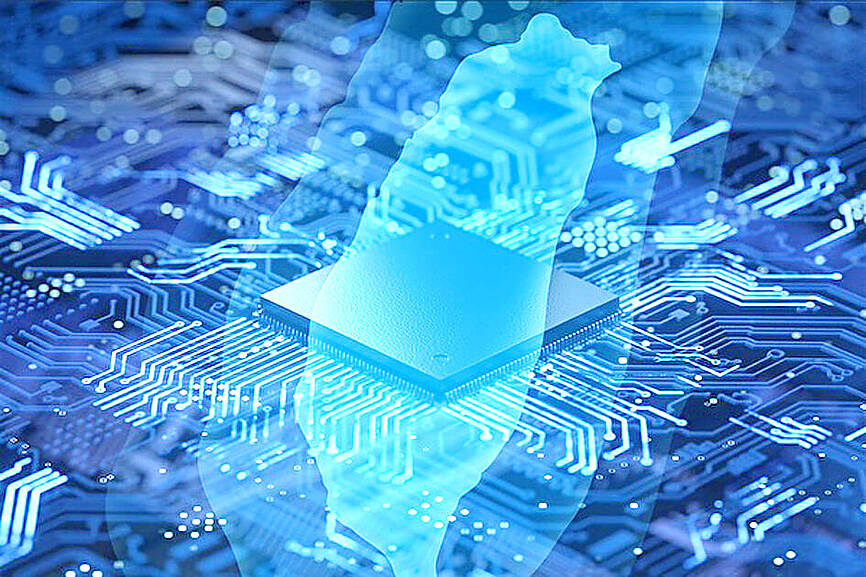
Photo: CNA
More than 90 percent of leading AI models are concentrated in the industrial sector, it said.
Since 2022, the computational power of these models has grown at an average annual rate of about 3.3 times, reaching the equivalent of roughly 17.1 million Nvidia H100 graphics processing units (GPUs), it said.
Nvidia accounts for 60 percent of the total computing power, followed by Google and Amazon, with Huawei (華為) in China contributing a small share, the report said.
However, nearly all of this computing power depends on a single semiconductor foundry in Taiwan, highlighting Taiwan’s critical role in the global AI hardware supply chain, as well as the vulnerability of that supply chain, it said.
Companies such as Nvidia and SK Hynix provide designs that are manufactured by TSMC and Samsung Electronics using advanced processes, it said.
Once completed, the AI chips are sent to companies such as Taiwan’s ASE Technology Holding Co (日月光) and US-based Amkor Technology for packaging and testing, the report said.
TSMC is a single point of dependency in the global AI supply chain, as it manufactures nearly all advanced AI chips, including Nvidia’s Blackwell GPUs and AMD’s MI300X, the report said.
Each stage of the supply chain involves high technical barriers, requiring decades of accumulated expertise, specialized equipment and massive capital investment to overcome, it added.
Taiwan had an AI diffusion rate of 28.4 percent in the second half of last year, the report said.
Compared with the previous year, global industrial robot installations remained flat in 2024, it said.
Some major markets, including the US, Germany and Italy, recorded declines, but Taiwan was an exception, which posted a 33 percent year-on-year increase — the highest in the world, it said.
The report also compared the performance of AI models from the US and from China, saying the US-China AI model performance gap has effectively closed.
The US and Chinese models have traded the lead multiple times since the beginning of last year, it said.
While China’s DeepSeek-R1 briefly matched the top US model in February last year, the top model manufactured by Anthropic of the US led by only 2.7 percent as of last month, it said.
US private AI investment reached US$285.9 billion last year, more than 23 times the US$12.4 billion invested in China, the report said.
However, China’s US$12.4 billion investment might be an underestimate, as it only included private investments and did not take into account the Chinese government’s funding for AI, the report said.

‘NO SECURITY RISK’: The Railway Bureau reassured the public that the technicians’ activities were limited to technical guidance and did not involve sensitive systems The Railway Bureau yesterday said it had invited eight Chinese technicians to assist with an airport MRT construction project. The bureau issued the confirmation after an Internet user said Chinese nationals had entered the construction zone of Taiwan Taoyuan International Airport’s Terminal 3 project. They asked why “individuals from an enemy state” were allowed access to such a major national infrastructure project, which raised serious concerns over Taiwan’s industrial safety, sensitive systems and information security. The bureau’s Northern Region Engineering Branch Office said subcontractor Taiwan Handle Industrial Co (台灣手把工業) of the Taoyuan airport MRT’s “Contract No. CU05 Project A14 Station Civil, MEP &

A US uncrewed surface vessel (USV) encountered multiple Chinese warships during an autonomous transit of the Taiwan Strait, US defense company Seasats said in a statement on Wednesday. Seasats announced that a Lightfish USV had completed the first autonomous transit of the Taiwan Strait. Over five days, the USV traversed the entire length of the Strait while constantly monitoring surface vessel traffic, the company said. The Lightfish encountered multiple Chinese warships, one of which was a Chinese People’s Liberation Army Navy (PLAN) Type 056 corvette, it said. The Chinese vessels were operating “well within Taiwan’s exclusive economic zone without transmitting their identity via the

Taiwan is still in the process of assessing the possibility of recruiting workers from Eswatini, the Ministry of Foreign Affairs said yesterday, adding that its goal is to help Eswatini upgrade its vocational training centers. If there are plans to recruit workers from Eswatini, safeguarding national security, protecting public health and ensuring the employment rights of Taiwanese would be prerequisites, Department of West Asian and African Affairs Director-General Yen Chia-liang (顏嘉良) told a news conference. Key considerations would also include filling labor shortages in specific industries, and fostering bilateral professional and technical exchanges, he said. Yen was asked about the progress of labor
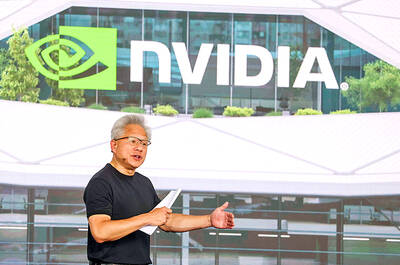
‘BOOMING’: ’ The number of partners we have here is incredible. You can see from their stock prices. They’re doing so well, they’re so happy,’ Jensen Huang said Nvidia Corp’s spending in Taiwan has ballooned to about US$150 billion a year, 10 times the US$10 billion to US$15 billion the company spent five years ago, Nvidia chief executive officer Jensen Huang (黃仁勳) said yesterday, suggesting Taiwan’s strategic importance in the global artificial intelligence (AI) supply chain. “Taiwan is the epicenter of the AI revolution. This is where the chips come, packaging comes. This is where the systems are made. This is where AI supercomputers were created,” Huang said at a meeting for the company’s employees in Beitou-Shilin Technology Park (北投士林科技園區) in Taipei, the planned site of Nvidia’s Taipei headquarters. “Taiwan


 RSS
RSS