


The US is likely to approve pending weapons sales to Taiwan in the coming weeks, a bipartisan group of senators assured Taiwanese lawmakers in a letter, urging Taipei to hasten its stalled defense spending in the face of pressure from China.
The letter comes ahead of a planned May 14 to 15 trip to China by US President Donald Trump, whose moves to secure a favorable trade deal with Chinese President Xi Jinping (習近平) have raised concerns in the US and Taiwan that he could curb Washington’s military support for Taipei.
“The United States Congress is fully committed to the timely delivery of critical capabilities to Taiwan and we expect that pending sales will be announced in the coming weeks,” US Senator Jeanne Shaheen, the ranking Democrat on the Senate Committee on Foreign Relations, wrote in the letter seen by Reuters.
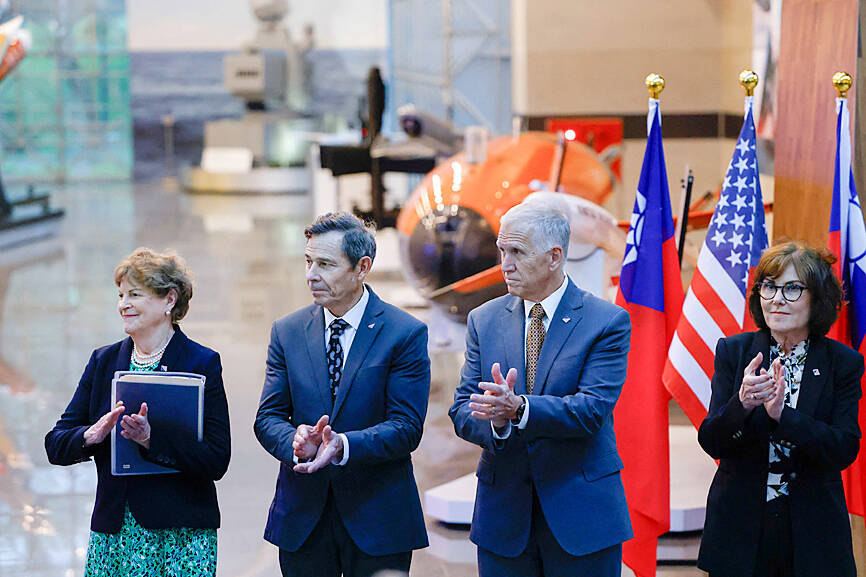
Photo: Ann Wang, Reuters
Democratic Senator Jacky Rosen and Republican senators Thom Tillis and John Curtis also signed the letter.
Those packages include “counterdrone assets, an integrated battle command system, and medium-range munitions to enhance Taiwan’s air defenses,” the senators said in letter dated Tuesday addressed to Legislative Speaker Han Kuo-yu (韓國瑜) and top opposition lawmakers.
President William Lai (賴清德) in November proposed US$40 billion in extra defense spending to counter China, but the opposition, led by the Chinese Nationalist Party (KMT), has tied up the proposal in favor of its own, less expensive plan.
Last week, KMT Chairwoman Cheng Li-wun (鄭麗文) visited China on what she called a “peace mission” to reduce tensions at a time when Beijing has stepped up military pressure against Taiwan.
US lawmakers have repeatedly pushed the Legislative Yuan to move forward with the defense outlays, and the letter reiterated the importance of enabling “not only procurement of American equipment but also speedier domestic production of asymmetric capabilities.”
China has long demanded a halt to weapons sales to Taiwan by the US, Taipei’s most important international backer despite a lack of formal diplomatic ties.
Xi told Trump in February that arms sales to Taiwan must be handled with “prudence,” and the Chinese leader is expected to press the Taiwan issue during Trump’s visit.
Nonetheless, the Trump administration in December approved a record US$11 billion in weapons sales to Taiwan.
Reuters has reported that weapons packages worth as much as US$14 billion could be announced by the Trump administration sometime following his trip, which was delayed from earlier this month.
In Taipei, DPP Legislator Chen Kuan-ting (陳冠廷) yesterday urged opposition parties to reach a consensus through next week’s classified briefing and caucus negotiations to pass the special defense bill as soon as possible and ensure the integrity of Taiwan’s defense system.
KMT Legislator Niu Hsu-ting (牛煦庭) yesterday said that Han held a cross-caucus negotiation three days ago, and that next week, the Ministry of National Defense is expected to hold another special project briefing before another round of cross-caucus negotiation is to take place next week.
The review would proceed according to established procedures, he said, adding that any such commitments or goodwill from the US would have a positive impact on advancing the arms procurement legislation.
Additional reporting by Lin Hsin-han

‘NO SECURITY RISK’: The Railway Bureau reassured the public that the technicians’ activities were limited to technical guidance and did not involve sensitive systems The Railway Bureau yesterday said it had invited eight Chinese technicians to assist with an airport MRT construction project. The bureau issued the confirmation after an Internet user said Chinese nationals had entered the construction zone of Taiwan Taoyuan International Airport’s Terminal 3 project. They asked why “individuals from an enemy state” were allowed access to such a major national infrastructure project, which raised serious concerns over Taiwan’s industrial safety, sensitive systems and information security. The bureau’s Northern Region Engineering Branch Office said subcontractor Taiwan Handle Industrial Co (台灣手把工業) of the Taoyuan airport MRT’s “Contract No. CU05 Project A14 Station Civil, MEP &

A US uncrewed surface vessel (USV) encountered multiple Chinese warships during an autonomous transit of the Taiwan Strait, US defense company Seasats said in a statement on Wednesday. Seasats announced that a Lightfish USV had completed the first autonomous transit of the Taiwan Strait. Over five days, the USV traversed the entire length of the Strait while constantly monitoring surface vessel traffic, the company said. The Lightfish encountered multiple Chinese warships, one of which was a Chinese People’s Liberation Army Navy (PLAN) Type 056 corvette, it said. The Chinese vessels were operating “well within Taiwan’s exclusive economic zone without transmitting their identity via the

Taiwan is still in the process of assessing the possibility of recruiting workers from Eswatini, the Ministry of Foreign Affairs said yesterday, adding that its goal is to help Eswatini upgrade its vocational training centers. If there are plans to recruit workers from Eswatini, safeguarding national security, protecting public health and ensuring the employment rights of Taiwanese would be prerequisites, Department of West Asian and African Affairs Director-General Yen Chia-liang (顏嘉良) told a news conference. Key considerations would also include filling labor shortages in specific industries, and fostering bilateral professional and technical exchanges, he said. Yen was asked about the progress of labor
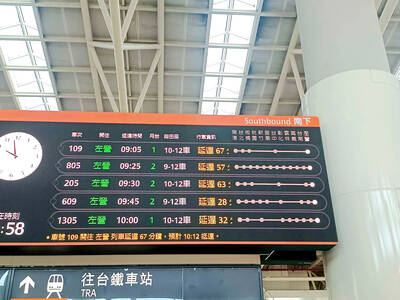
The nation’s usually punctual high-speed rail system yesterday was hit by major disruptions after all scheduled services were canceled and replaced with three hourly trains offering only non-reserved seating, affecting more than 200,000 passengers. Preliminary findings indicate the disruption was caused by a faulty power module in a track switch control cabinet, Taiwan High-Speed Rail Corp (THSRC) said, adding that as a full system inspection could only be conducted after operations end for the day, a decision on whether normal service would resume today would be announced before the first train departs. During a routine inspection early yesterday, a switch signal abnormality


 RSS
RSS