


Compromising with authoritarian regimes comes at the cost of sovereignty and democracy, President William Lai (賴清德) wrote on Facebook yesterday, ahead of Chinese Nationalist Party (KMT) Chairwoman Cheng Li-wun’s (鄭麗文) meeting with Chinese President Xi Jinping (習近平).
In the past few years, China has continuously carried out “gray zone” harassment and military intimidation in the Taiwan Strait, seriously undermining regional peace and stability, Lai said.
Cheng is in China on what she has called a “peace” mission, where she met with Xi yesterday.
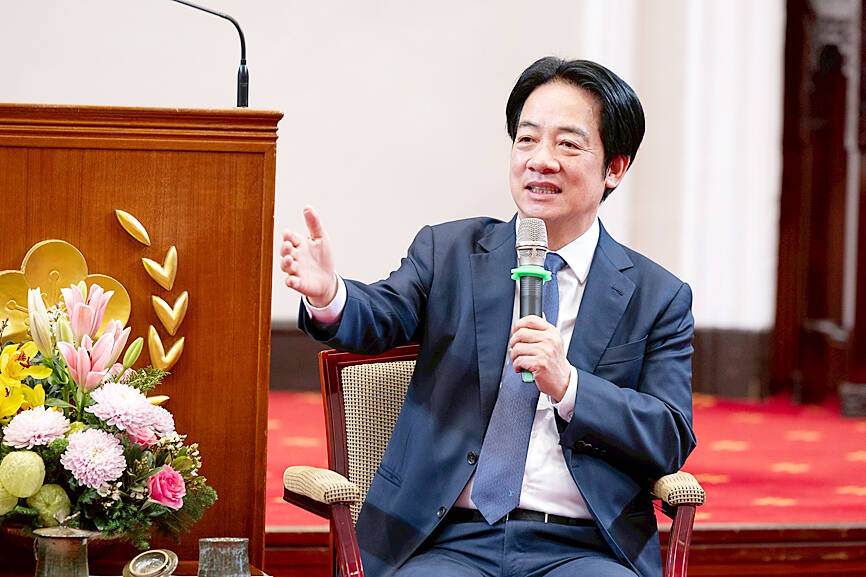
Photo courtesy of the Presidential Office
“We hold ideals about peace, but they are not unrealistic fantasies. History shows that compromising with authoritarian regimes comes at the cost of sovereignty and democracy — it will not bring freedom, nor will it bring peace,” Lai said.
Peace is achieved through strength, and strength is achieved through long-term, stable investment, he said.
Taiwan needs to show its determination to defend itself to earn allies’ support, he added.
National defense spending this year surpassed 3 percent of GDP, in line with NATO standards, and is expected to reach 5 percent of GDP by 2030, Lai said.
The government has proposed an eight-year, US$40 billion special defense budget to build a “T-Dome,” a multilayered air defense system, which would enhance asymmetric warfare capabilities, he said.
Taiwan hopes to partner with advanced defense industry nations such as the US to jointly establish a line of defense that safeguards democratic values, he added.
It is regrettable that the special defense budget remains stalled in the Legislative Yuan, with opposition parties boycotting negotiations and delaying a plan backed by about 70 percent of the public and supported by allies, Lai said.
Delays weaken Taiwan’s defense capabilities and risk undermining international confidence in its commitment to self-defense, he said.
Facing external military threats and “united front” tactics, ruling and opposition parties should set aside their differences, as national security cannot wait and defense cannot be compromised, Lai said.
An American Institute in Taiwan spokesperson via e-mail said that meaningful cross-strait exchanges should focus on unconditional dialogue between Beijing’s leadership and Taiwan’s democratically elected government, while also encompassing interactions with Taiwan’s other political parties.
The US supports cross-strait dialogue and expects that cross-strait differences would be resolved peacefully, without coercion and in a manner acceptable to the people on both sides of the Strait, the spokesperson said.
US resolve remains firm, they said, adding that the US would continue to deepen its cooperation with Taiwan, advancing ties in the areas of security, economics, technology and people-to-people exchanges to fulfill the objectives of the Taiwan Relations Act, and contribute to regional peace, security and prosperity.
Additional reporting by Fang Wei-li

‘NO SECURITY RISK’: The Railway Bureau reassured the public that the technicians’ activities were limited to technical guidance and did not involve sensitive systems The Railway Bureau yesterday said it had invited eight Chinese technicians to assist with an airport MRT construction project. The bureau issued the confirmation after an Internet user said Chinese nationals had entered the construction zone of Taiwan Taoyuan International Airport’s Terminal 3 project. They asked why “individuals from an enemy state” were allowed access to such a major national infrastructure project, which raised serious concerns over Taiwan’s industrial safety, sensitive systems and information security. The bureau’s Northern Region Engineering Branch Office said subcontractor Taiwan Handle Industrial Co (台灣手把工業) of the Taoyuan airport MRT’s “Contract No. CU05 Project A14 Station Civil, MEP &

A US uncrewed surface vessel (USV) encountered multiple Chinese warships during an autonomous transit of the Taiwan Strait, US defense company Seasats said in a statement on Wednesday. Seasats announced that a Lightfish USV had completed the first autonomous transit of the Taiwan Strait. Over five days, the USV traversed the entire length of the Strait while constantly monitoring surface vessel traffic, the company said. The Lightfish encountered multiple Chinese warships, one of which was a Chinese People’s Liberation Army Navy (PLAN) Type 056 corvette, it said. The Chinese vessels were operating “well within Taiwan’s exclusive economic zone without transmitting their identity via the

Taiwan is still in the process of assessing the possibility of recruiting workers from Eswatini, the Ministry of Foreign Affairs said yesterday, adding that its goal is to help Eswatini upgrade its vocational training centers. If there are plans to recruit workers from Eswatini, safeguarding national security, protecting public health and ensuring the employment rights of Taiwanese would be prerequisites, Department of West Asian and African Affairs Director-General Yen Chia-liang (顏嘉良) told a news conference. Key considerations would also include filling labor shortages in specific industries, and fostering bilateral professional and technical exchanges, he said. Yen was asked about the progress of labor
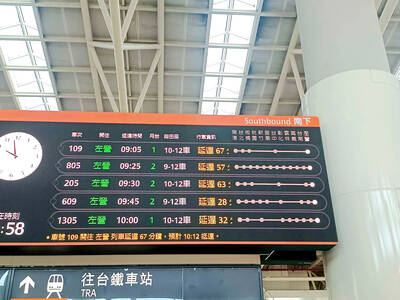
The nation’s usually punctual high-speed rail system yesterday was hit by major disruptions after all scheduled services were canceled and replaced with three hourly trains offering only non-reserved seating, affecting more than 200,000 passengers. Preliminary findings indicate the disruption was caused by a faulty power module in a track switch control cabinet, Taiwan High-Speed Rail Corp (THSRC) said, adding that as a full system inspection could only be conducted after operations end for the day, a decision on whether normal service would resume today would be announced before the first train departs. During a routine inspection early yesterday, a switch signal abnormality


 RSS
RSS