


Iran, the US and Israel late on Tuesday agreed to a two-week ceasefire, an 11th-hour deal that headed off US President Donald Trump’s threat to unleash a bombing campaign that would destroy Iranian civilization, but yesterday, hours after the announcement, Iran and Gulf Arab countries reported new attacks.
It was not clear if the strikes would scuttle the deal, which US Vice President J.D. Vance called “fragile.”
US Secretary of Defense Pete Hegseth yesterday told a news conference at the Pentagon that the US has had a decisive military victory over Iran.
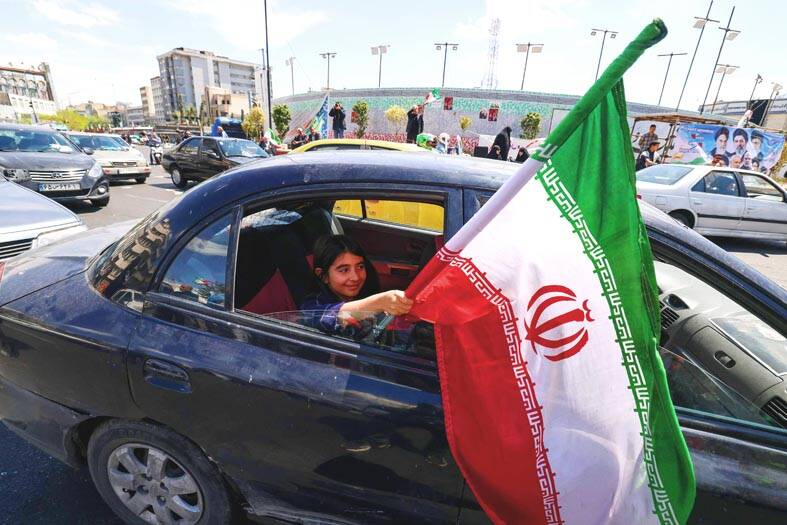
Photo: AFP
Even before the new attacks, much about the agreement was unclear as the sides presented vastly different visions of the terms.
Iran said the deal would allow it to formalize its new practice of charging ships passing through the Strait of Hormuz, a crucial transit lane for oil, but the terms were not clear, nor was whether ships would feel safe using it. It was also unclear whether any other country agreed to this condition.
Hegseth said the strait was already open and that the US military would be “hanging around” in the Middle East to ensure Iran complies with the ceasefire.
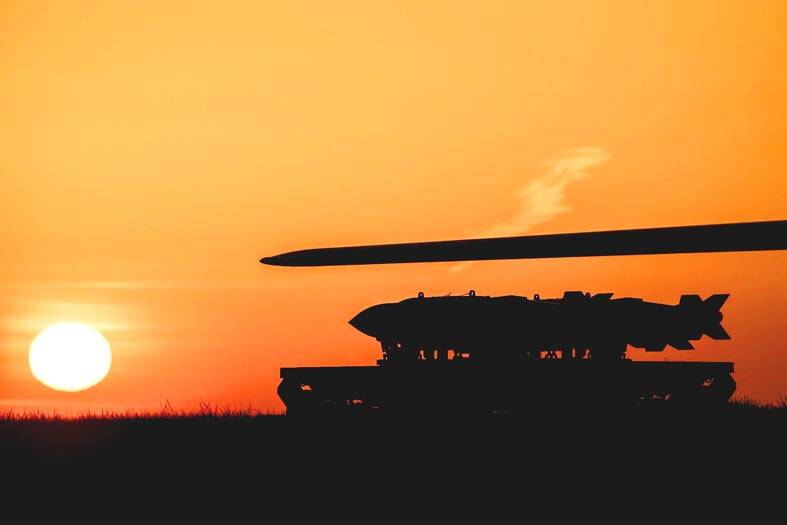
Photo: Bloomberg
Iranian state television yesterday reported that the first ship had already passed through the strait with Tehran’s permission.
Pakistan, which helped to mediate the deal, and others said fighting would pause in Lebanon, where Israel has launched a ground invasion against the Iran-backed Hezbollah militant group.
However, Israel said the agreement does not extend to Hezbollah.
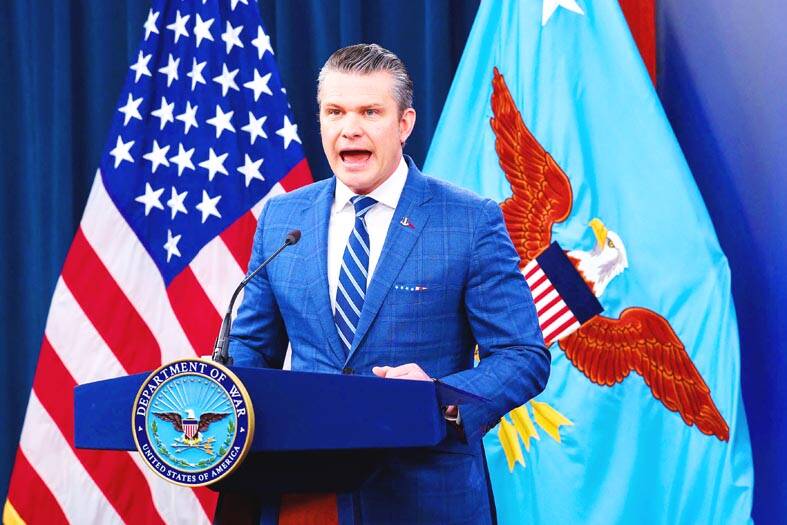
Photo: Reuters
Israeli strikes yesterday hit several dense commercial and residential areas in central Beirut afternoon without warning, hours after the ceasefire was announced.
The Lebanese Ministry of Health said that dozens were killed and hundreds wounded in an early estimate.
The fate of Iran’s missile and nuclear programs — the elimination of which were major objectives for the US and Israel in going to war — also remained unclear, but Hegseth said that Tehran’s missile program had been functionally destroyed.
Trump said the US would work with Iran to remove buried enriched uranium, although Iran did not confirm that.
In the streets of Tehran, pro-government demonstrators chanted: “Death to America, death to Israel, death to compromisers,” after the ceasefire announcement, and burned US and Israeli flags.
The chants underscored the anger animating hard-liners, who have been preparing for what many assumed would be an apocalyptic battle with the US.
Trump on Tuesday said that “a whole civilization will die tonight,” if a deal was not reached.
Trump initially said Iran proposed a “workable” 10-point plan that could help end the war the US launched with Israel on Feb. 28, but when a version in Farsi emerged that indicated Iran would be allowed to continue enriching uranium — which is key to building a nuclear weapon — Trump called it fraudulent without elaborating.
Vance later said the deal was being misrepresented within Iran, although he did not offer details.
Iran’s demands for ending the war include a withdrawal of US combat forces from the region, the lifting of sanctions and the release of its frozen assets.
“We are, and will be, talking Tariff and Sanctions relief with Iran,” Trump wrote online yesterday.
It is not clear if other Western nations would agree to that — and the other points are likely nonstarters.
Pakistan said that talks to hammer out a permanent end to the war could begin in Islamabad as soon as tomorrow.
US Chairman of the US Joint Chiefs of Staff Chairman General Dan Caine praised the halt in fighting, but added: “Let’s be clear, the ceasefire is a pause, and the joint force remains ready.”
Additional reporting by Bloomberg

A signaling system malfunction disrupted high-speed rail (HSR) services beginning at 8am today, with trains temporarily reduced to three northbound and three southbound trains per hour as authorities conduct inspections. The malfunction occurred on a section of track in Miaoli County during pre-operation checks early this morning, forcing northbound and southbound trains to use a single track, the HSR operator said. The regular schedule has been replaced with three hourly trains offering only nonreserved seating in each direction, stopping at every station, it said, adding that business class cars would still have reserved seating. Departures from terminal stations are scheduled at the top

‘NO SECURITY RISK’: The Railway Bureau reassured the public that the technicians’ activities were limited to technical guidance and did not involve sensitive systems The Railway Bureau yesterday said it had invited eight Chinese technicians to assist with an airport MRT construction project. The bureau issued the confirmation after an Internet user said Chinese nationals had entered the construction zone of Taiwan Taoyuan International Airport’s Terminal 3 project. They asked why “individuals from an enemy state” were allowed access to such a major national infrastructure project, which raised serious concerns over Taiwan’s industrial safety, sensitive systems and information security. The bureau’s Northern Region Engineering Branch Office said subcontractor Taiwan Handle Industrial Co (台灣手把工業) of the Taoyuan airport MRT’s “Contract No. CU05 Project A14 Station Civil, MEP &

Taiwan is still in the process of assessing the possibility of recruiting workers from Eswatini, the Ministry of Foreign Affairs said yesterday, adding that its goal is to help Eswatini upgrade its vocational training centers. If there are plans to recruit workers from Eswatini, safeguarding national security, protecting public health and ensuring the employment rights of Taiwanese would be prerequisites, Department of West Asian and African Affairs Director-General Yen Chia-liang (顏嘉良) told a news conference. Key considerations would also include filling labor shortages in specific industries, and fostering bilateral professional and technical exchanges, he said. Yen was asked about the progress of labor

A US uncrewed surface vessel (USV) encountered multiple Chinese warships during an autonomous transit of the Taiwan Strait, US defense company Seasats said in a statement on Wednesday. Seasats announced that a Lightfish USV had completed the first autonomous transit of the Taiwan Strait. Over five days, the USV traversed the entire length of the Strait while constantly monitoring surface vessel traffic, the company said. The Lightfish encountered multiple Chinese warships, one of which was a Chinese People’s Liberation Army Navy (PLAN) Type 056 corvette, it said. The Chinese vessels were operating “well within Taiwan’s exclusive economic zone without transmitting their identity via the


 RSS
RSS