


To stabilize domestic prices in response to the Middle East conflict, the Executive Yuan yesterday announced that electricity rates would remain unchanged from this month through September, adding that fuel prices would also stay flat this week.
To maintain price stability, the top priority is to ensure normal production and distribution operations, Executive Yuan spokeswoman Michelle Lee (李慧芝) told a news conference.
The Ministry of Economic Affairs has been instructed to require CPC Corp, Taiwan (台灣中油) and Formosa Petrochemical Corp (台塑石化) to maintain stable production and secure sufficient supplies, including increasing the availability of light oil, to keep prices steady.
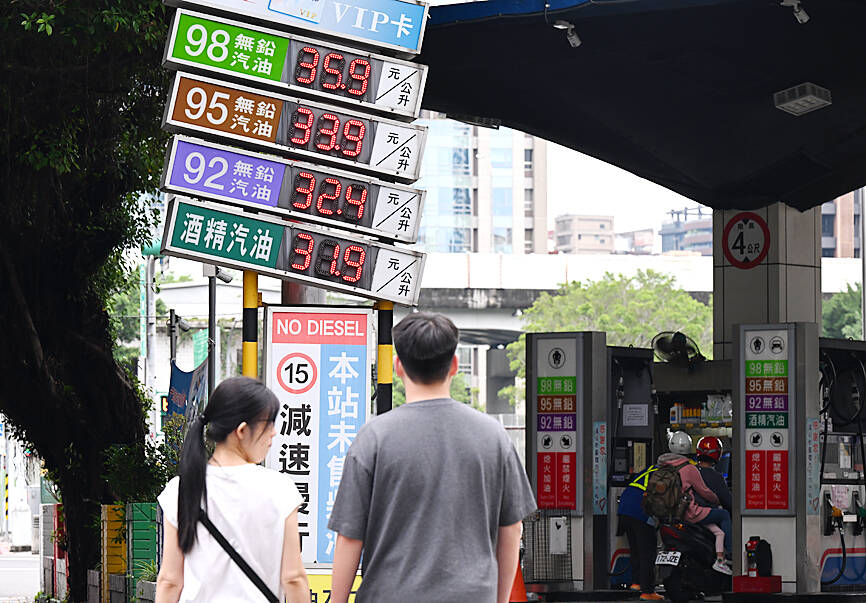
Photo: Liao Chen-huei, Taipei Times
Lee quoted Premier Cho Jung-tai (卓榮泰) as directing the Ministry of Agriculture to implement all measures to stabilize the agriculture sector, including supplies of fertilizers and fuel used in farming and fishing.
The Ministry of Transportation and Communications will, as prescribed, initiate subsidies for aviation fuel on domestic routes, she added.
The economics ministry’s electricity price review committee has decided that electricity rates would remain unchanged from this month to September, Industrial Development Administration Deputy Director-General Tsou Yu-hsin (鄒宇新) said.
Gasoline and diesel prices are also to stay the same this week, Tsou said, adding that prices for bottled liquefied petroleum gas and household natural gas would not increase this month.
“We have reviewed the shipping schedule for gas deliveries from April to June, and 31 percent of shipments would be affected by the conflict in the Middle East. However, we will ensure that the safety stock remains above 11 days,” he said.
“We have worked to adjust shipping routes so that shipments leave via the Red Sea, or we use spot purchases to make up the difference,” Tsou said.
“Of this adjustment, about 46 percent is handled by rerouting exports through the Red Sea, and 54 percent through spot purchases,” he said.
“Overall, through these efforts, our strategic safety stock is currently above 140 days,” he said.
Lee also quoted Cho as saying that there are still a number of Taiwanese nationals in the Middle East region who require special attention.
The government will make every effort to ensure their safety, so there are no security concerns, she added.
However, as the conflict is ongoing, Taiwanese nationals are urged not to travel to the Middle East to avoid potential incidents or emergencies, Cho was quoted as saying.
Additional reporting by AFP

‘NO SECURITY RISK’: The Railway Bureau reassured the public that the technicians’ activities were limited to technical guidance and did not involve sensitive systems The Railway Bureau yesterday said it had invited eight Chinese technicians to assist with an airport MRT construction project. The bureau issued the confirmation after an Internet user said Chinese nationals had entered the construction zone of Taiwan Taoyuan International Airport’s Terminal 3 project. They asked why “individuals from an enemy state” were allowed access to such a major national infrastructure project, which raised serious concerns over Taiwan’s industrial safety, sensitive systems and information security. The bureau’s Northern Region Engineering Branch Office said subcontractor Taiwan Handle Industrial Co (台灣手把工業) of the Taoyuan airport MRT’s “Contract No. CU05 Project A14 Station Civil, MEP &

A US uncrewed surface vessel (USV) encountered multiple Chinese warships during an autonomous transit of the Taiwan Strait, US defense company Seasats said in a statement on Wednesday. Seasats announced that a Lightfish USV had completed the first autonomous transit of the Taiwan Strait. Over five days, the USV traversed the entire length of the Strait while constantly monitoring surface vessel traffic, the company said. The Lightfish encountered multiple Chinese warships, one of which was a Chinese People’s Liberation Army Navy (PLAN) Type 056 corvette, it said. The Chinese vessels were operating “well within Taiwan’s exclusive economic zone without transmitting their identity via the
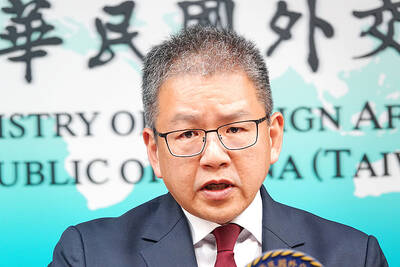
Taiwan is still in the process of assessing the possibility of recruiting workers from Eswatini, the Ministry of Foreign Affairs said yesterday, adding that its goal is to help Eswatini upgrade its vocational training centers. If there are plans to recruit workers from Eswatini, safeguarding national security, protecting public health and ensuring the employment rights of Taiwanese would be prerequisites, Department of West Asian and African Affairs Director-General Yen Chia-liang (顏嘉良) told a news conference. Key considerations would also include filling labor shortages in specific industries, and fostering bilateral professional and technical exchanges, he said. Yen was asked about the progress of labor
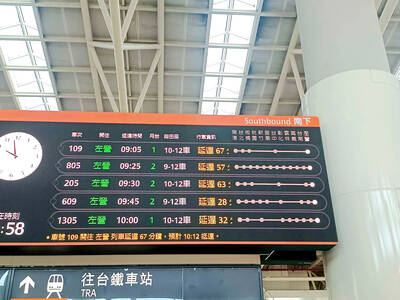
The nation’s usually punctual high-speed rail system yesterday was hit by major disruptions after all scheduled services were canceled and replaced with three hourly trains offering only non-reserved seating, affecting more than 200,000 passengers. Preliminary findings indicate the disruption was caused by a faulty power module in a track switch control cabinet, Taiwan High-Speed Rail Corp (THSRC) said, adding that as a full system inspection could only be conducted after operations end for the day, a decision on whether normal service would resume today would be announced before the first train departs. During a routine inspection early yesterday, a switch signal abnormality


 RSS
RSS