


Premier Cho Jung-tai (卓榮泰) yesterday urged swift legislative review of the central government’s general budget after torrential rain hit Miaoli County, causing muddy floodwaters to cascade into homes.
Cho issued the call through a post on Facebook after areas in Miaoli and Hsinchu reported disruptions due to torrential rain.
Miaoli County Commissioner Chung Tung-chin (鍾東錦) said areas around the Tongsiao Power Plant were flooded, while the flooding in Houlong Township (後龍) had reached car tire height.
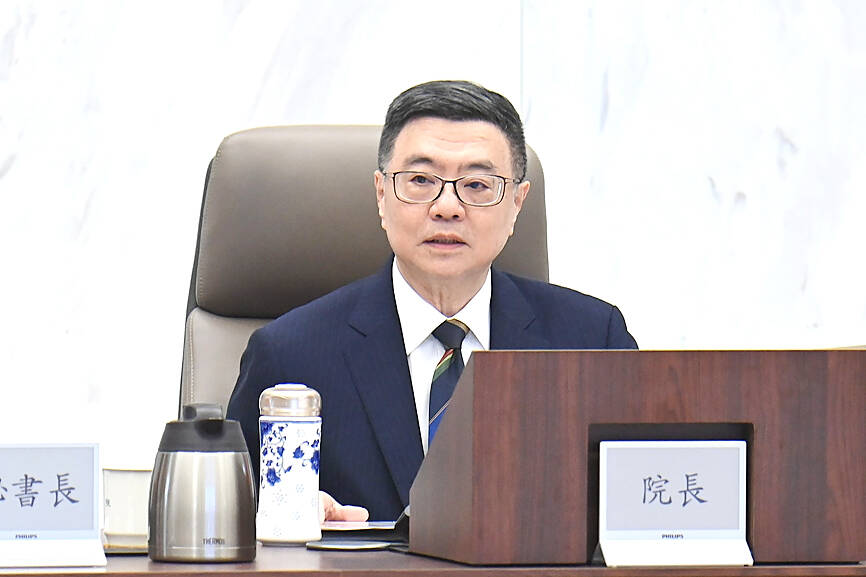
Photo: Taipei Times
Roads near the Carrefour outlet in Miaoli City and an underpass were closed, forcing people to use alternative routes, he said, adding that several roads in the mountainous Nanjhuang Township (南庄) were also closed due to flooding.
The county has opened a level-three emergency response center by integrating available resources, Chung said.
In Hsinchu County, more than 10 residents in mountainous Beipu (北埔) and Emei (峨眉) townships trapped by rising flood water were rescued by firefighters, Hsinchu County Commissioner Yang Wen-ke (楊文科) said.
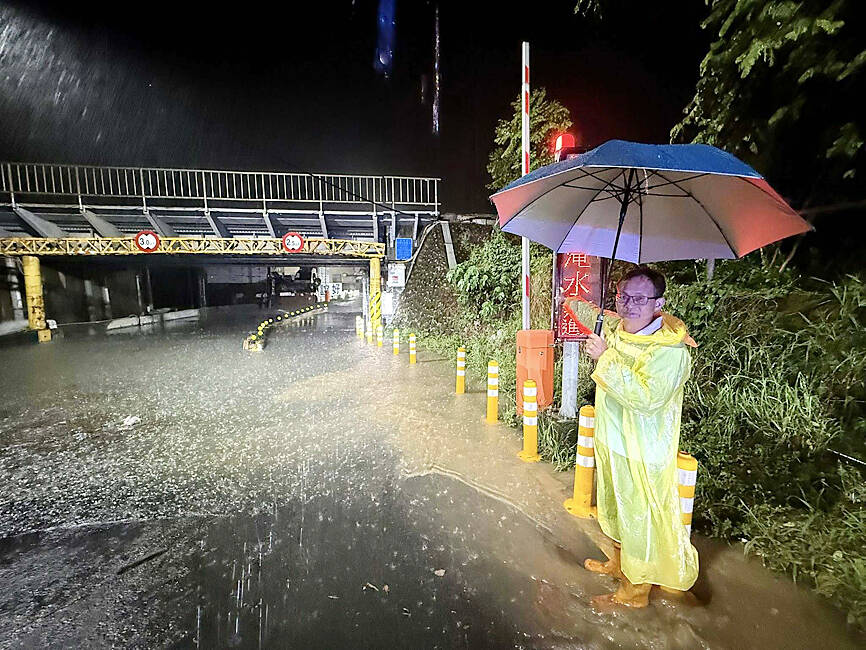
Photo: Screen grab from Tseng’s Facebook page
Heavy rain also resulted in flooding, fallen trees and landslides in several mountainous locations across the county, with roads in Wufeng (五峰), Jianshi (尖石) and Beipu townships closed to the public, he said.
The Hsinchu City Government has also opened a level-three emergency response center to handle the aftermath of the flooding, after rainfall reached up to 50.5mm per hour and caused severe flooding in the city.
As of 8am, the city had received four disaster reports: two cases involving flooding in private homes, one about a flooded underpass and another concerning a fallen tree.
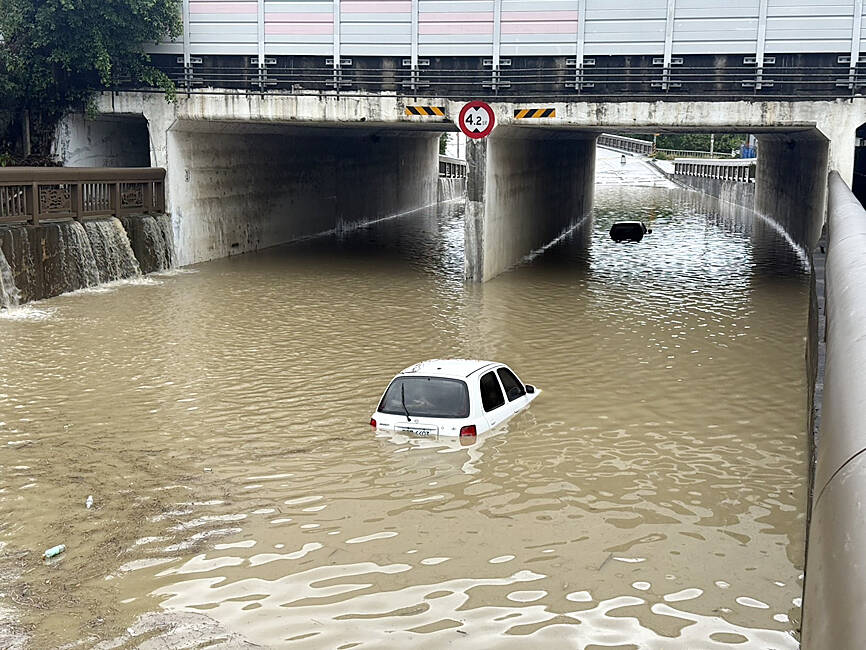
Photo: CNA
The flooding in the two private homes and the underpass has been cleared.
Cho said that torrential rain has caused severe flooding in Miaoli and other areas, with mudflows pouring into many homes, vehicles stalling and traffic disrupted.
He said he has instructed central government agencies to closely monitor disaster conditions across all regions, report immediately and provide timely support to local governments, adding that public safety was the top priority.
“Facing extreme climate is already a major challenge, but the greatest challenge is that, despite repeated appeals and requests from the Executive Yuan, the Legislative Yuan has still failed to pass this year’s general budget before the arrival of the flood season,” he said.
Extreme weather is posing mounting challenges for Taiwan, compounded by ongoing instability in the Middle East, he added.
From stabilizing prices and ensuring steady supplies of daily necessities to bolstering disaster response capabilities, all depend on adequate budget support, Cho said.
“However, with the annual general budget still pending final passage, disaster relief funds and secondary reserve funds remain inaccessible — undermining the government’s ability to respond swiftly to emergencies,” he said.
For this year’s general budget, the central government has allocated NT$2.8623 trillion (US$89.53 billion) in revenue and NT$3.35 trillion in expenditures.
Opposition lawmakers have blocked review of the budget, citing dissatisfaction with the Executive Yuan’s failure to include funds to raise military pay, and police and firefighter pensions, as well as the Cabinet’s refusal to countersign bills passed by the Legislative Yuan.
The general budget was submitted for review at the end of August last year, but has not been sent to legislative committees for review.

SILENCING CRITICS: In addition to blocking Taiwan, China aimed to prevent rights activists from speaking out against authoritarian states, a Cabinet department said The Ministry of Foreign Affairs (MOFA) yesterday condemned transnational repression by Beijing after RightsCon, a major digital human rights conference scheduled to be held in Zambia this week, was abruptly canceled due to Chinese pressure over Taiwanese participation. This year’s RightsCon, the world’s largest conference discussing issues “at the intersection of human rights and technology,” was scheduled to take place from tomorrow to Friday in Lusaka, and expected to draw 2,600 in-person attendees from 150 countries, along with 1,100 online participants. However, organizers were forced to cancel the event due to behind-the-scenes pressure from China, the ministry said, expressing its “strongest condemnation”
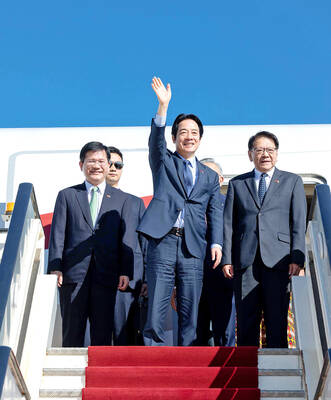
DELAYED BUT DETERMINED: The president’s visit highlights Taiwan’s right to international engagement amid regional pressure from China President Willaim Lai (賴清德) yesterday arrived in Eswatini, more than a week after his planned visit to Taiwan’s sole African ally was suspended because of revoked overflight permits. “The visit, originally scheduled for April 22, was postponed due to unforeseen external factors,” Lai wrote on social media. “After several days of careful arrangements by our diplomatic and national security teams, we successfully arrived today.” Lai said he looked forward to further deepening Taiwan-Eswatini relations through closer cooperation in the economy, agriculture, culture and education, as well as advancing the nation’s international partnerships. The president was initially scheduled to arrive in time to celebrate
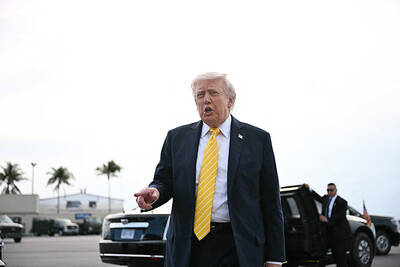
Iran’s Islamic Revolutionary Guard Corp (IRGC) yesterday said the US faced a choice between an “impossible” military operation or a “bad deal” with Tehran, after US President Donald Trump disparaged Iran’s latest peace proposal. Negotiations between the two countries have been deadlocked since a ceasefire came into effect on April 8, with only one round of direct peace talks held so far. Iran’s Tasnim and Fars news agencies reported that Tehran had submitted a 14-point proposal to mediator Pakistan, but Trump was quick to cast doubt on it. “I will soon be reviewing the plan that Iran has just sent to us, but

A group affiliated with indicted Chinese immigrant Xu Chunying (徐春鶯) is to be dissolved for monitoring Chinese immigrants in Taiwan, a source said yesterday. Xu, the secretary-general of the Cross-Strait Marriage and Family Service Alliance, was indicted on March 24 on charges of violating the Anti-Infiltration Act (反滲透法). The alliance “illegally monitored" Chinese immigrants living in Taiwan on behalf of the Chinese Communist Party (CCP) and the Ministry of the Interior is expected to dissolve the organization in the coming days under provisions of the Civil Associations Act (人民團體法), the source said. Xu, who married a Taiwanese in 1993 and became a Republic


 RSS
RSS